



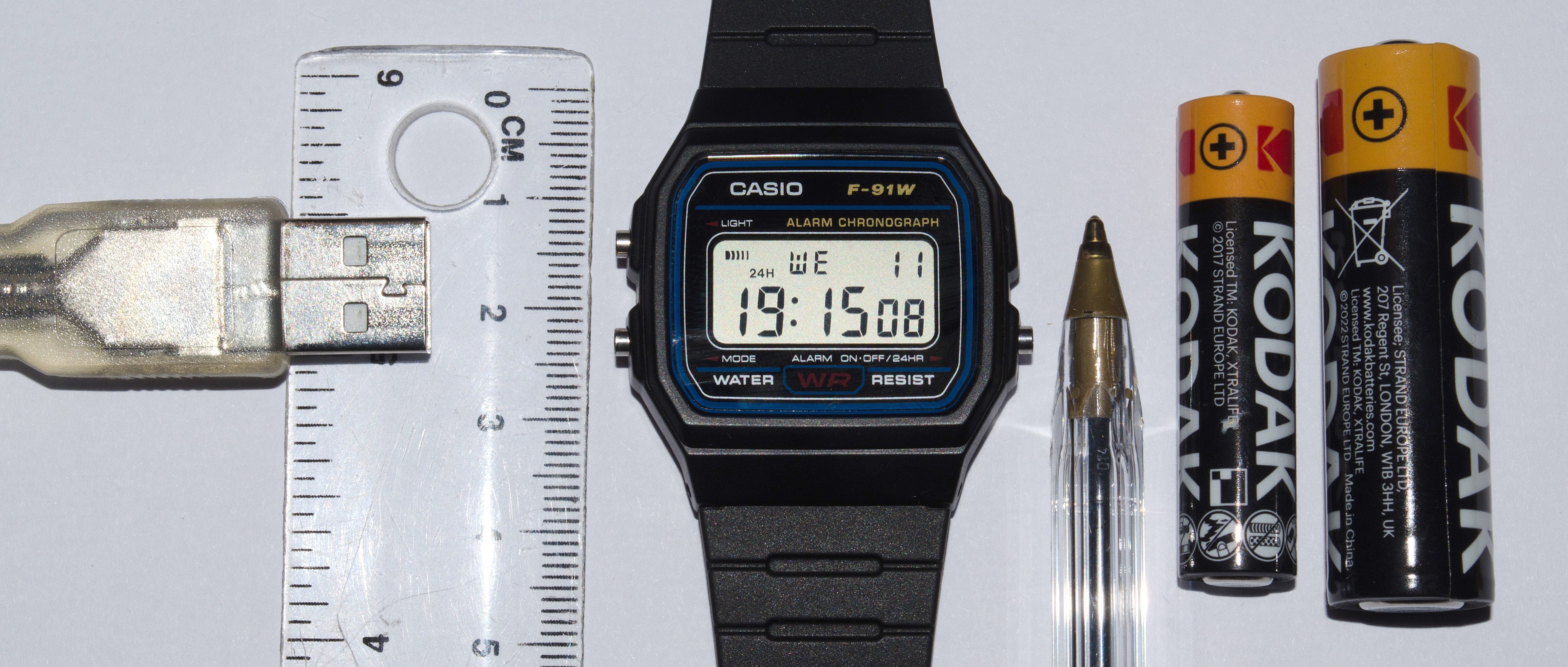
I’m wearing a Casio F-91W right now. It cost me about $14 CAD and has brought me immeasurable joy. My aussiedoodle uses it as a part-time chew toy. It’s frozen down to -40º on an expedition and cooked at over 200º in a sauna. It looks even better since I repaired it with a zip tie.
Recently, I discovered the deep lore of this watch. And I’m now convinced that it holds its own against wrists sporting Rolexes, Audemars Piguets, and Patek Philippes. What it lacks in sophistication, the Casio F-91W makes up for in its unreasonable adequacy.
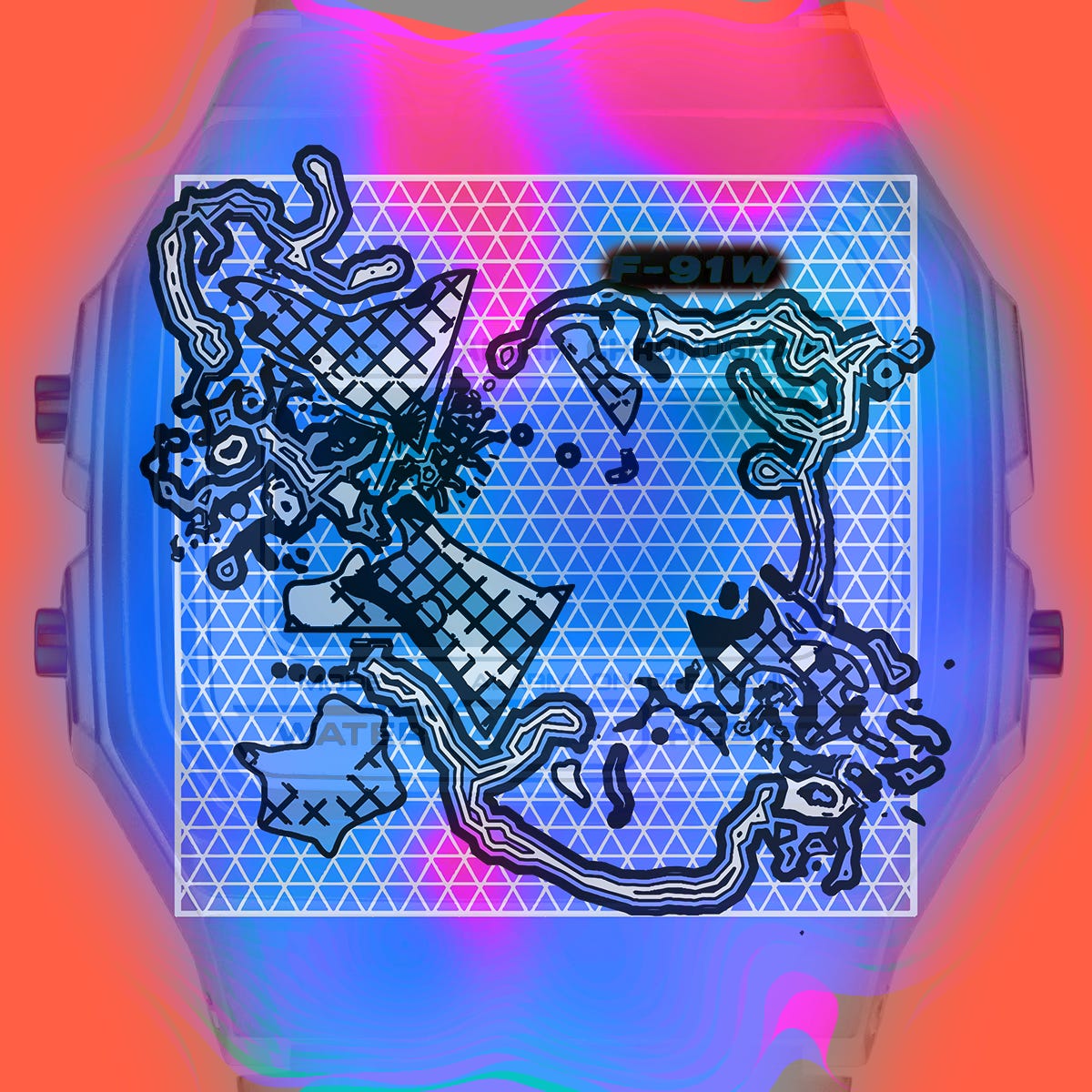
What do I mean by that? Obviously, the thing is quasi-indestructible. It’s also cheap, reliable and ubiquitous. As far as a timepiece goes, it’s a Maslowian choice. The F-91W meets all of one’s basic timekeeping needs. For that reason, it’s been worn by precocious schoolkids and global figures alike: Barack Obama, Captain Ripley in the movie Alien and, notoriously, Osama bin Laden.
One of the reasons that this watch became so widely associated with terrorism is that it has indeed been used as a timer in improvised explosive devices. A leaked document showed that U.S. government interrogators regarded the F-91W as a telltale sign that a detainee was associated with terrorist operations. Ironically, many American servicepeople rely on the same watch.
But why is it such a common choice among militant groups?
It’s adequate. Utility (alarm, stopwatch, waterproof robustness) at minimal price.
It’s ubiquitous. Global popularity means it’s easy to replace.
It’s uniform. The watch’s design has remained virtually unchanged for decades.
One of the big ideas that emerged from the Summer of Protocols research program is that protocols are unreasonably sufficient. The story of the F-91W is a curious one. A single watch isn’t a protocol, but it is unreasonably sufficient. That made it the world’s most popular watch, transforming a quintessential consumer gadget into a piece of the planetary landscape, neutral and equally available for use by good and bad actors.
The Adequacy Thesis
Through the popularity of this watch, Casio created a global supply chain of time. It’s a system that anyone can tap into from virtually anywhere in the world.
It’s also a clear embodiment of Gall’s Law: “A complex system that works is invariably found to have evolved from a simple system that worked”.
In spirit, that’s a great quote. But if I could tweak it slightly, I’d replace the second ‘system’ for ‘thing’ because the initial kernel is usually not best understood as a system. Sorry, systems thinkers—a watch is a watch.
There’s something rather interesting about how many of the most consequential technologies (shipping containers, email, the Toyota Hilux, vaccines, etc.) tend to be the adequate ones, not the sophisticated ones. I have a thesis that Gall’s Law exists because popularity provides one of the rare, legitimate excuses to complicate things. And because sophistication has such high opportunity costs, it’s antithetical to popularity, especially in the long run.
Occasionally, those opportunity costs are worth paying. In the context of navigation or aerospace, precision timekeeping is a must. The Artemis III space mission aims to be the first crewed lunar landing since Apollo 17 in 1972. Such a complicated operation cannot afford to run on the stainless steel caseback of a F-91W, which can gain +/-1 second per month. That’s easily enough to make a very expensive—if not deadly—miscalculation.
Many of civilization’s most important operations depend on clocks. Swiss watches, famously, emerged to meet the demand for precise train timetables in Europe. But there are wide variety of clocks, all created to enable the reliable repetition of critical activities… like averting disaster.
Protocol-as-Clock
This week, the Doomsday Clock has ticked its way to 85 seconds from midnight and I’ve been thinking a lot about clocks – from my tough little Casio to the ability of blockchains to introduce good friction into the world. Because protocols sequence events, they impose specific temporal orders, whether through clocks or rhythms.
When two friends attempt to call each other at the same time, sometimes the line will appear as busy. They’ll both (probably) wait a few seconds or minutes before trying again. There isn’t a widely agreed upon amount of time to wait, and that’s why it works.
TCP/IP, the protocol suite that makes the internet possible, shapes time through rhythm. That makes it a clock in its own right, since it’s not relying on an external timekeeping device. TCP/IP forces computers to “shake hands” in a certain sequence, otherwise information won’t make it from device to device.
During last year’s Protocol School, composer Ben Zucker taught a course titled Musicalization not Music. Because protocols sequence how we do things and communicate, there is an inherent musicality to their design.
I’ve repeatedly joked with Ben that the TSA should hire him as a consultant to improve the choreography of their security lines. (Seriously, though.)
Time to Think
New technologies promise to affect how we think about time. Some also share the unreasonable adequacy of the Casio F-91W and promise to become a planetary landmark.
LLMs and AI tools are powerful. They’re used everywhere, all the time, by everyone, all at once. Just like the world’s most popular watch, the availability and affordability of these tools is accelerating their diffusion. Not all actors, obviously, will use them in prosocial ways. Policing use will be difficult because of the ubiquity of AI tools; certain versions, like LLMs that can run locally on a device and can’t be nerfed with a cloud update, might become associated with bad actors as a result of negative events.
However, there are differences. The capabilities of LLMs are far more complicated than any wristwatch. Many software tools can be patched or updated live, regardless of where their users are. The underlying information architectures are still evolving.
Working with AI gives one a sense that time is accelerating, whereas wearing a Casio (or working with blockchains) makes one feel like life is simply marching along.
AI-assisted teams and AI agents can rapidly become out of sync with supply chains. Blockchains are inexorable clocks that provide a foundation for coordination problems like establishing contracts or rules for marketplaces.
New technologies are creating a battle over time.
The Summer of Protocols research program and its community have published some great work on time that you might enjoy:
Protocols in Emergency Time by Olivia Steiert
New Time Machines by Aaron Lewis, Kei Kreutler, Alice Noujaim, Nahee Kim, and Spencer Chang
Fire Protocols & Attention as Autopoietic Space by Nathalia Scherer and Jiordi Rosales
Enjoyed this read very much. thank you for writing
LLMs are complicated, but are assembled from matrix multiplications. Follows your observation quite well