



In our kickoff Obliquities editorial on February 2, we argued that we are witnessing a shift from destination intelligence to intelligence media (by analogy to social media). We argued that these media transport social kernels (by analogy to the social objects of Web 2.0) between contexts. We argued that, as with containerization in the world of atoms, the shift to intelligence media will be marked by intermediate products rather than complete artifacts circulating through relatively “dumb” pipes, creating a new kind of sociality encompassing both machines and humans.
In the weeks since, thanks to the explosive adoption of coding agents like Claude Code, we’ve been inundated by evidence for this view of the future of AI. Amateur hobbyists are now vibe-coding entire complex digital production infrastructures involving dozens of agents swarming in parallel across a single computer’s filesystem, within complex organizational scaffoldings. We could think of these as agent factories.
Agent factories enable a great deal of complex higher-order action. Much of the attention has been drawn to moltbook (“Reddit for agents”), and the many entertaining trainwrecks involving OpenClaw (“claw” seems to have emerged as a term of art for an agent living dangerously and autonomously on its own server on the public internet, often armed with crypto wallets – what could go wrong?). But the truly interesting developments are largely invisible – individuals with significant mutual trust interacting with each other through their personal and bespoke Claude Code infrastructures, exchanging work-in-progress materials.
We could call these interaction patterns have your factory call my factory, and the underlying relationship pattern F2F (a rather fun overload of face-to-face). An exuberant F2F ecology is likely to be a central feature of the protocolized future.
My own personal experience with Claude Code illustrates the pattern well.
Case Study: Indie Book Publishing Pipeline
I started my first week of using Claude Code by producing an online book of my Twitter archive, but I ended it by setting up an entire book manuscript production factory. Currently, my factory dashboard shows a couple of dozen book projects in flight, most derived from two decades worth of my personal blog and newsletter archives (including new editions of old books), and a handful of from-scratch projects.
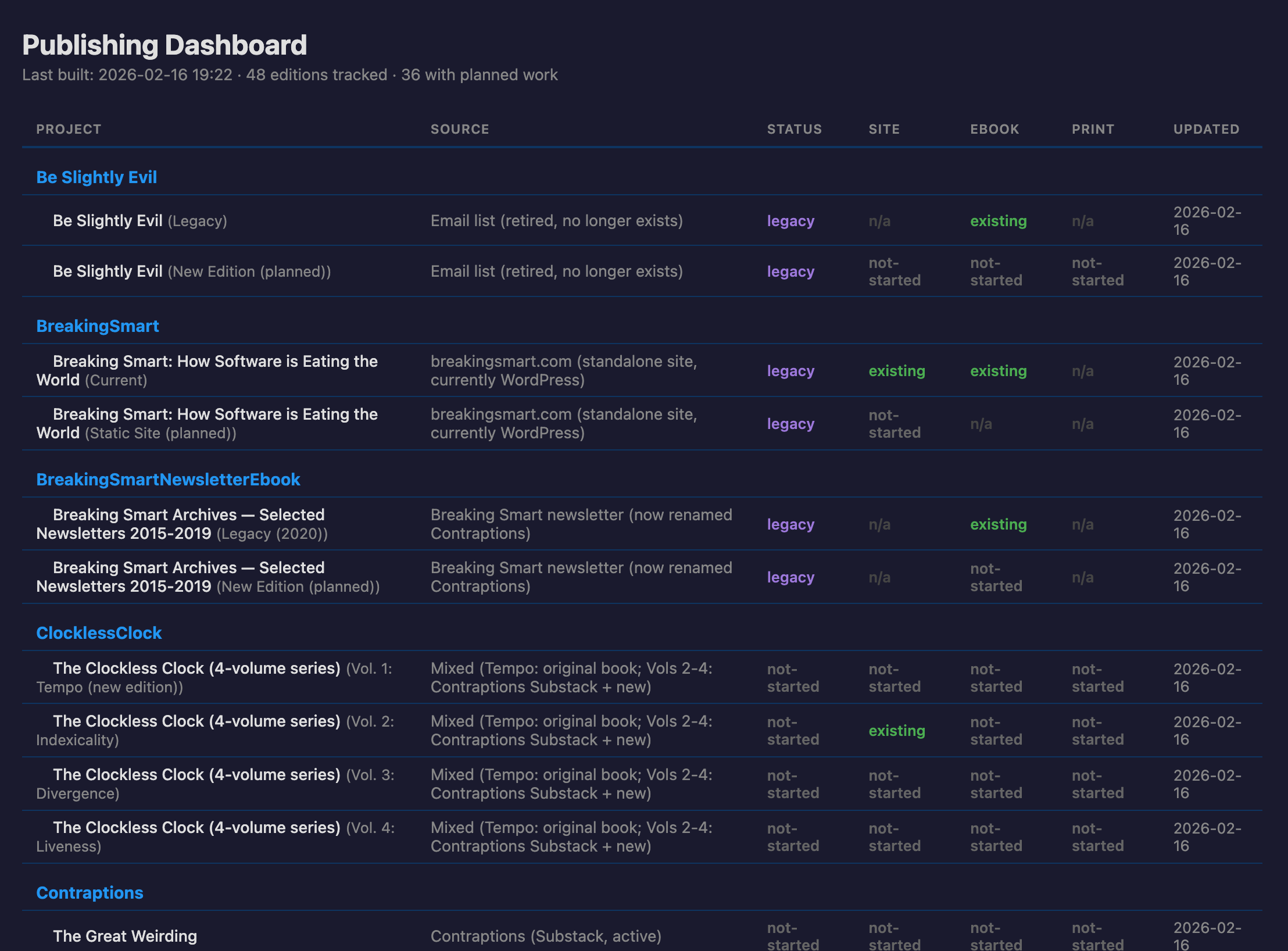
Factory is really the only word for what I’m doing. In my case, a factory resembling a flexible job shop of the sort that makes varied things using a flexibly configured set of machine tools. My book projects are individual enough that each needs some bespoke handling, but similar enough that many processes and code modules can be reused. So a job shop is both an appropriate metaphor and a useful reference pattern. Other patterns would be appropriate for other production activities – flow shops, cell-based factories, assembly lines.
I found myself relying on dim memories of decades-old industrial engineering and operations research coursework to set things up. The factory floor is a portion of my laptop filesystem within my Dropbox folder, where various Claude Code sessions operate within a folder hierarchy and each folder has its own claude.md file. Each folder with a claude.md is a bit like a workstation or cell. Thought needs to go into defining boundaries, hand-off artifacts, and so on.
But setting up a Claude factory wasn’t the most interesting thing I did. It was setting up a logistics link between my factory and another Claude factory, set up by my long-time publishing co-conspirator Jenna Dixon, who has helped me personally publish two books in the past, and also handled much of the publishing work for Summer of Protocols/Protocolized, including the complex Protocol Kit and four books.
Jenna also happens to be an enthusiastic early adopter, and has set up her own factory to produce finished books from manuscripts. My factory takes messy raw materials and produces rough first-draft manuscripts. Her factory will take those manuscripts and produce finished artifacts that can be uploaded to Amazon for distribution as print and ebook volumes.
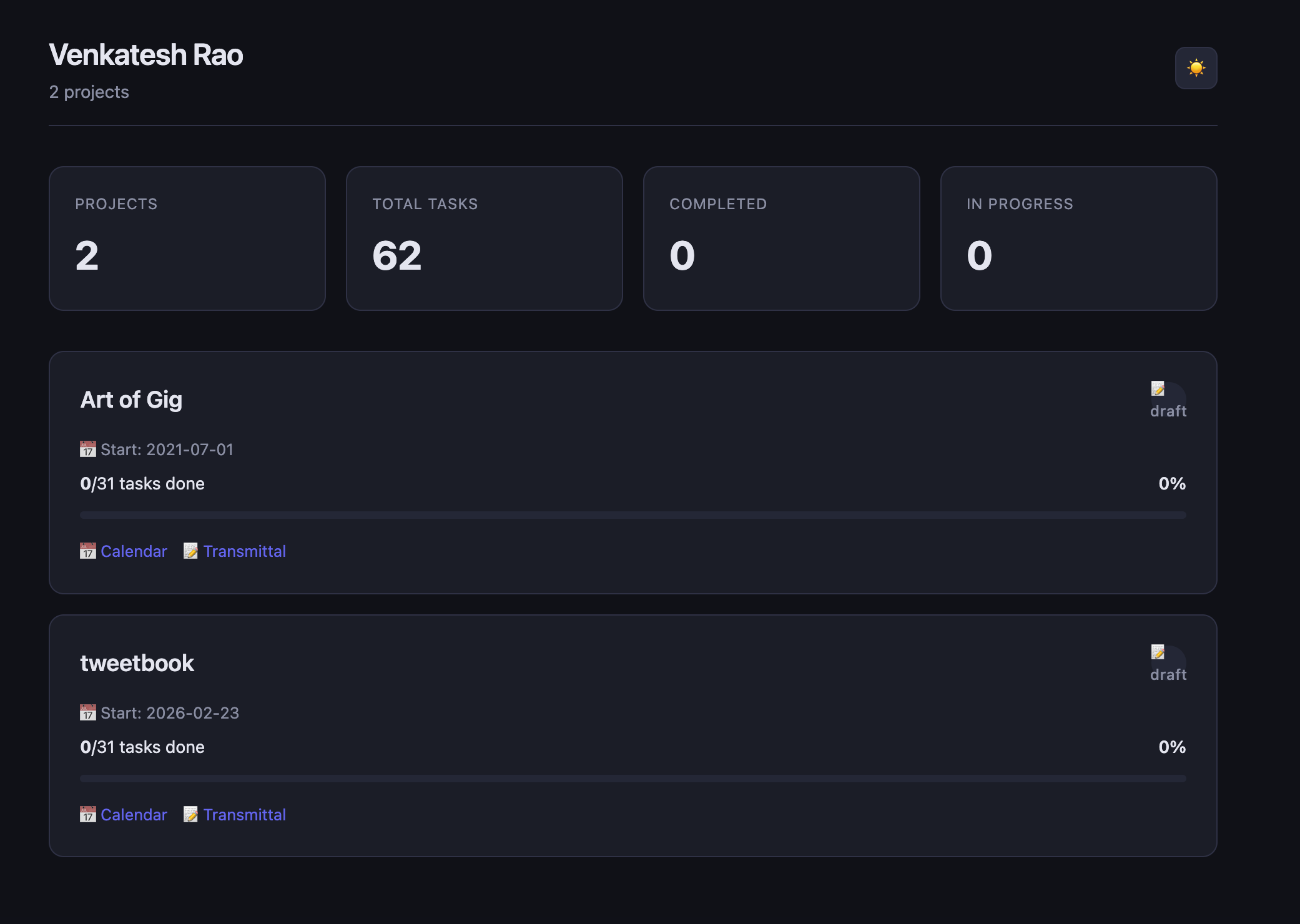
The handoff point between us is a shared Dropbox folder plus a “manuscript transmittal” server she’s set up for metadata. Here’s my “account” view of her factory:
And here is the manuscript transmittal page:
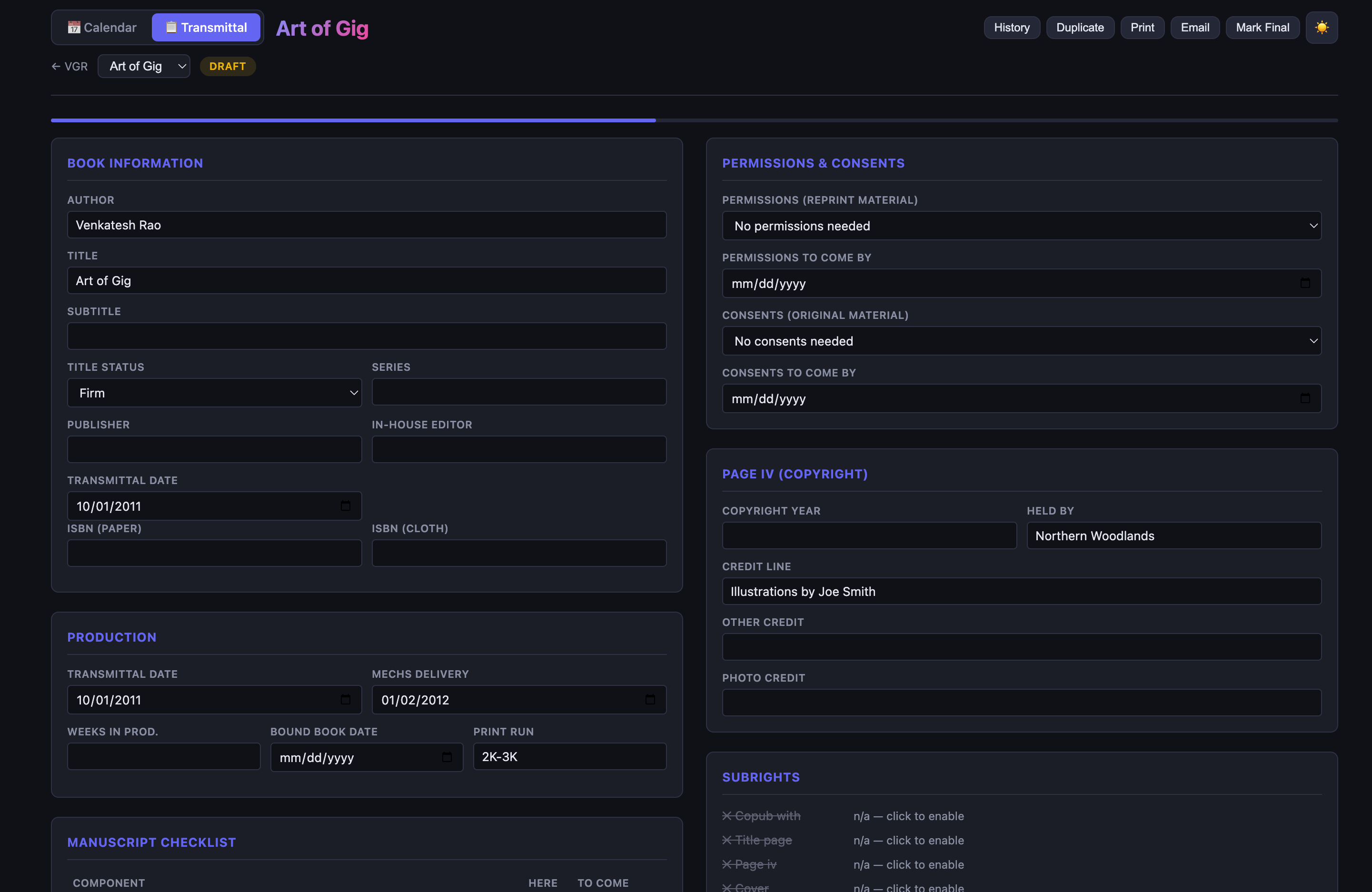
The fascinating thing? This very corporate-seeming pipeline was set up by two people who basically don’t code!
What we do bring to the party though, is domain expertise.
Domain Knowledge > Coding Knowledge
Jenna is a publishing industry veteran who knows exactly how to set up and run book production. I’m an experienced blogger and self-publisher with a dozen self-published books to my credit. We both know what we’re doing on our respective ends of this pipeline. Claude Code brings highly skilled coding ability to the party, but Jenna and I bring the (rather artisanal in this case) domain-specific knowledge required to decide what to do and how. Tasks that call for opinionated and tasteful decision-making rather than raw intelligence or procedural skills. We do both need some intelligence to make this work, but that’s not the main act. It’s a sideshow, provisioned in commoditized form by Anthropic.
Our F2F link is live. We’re currently discussing fussy details that are involved in producing a print version of my Twitter book. I sent her a docx file produced by my factory that’s the starting point for her factory, and she turned it around with revised requirements, which I implemented and returned to her. I had to tell my factory to redo the initial docx to address some global styling issues before Jenna’s factory can begin designing the book. I’m figuring out how best to automate the pipeline.
Both of us are using a good deal of custom code written by Claude Code, along with open standards like docx. We’re currently using Vellum (book design software), but we’re exploring replacing it with a bespoke design tool.
So far I haven’t touched a line of content text, and haven’t even looked at any code. I watch the action entirely at the shell level, like a factory floor supervisor. Python, json, and html fly around, while I chew on my cigar in my top hat.
This is not an isolated example. Elsewhere, with collaborators on a hobbyist robotics project, I’m helping prototype a discovery and marketplace infrastructure using the Ethereum 8004 discovery protocol for AI agents, and the 402 payments protocol.
And in the broader Claude ecosystem, the primary article of commerce is the skill, a fragment of agentic intelligence that perfectly fits the definition of social kernel. A kind of industrial intermediate, albeit for a cottage industry of individual-scale agent factories.
I’m sure there are plenty of more complex examples under development.
What are we to make of this type of F2F relationship? The principals (“legal persons”) involved in such interactions are individual humans, but the connections between them are a universe apart from the simple “friend” and “follower” type digital relationships we’re used to. Interactions are vastly more complex than social objects in digital envelopes that track likes and shares.
The only precedent I can think of is B2B relationships between factory-like entities.
I strongly suspect that this is the invisible 90% of the iceberg in the agentic AI revolution. While the public theatrics on moltbook and the claw ecosystem are much more visible, the sheer depth of capability integrations enabled by factory-to-factory connections between individuals argues in favor of high-trust relationships being the locus of the real action. Especially considering the zeitgeist vibe shift, in human social media, from more public spaces to Dark Forest/cozyweb spaces.
In intelligence media, there’s a lot more you can do within trusted friendships than within parasocial relations. Low-trust relationships are in fact rapidly hemorrhaging social energy.

The Factory-Owner Economy
One of the biggest concerns going around right now is the future of jobs, or more generally, the future of work. The conversation is a familiar one. Pessimists issue apocalyptic warnings of impending economic collapse. Optimists rehearse sunny arguments about the lump of labor fallacy, Jevon’s paradox, and Milton Friedman’s notion of “new wants and needs” emerging to fill the economic vacuums created by the disappearance of old ones.
Whether optimistic or pessimistic, our discourses seem unable to think about the future outside of existing categories – jobs, SaaS companies, outsourced white-collar labor, knowledge-work professions, mortgages. Several viral essays in recent weeks have (rather cynically and aggressively) doubled down on prognostication based on such bankrupt ontologies, to feed both wishful dreams and lurid fears, instead of taking on the harder work of coming up with useful new categories to think with.
The “factory owner” economy offers at least one new category to think with. It suggests, for instance, that in the future, rewarding and fulfilling work will be organized neither as “jobs” nor “gigs” but at least partly as an economy of bespoke F2F artisanal capitalism. The main factors of production are intelligence-on-tap that is too cheap to meter at the detail level, computers, and internet connections.
The F2F ecology won’t be the whole future of course (one of our doctrinal beliefs here at Protocolized is “your imagined future isn’t the only one unfolding while everything else stays unchanged”), but it will be one big force shaping it.
Is this an optimistic or pessimistic future? That is the wrong question. The right question is: Is it an interesting future; one that allows us to continue playing the game of civilization?
We here at Protocolized believe the answer is yes. And a big part of our mission this year is to put some serious thinking behind that answer.
This was enjoyable...the next step is about how does one take your factory and create a high trust environment around it so that it gets grounded as a non optional dependency. Thanks for sharing.
The F2F links you are building sound a lot like protocols. You have to collaborate with another person to bootstrap protocols that enable your AI factories to work with one another. Initially these F2F relationships and the protocols that enable them will be bespoke. However, I think its safe to assume that these F2F relationships will be able to scale past "strong trust" relationships to bigger groups that have lower amounts of trust, if effective protocols can be designed. MCP exists, I know - but what you're describing here is a whole different animal. What kind of standards and protocols will need to be designed to enable one person's personalized Claude factory to communicate to another's?