



The story of Charles Darwin’s finches would sound strange if Darwin was, himself, a finch.
But that is the strange story of Bronisław Malinowski, who after a childhood of illness became a pioneer of anthropology. In 1914, Malinowski accidentally began an expedition to Melanesia – documenting social systems in New Guinea, Fiji, New Caledonia – that would return him to Europe five years later, in 1919. You might think that you were born too late for such an adventure, but you were not.
Malinowski was an influential and contentious researcher. The 2018 edition of the International Encyclopedia of Ethnography credited him with shaping the field of ethnography. He was known for stressing the importance of getting “off the verandah” and exploring everyday life. Not all of his colleagues approved of his methodology and it’s unlikely that his opinions have aged well.
What did last, however, were Malinowski’s innovations to the art of people watching.
Fei Xiaotong was among Malinowski’s students at the London School of Economics and went on to have an adventurous, difficult career as an anthropologist in China. Fei embraced Malinowski’s anti-armchair sensibility but disagreed with his claim that social institutions exist to satisfy universal human needs – arguing that social order is more about relational positioning and that Chinese society cannot be reduced to problem-solution pairs.
Today, such intellectual adventures don’t require the overhead of an expedition. You needn’t go far to find strange rules; you might not realize how much you live in your own world. Every day we interface with a tangled bank of technologies, laws, and cultural norms. Paying attention to the world around us is enriching; I would argue that we have far more interesting things to observe than Malinowski did.
Scholarship and profitable application can be an afterthought. Before Darwin was Darwin, he was Charles, a birdwatcher from England. His naturalistic theories emerged from thorough documentation. He was collecting data without a hypothesis!
If you’re unfamiliar, protocol watching can be grokked as a cousin to birdwatching or people watching. Its closest sibling might be umarelling; loitering around construction sites to check out works in progress. It has a simple definition: watch the protocols – from TCP/IP to traffic lights – as they happen around you.
Ethnographic practices might help us all to be more observant in and around our professional spaces.
Software UI/UX designers, bike lane planners, and football coaches alike must study how people interact with each other and with their environments. People in these jobs, however, start with goals in mind. They have an objective: improve user retention, reduce accidents, win more trophies, etc. Protocol watchers are also rigorous, but don’t have the disadvantage of time pressure. They can collect, collect, and collect and let patterns – and profit – emerge naturally.
It’s a potent, if nerdy, hobby. I wrote a first version of this guide last year. Since then, I’ve gotten a much better feel for patterns in how we coordinate, argue, and share information. No course registration required. No sailing ship overhead. From hiking trails and mechanic shops to airport tarmacs and financial transactions, there’s always something to learn or even replicate. It’s an adventure-in-a-lens.
My challenge to you: take up protocol watching as a miniature hobby for the new year. It’s perfect for transforming dead time in airports, traffic jams, and boarding queues into a tad more interesting downtime. It’s also a sneaky way to get off your phone a bit more, if that’s on your list of resolutions.
Some examples to orient your eyeballs:
Queueing protocols at airports, bus stations, and ferry ports. Who gets to skip the line? Are there different types of lanes?
Gift-giving protocols at parties. Are you expected to bring something for the host? What purpose do gifts serve? Is the expectation stated or implicit? When do people open gifts?
Out-of-office messages. What information do people provide? How standardized is it? Is the medium automated emails, their main publication, or their website?
Hardware standards. Charging outlets, bolt sizes, countertop heights – they afford interoperability in the long run, but is it worth the inconvenience? Who makes standards?
Transactions. How do you establish trust with vendors? When people get stuck on the side of the road in a snowbank, why is it that others help without expectation of compensation?
It’s important to follow your own interests when protocol watching. Otherwise it will be less of a hobby and more work. Enthusiasm is the bottleneck – Darwin and Malinowski both entertained a deep-seated interest. Treat the examples above, and the tools and tips of the trade below as a starter pack of suggestions. Once you’ve spotted a couple of easy-to-recognize protocols, keep looking and take note of everything you find interesting and potentially useful.

Tools
Since everyone likes tools, we’ll start with those. These will help you build a sharper eye, faster. They’re also the backbone of a compounding hobby. The thoroughness of your notes or working memory will determine how easily you can spot patterns in your observations later. These tools will help you record, detect, inspect, and taxonomize the protocols you observe.
NOTES
At a minimum you should keep notes, whether on paper or digitally. Minimalists and flaneurs can start with just a notebook or mobile notes app – aim to fill up your first notebook as fast as possible.
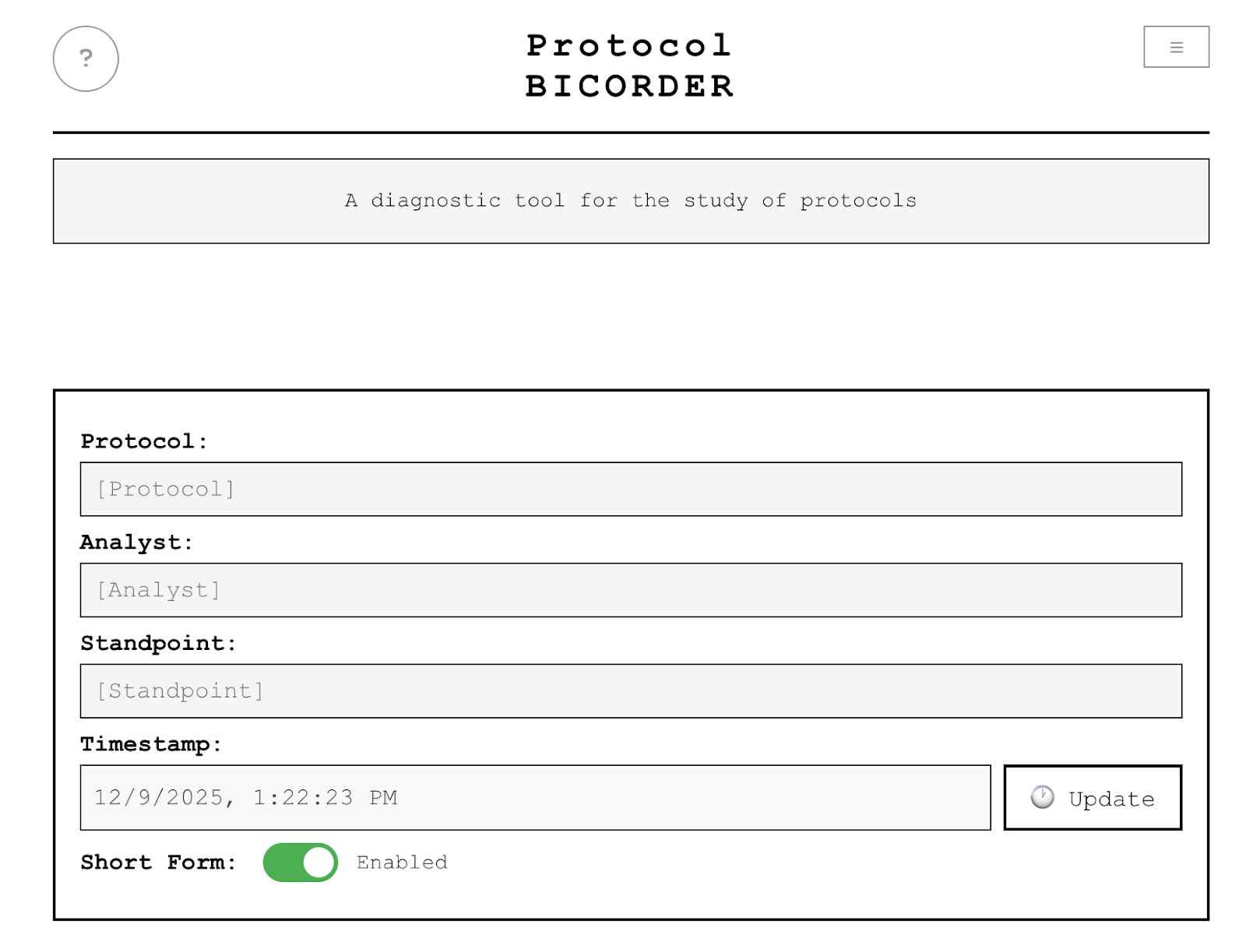
To level up your game, the best off-the-shelf tool for this is the Protocol Bicorder, developed by University of Colorado professor Nathan Schneider, who also maintains the Protocol Oral History Project. The recently-created Bicorder will help you understand and catalogue protocols via some scoring scales, based on research from the Summer of Protocols program. I recommend you enable the Short Form mode.
Sketching is another nice way to take notes. Whether it’s a physical thing you draw or a choreography at a TSA security checkpoint, we’d love to see what you come up with.
COMMUNITY
When kickstarting a hobby, it’s helpful to chat with fellow hobbyists. Documenting and sharing protocols is also just fun. Our Discord has a dedicated #protocol-watch channel for exactly that. Posting there is low stakes and even lurking will give you a sense for how other people treat this as a hobby. Send a photo, video, sketch, or the JSON file generated from your bicorder entry anytime.
Protocol watching is also more fun with a buddy, kind of like people watching. Provided you have a sufficiently nerdy friend or anthropologist family member nearby, this could make for a good way to kill time.
TENSION DIAGRAMS
Every protocol is an engineered argument and exists to manage an underlying tension. Part of the game of protocol watching is trying to identify that tension. A common one is convenience vs. safety (hello again, TSA). At a minimum, you should seek to name the tension. If you want to level up your intuitions, make a diagram with the following template.
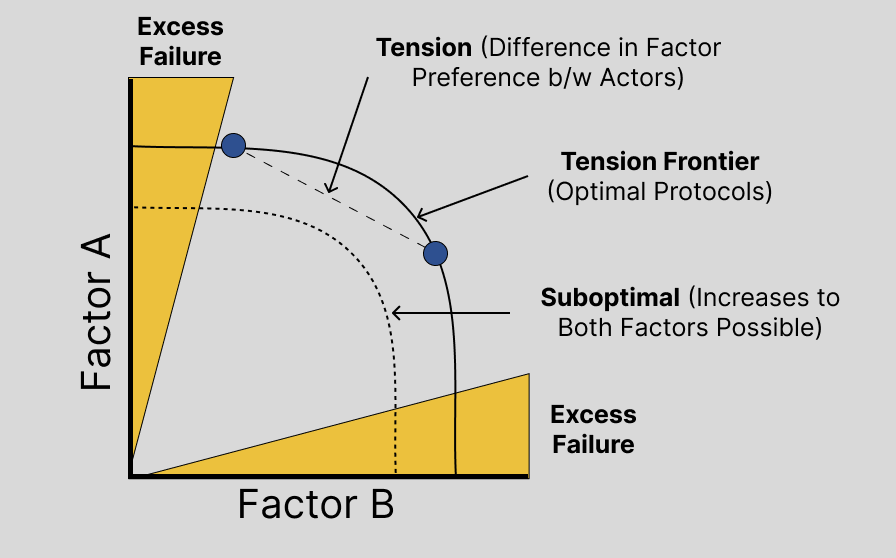
Label the axes with your factors. Draw a trade-off curve. Where does the protocol land? Is it on the frontier? Or can you easily imagine a tweak that would improve, say, convenience AND safety at the same time? Which actors prefer a safer version? Who prefers a more convenient version?
For a detailed example, check out One Tension to Rule Them All.
TRANSLATORS AND TRACKERS
A translator is a must-have tool. For example, the maintenance tags on fire extinguishers and defibrillators are full of jargon, codes, and acronyms. Using an LLM can help you translate those really quickly. You might also see protocol artifacts written in other languages – are there subtle differences not explained by translation?
Trackers are another fun augmentation. They are the telescope of protocol watching. Tools like FlightAware, FIRMS, VesselFinder, ISO standards, and IQAir all provide a unique look at the world. You can track flights, wildfires, cargo ships, food classification standards, and global air quality all from your phone browser.
You can also use LLMs to generate professional briefs and histories of protocols you observe, as rafa and Sachin sometimes do with their writing projects, NPC Inc. and Summer Lightning , respectively.
Tips
Your toolkit should also include some principles and heuristics. These three tips will help you improve over time and might enable your protocol watching to compound from hobby to competency.
First, go for the hotspots. Places with a mix of hardcore engineering and human factors, like airports, libraries, kitchens, universities, factories, mines, farms, legislative assemblies, and so forth.
Second, go through, around, and behind the protocols. Get a feel for what they’re like as a participant. Try to hack them – skip lines, find workarounds. Talk to the people who design and enforce them. By exploring multiple perspectives you’ll develop a much richer perspective or, at least, not become as jaded towards a protocol’s apparent dysfunction.
On a related note, the third thing you should pay attention to: protocols are most visible when they’re not working. As much as it’s fun to catch one breaking down, it’s even more satisfying to spot a protocol that’s doing its job invisibly well.
Congrats, you’re now initiated to the protocol watching club! Beyond the benefits mentioned above (and general aura enhancement), this certification will improve your odds of acceptance into next year’s Protocol School.
The editorial team at Protocolized is thrilled about all of the stories and studies we published this year. We encourage anyone who wants to write with us to try protocol watching. It will help sharpen your imagination for futures that might logically unfold from new technologies. It will also help you add another dimension to you worldview.
Happy protocol watching and thanks for reading Protocolized. All 84(!) issues from this year are available in archive. See you in 2026 for more stories about strange rules and essays about protocols – the world’s (mostly) invisible infrastructure.
The Protocolized team - Timber, Venkat, Tim, James, Josh, and Jenna
Great read, I'd never heard of Protocol Watching. In my world, a protocol is the base layer of software engineering - the essential foundation and architecture that supports the building. I like the parallel this has with 'protocol' as social infrastructure IRL; A Beautiful Mind meets the Matrix.
Re: Tools, I'd like to throw MegaMem in the recommendation basket for your audience. In fact, I think it would be a fascinating experiment to build ontologies specifically around protocols, factors and tensions for GraphRAG; resulting in automatic analysis, deeper insights AND smarter AI.
https://endogon.substack.com/p/introducing-megamem
For those of you that are actively using systems and tools for protocol watching, I'd be happy to meetup and share ideas.
@timber where do you track your protocol logs out of curiosity? A fun metaprotocol would be to asynchronously offer feedback on each others logs