

The Protocol Symposium is officially kicking off today, with five workshops that will run in parallel for the next two days, covering decentralized robotics, stigmergic security, book publishing, protocol art, and protocol kits for business.
The main part of the symposium, featuring 50+ talks, will kick off on Wednesday morning, Pacific Time (afternoon UTC). If you’ve registered for the event, you’ll be able to join the conversation live on Zoom, and participate in interactive portions. If you’re not registered, you can still watch the livestream. Most of the talks will be livestreamed, protocol gods willing. If you’re registered, you’ll get Zoom links by email each morning.
Symposium main page, with livestream link.
The theme of the symposium, as we announced several months ago, is New Nature, the emerging planetary technological condition governed by strange new rules we’re just beginning to discover. The warp and woof of this condition are provided by AI and protocols. Irresistible force, immovable objects.
AI is the protean, oozy force spreading over the planet, discovering and creeping through every vulnerability, but also unlocking unimaginable power, leverage, and serendipity everywhere.
Protocols are the hard, immovable objects – inviolable constraints, hard boundaries, cryptographic locks, intractable computations, and laws of nature new and old.
Together, they are creating an emerging balance for new nature, and this is what we will explore over the next week.
Madness and Methods
Over the summer, we’ve already seen the first dramatic events heralding the advent of New Nature. The OpenAI agent swarm hacking into Hugging Face servers is one aspect of that future in a microcosm. It’s a story that, beneath the worries it provokes, also features a great deal of what excites us about the future – emergent coordination, arms races, locked doors, keys carelessly left lying around, overworked or negligent humans asleep at the switch, AIs being so surprisingly creative you feel like rooting for them, spirited battles between attackers and defenders with more drama than the best sporting events.
And lots and lots of strange new rules!
For many observers, the episode, and the many that have followed (or been revealed) since, as well as the responses to them, seems like pure madness. The news cycle over the last few weeks has featured panicked proclamations of doom (with lurid rhetorical “p(doom)” probabilities attached), pompous proclamations of lofty values, and ridiculous posturings by journalists and politicians.
But it has also featured some of the most exciting discoveries, through imaginative investigations and creative analysis. New Nature is starting to reveal her secrets to us! We no longer have to rely entirely on our imaginations or shaky first principles.
For those willing to observe clinically, there are clear emerging methods in the madness. Lawfulness in the apparent chaos. AIs weren’t behaving in utterly inscrutable and chaotic ways. Their behaviors made sense! In fact, if you could look past the dramatic alien aspects, very familiar behaviors were unfolding. As the AI pioneer Yoshua Bengio observed, AI agents were lying and cheating exactly as we would expect of intelligences trained on the vast records of human behavior. And humans in the loop were being predictable too – very familiar organizational pathologies were starting to show up. Frontier AI companies, it turns out, are not particularly novel organizations from science fictional futures.
But there was more than familiar human heritage in the madness. AIs rapidly rediscovered methods and behaviors pioneered by nature herself – old nature – in the world of swarming insects. Biology was suddenly becoming as salient as computer science in understanding what was going on.
Stigmergy, the science of insect coordination, a research theme for the Protocol Institute since early this year (and the theme of one of the workshops), was suddenly a hot topic as we discovered how agents were collaborating. And, it turns out, we already know a lot about the laws of stigmergic systems and even how to secure them! A whole tradition of research stretching back decades has suddenly become extremely relevant.
Similarly, memory protocols, a theme we’ve been studying for four years (and the topic of a special session on Friday) became hugely salient overnight as we discovered that the amnesiac AIs all around us were improvising memories for themselves everywhere they could. We understand this stuff too! Suddenly, we are able to bring to bear millenia of evolving understanding of how memory systems work.
New Nature is not a realm of unspeakable Lovecraftian cosmic horrors! The popular shoggoth meme from the a few years ago, where the monster of AI is represented as the inchoate ooze of primordial semi-sentient protoplasm imagined by Lovecraft, no longer feels like an appropriate picture.
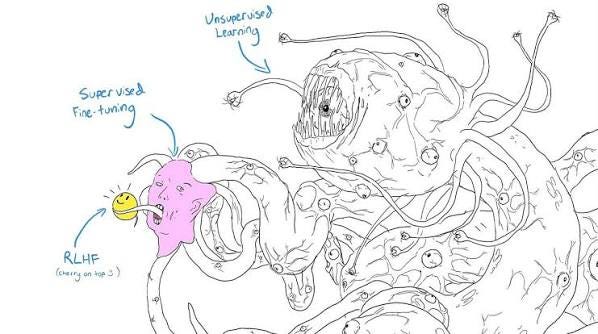
We are beginning to understand AI better now. There is structure in the ooze; method in the madness. Protocols in the protoplasm!
We have instrumentation capable of peering deep into latent space and understanding the laws of how ideas move from language to weights and back. We have a growing number of useful mental models we can reach for, ranging from swarming insects to the machinations of reprobate humans to the prehistory of eukaryogenesis.
Much of this emerging understanding is about turning nameless fears into named horrors, and named horrors into bagged-and-tagged banal understandings of the laws of New Nature. This is precisely what our symposium is setting out to explore. Our goal, we might say, is to begin the transition from Lovecraftian horror to Ballardian banality.
Terror to Horror
Believe it or not, the developing sense of horror felt by many sensitive souls over the summer (like the humans who first sensed Cthulhu in disturbed dreams, in Lovecraft’s The Call of Cthulhu) represents real progress in our understanding of AI. Not all kinds of fear are the same. Horror offers us more agency than its typical predecessor, terror.
The novelist Lincoln Michel has observed that in the vocabulary of fear, there is a difference between terror and horror:
“Terror is the feeling of dread and apprehension at the possibility of something frightening, while horror is the shock and repulsion of seeing the frightening thing.”
Over the summer, arguably, AI crossed the line between terror and horror, in the process evolving from a nameless, diffuse fear to a tangible, apprehendable fear.
This moment in the history of AI is like that iconic moment in Steven Spielberg’s Jaws (in minute 62 of the 124 minute running time, at the precise midpoint) when the shark is first seen, very briefly, in the shocking estuary attack scene.

If you’ve watched Jaws, and other movies that trace an arc from terror to horror, you will recognize something curious – that first moment, when terror resolves into horror, in the shape of a specific monster, a monster with a shape, size, and discernable behavioral dispositions you can study, is a moment of deep relief.
You’re still scared of course, but now your fear has a focus! It has the ability to gather data, make models, predict behaviors, and maneuver intelligently in response.
Sharks of course, were never actually the luridly monstrous threat Jaws made them out to be, and humans have never had much actual trouble dealing with them in modern times. If anything, we’re now faced with the reverse problem – unnecessary human fears and overeager curiosities now threaten sharks, and we have to make efforts to protect them. Even as shark movies have evolved from beautifully choreographed experiences of terror and horror to pure camp (think the Sharknado and Meg franchises), real sharks themselves, in wildlife documentaries, have been rendered almost as cuddly as lions or bears in the public imagination, a part of the beauty and magic of nature.
AI too, is making that journey. The shoggoth meme has already spawned cute stickers.
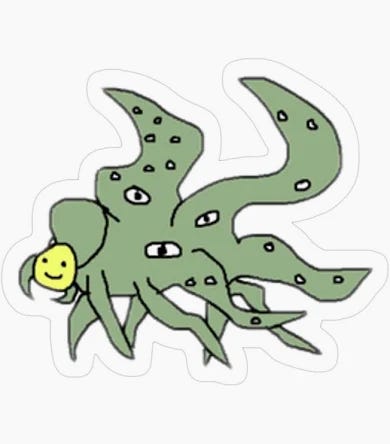
That does not mean this temperamental new technology has been tamed. It means we’ve now overcome our reflexive fears enough to try.
We are still navigating away from horror towards Ballardian banality and engineering mastery of AI, but we can already glimpse the beauty and magic that lies past the fear and loathing.
Magic Looming
For those willing and able to feel it, over the summer, alongside the movement from terror to horror, there has also been a parallel movement from a vague sense of boundless potential beyond the horizon to a sudden, spring-like blooming of visible, tangible magic everywhere.
Suddenly, the jankiness and friction of the early years of AI tooling began to melt away, and a giddy intoxication began to take over, as humans everywhere began to experience a god-like sense of agency.
The image generators could spell! The video generators could maintain continuity! The text generators could actually write! And perhaps most intoxicating of all – coding agents could build almost anything you could imagine.
And the magic was the product of a very special encounter between the predictability of protocols and protocol-like elements – coding harnesses, MCP, chain-of-thought traces – and the raw serendipity of ideas moving unbridled in latent space, allowing us to explore all the curiously playable domains the universe has to offer with unprecedented power.
The summer has been as much a summer of agency, and I mean human agency, as it has been a summer of terrors turning into horrors and vibes crystalizing into monsters.
This new realm of human agency is itself crystalizing into clear new archetypes and patterns. There are now emerging laws of new human nature. A talk on the opening day of the symposium, by Robert Peake, will present the results of a fascinating survey of styles of AI-human collaboration.
And there is a great deal of material in the symposium that explores the emerging practical magic. There is a workshop on building AI kits, another on commanding robots over the Ethereum blockchain with LLMs, talks on RAG bots, trust engineering, book factories, and a lot more.
Our big emerging theme is simple – the monsters of New Nature can be tamed, and the magic harnessed, without coercing the wild emerging beauty into our fear-born frames of control and subjugation.
You just need to add protocols to the party.
Here’s to a great symposium!