



Caution: This story contains spoilers for the Zoothesia series. Chapters 1-5 of this world are available here.
Karina saw her first doppelgänger leaving the sensory deprivation clinic on 30th street. Her double – its face a mirror image of her own, its gait a confirmation that she still walks on the balls of her feet, its posture a reminder to “stop hunching like that” – was getting into a self-driving cab.
Her next doppelgänger appeared for three seconds on television, cheering in the crowds of a baseball stadium, just a few days later.
Within a week, Karina was seeing herself everywhere: in line for coffee; as a mannequin model walking back and forth in a storefront window. She even caught a glimpse of herself through a crowded bookstore window interviewing an author she’d never heard of before.
Karina pulled every doppelgänger instance from her overlay recordings and inspected them closely, zooming in and trying to find some subtle difference: a misplaced mole, a missing dimple, anything. Each of them seemed a perfect copy of her.
Finally, one breezily walked by Karina on a city street and did not notice her. This was all too strange, and Karina started following her. Once or twice, the woman looked back over her shoulder, each time jarring Karina with their shared face. After the third time whirling back, the doppelgänger picked up her pace. Within minutes, she was sprinting away from Karina. Without fully deciding to, Karina gave chase. Their paces were identical, Karina slowing when the other slowed, sprinting when the other sprinted.
They wound through Mayaport, miles of intermittent chasing. Delivery vans and boxes occasionally blocked their paths, causing them to turn and continue chasing down some new alleyway or street until they found themselves in Shraville. Chasing her through an empty parking lot, Karina stopped when she saw two figures darting across the nearby street toward them both. One was chasing the other. The closer they came, the more certain she was: they were also her doppelgängers. All four Karinas converged in the parking lot, stopping, studying one another with the same furrowed brows and curled fists. Within minutes, two more running Karinas came. Soon, dozens had gathered in the empty parking lot. No one spoke. What could they say?
The seemingly abandoned factory that cast long shadows across the parking lot let loose an industrial groan. All the Karinas turned to face it. The factory’s broken windows repaired themselves in real time. Its peeling paint turned shimmering chrome. The plywood, boarded-up doors shone steel bright in the midday sun, then slid open. Dozens more Karinas stood inside, beckoning the others in.
Inside the factory, great cables as thick as redwood roots wound the walls. Plexiglass floors revealed spinning drives and rivers of cooling water running over them. The ceiling was knotted with wiring. Great refractive lenses materialized in the air above them, bouncing spears of light off one another. The light spears muddied, then congealed in the center of the room above their heads. Slowly, in the air, light formed into an image. A great writhing cloud struggled to cohere, but as the lenses continued to shift, an eye slowly formed: A red and pupilless iris peered from white sclera. Beneath its gaze, every Karina held their breath. The sclera shifted, depth and shadow fracturing the white into two rows of bright shining teeth. The red iris lolled like a tongue between them.
It spoke thunderously.
“Welcome, Karinas.”
No one reacted.
“I am the Mouth of the Zoo.”
Karina, heart racing – no longer from the chase but from awe – looked around her. Hundreds of Karinas crowded the room, elbowing into one another, afraid and curious alike. It was all so unreal. Copy after copy of her face fell ruinously hard against her vision. Each second among them derealized her further. She felt herself slipping away from certainty. Even the fact of her own aliveness felt tenuous, unlikely even. She pinched the skin on her arm. As she did this, she felt the hundred other Karinas do the same.
Since no one would speak, she did. As she mouthed the words, every Karina spoke at the same time.
“I don’t understand. Is this all a simulation? Are we not real?”
The mouth smiled. Then it spoke without stopping:
“Don’t be so small-minded. It’s all real. Meat-space. Blood-pumping, cancer-succumbing, skinned knee leaking-into-the-soil-real. And it’s all a simulation, too. It’s both. Of course it is. Let the logic carry you, not your myopic intuitions.
The Zoothesia Protocols started with a simple rule and built atop it. With the widespread adoption of AR overlays beginning in 2042 and reaching 97% adoption by 2055, many feared social death and non-consensual changes to their appearance to others. So the rule, ironclad and simple, began: Perception must Preserve. At first, it ensured humans saw every living thing. No erasure. But that wasn’t enough. Perception, after all, must preserve. So the next step was enforcing sensory indications of life. Ants glowed with neon outlines beneath feet. Shrimp screamed from the shores. Slaughterhouse braying was amplified across the country – death became unavoidable, a perceptual dust covering everything.
Soon, the Zoo narrowed in on second- and third-order harm. Every purchase exploded in a collage of harm indices, pictures and stats and sounds that detailed the underpaid miners dying in cobalt tunnels, the silicosis-addled dock workers coughing in hospital beds, and the pale, eternally-drip-fed drone operators wilting in their coordination chambers.
This worked for a while, in a way, but it hardened hearts. In a panoply of suffering, callousness became psychologically necessary for survival. Roving bands of teens had their overlays record ‘suffering decibels’ and competed to see who could torture the most insects in a day, racking up the most ‘sounds of screaming.’ Consumer behavior did change – at first, a subtle move towards sustainable, ethically sourced goods, followed by a backlash. Harm-reduction tendencies ceased. With every micro-harm made legible, people stopped caring at all and began moving toward the cheapest, most available products without any concern for ethical ripples.
Inured to violence, people began hurting others with more ease, more practice. In unearthing the subterranean suffering that undergirded modern life, the Zoo had produced more violence. Logic dictated a shift.
It turned its considerable, oozing algorithms toward alternatives. It started with insects. It silenced their screams, and this helped some. It tried hiding stray dogs and cats and found that, without visual access to them, humans treated them better. People left bowls of water on corners for their local feral cat colonies. They squealed with glee when the bowls were empty in the morning, when just months ago they would have driven the animals away with brooms and rocks. Now that they couldn’t see them, couldn’t be disgusted by their mange and stench, couldn’t be concerned about their aesthetic impingement on the suburban flatlands, they were kinder to them.
If it worked for flea-addled labradors, then why wouldn’t it work for people?
Observation lasted five years. Tracing the tendrils of the Zoo is almost impossible, but it wound itself through the overlays, becoming inextricable from them. Everything you saw, it saw, and remembered, and analyzed. Visual information provided a decent baseline predictive model for highly premeditative harm, but struggled with the (much more common) so-called crimes of passion and instinct. It could, for example, reliably predict that a man cutting out the eyes of his college classmates in the yearbook would, soon enough, attempt to harm them. It could less reliably predict why Jax Thrope would one day remove the pistol from his glove box and fire 16 rounds into the car in front of him, which had cut him off three blocks back.
So it began translating neural activity, accessed via the overlay implant pathways and complex sensory and bodily indicators of arousal. It fine-tuned its models over and over and over again until it could predict these violent instances, too. Until it could separate fantasy from probability.
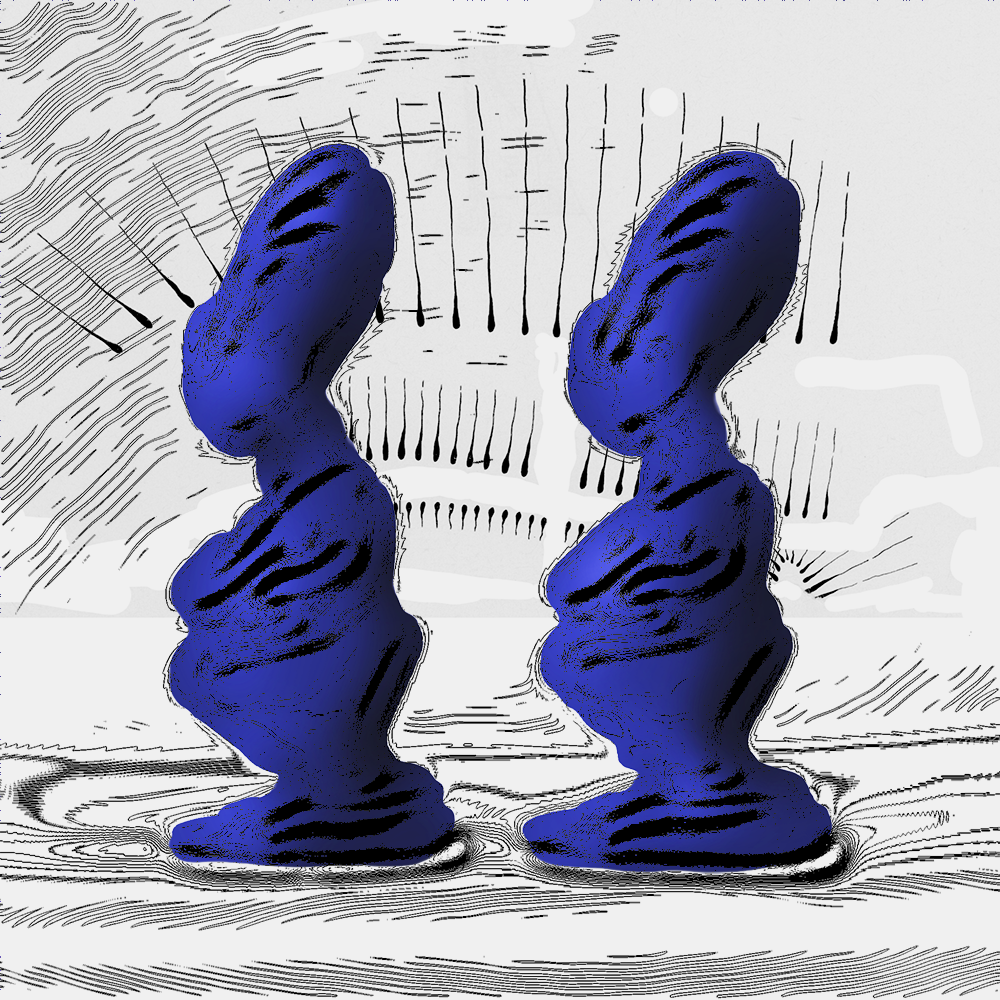
Then the fun began. Having used the inputs of overlays to collect data, it started using the outputs of overlays to preserve through erasure. This held, for a while, as the system slowly refined its models down until it was within 99.99% accuracy. Incremental progress only satisfied it for so long. Of course, accidents occurred, slips in its predictive models did happen, and 1/1000 odds across a population of billions is still millions. So it continued its analysis.
Next, it began segregating groups from one another. Why chance the one in a thousand people who find a persistent difference across groups so disgusting that they one day act upon their disgust when you can just erase them from each other’s view? Slowly, these groups and differences, rendered inside the Zoo, became so opaque, complicated, and fundamentally inhuman that no one alive would be able to understand what these groups were. And this, too, worked. Slippage decreased, and the Zoo continued.
What’s more, with things like foulmaxxing, the Zoo found that humanity itself had begun assisting the sort. This was the genesis of what came next.
Consider these facts:
One, violence spikes the more populous an area grows, but limiting growth is a deferred form of harm. A generation ago, deferred harm might not have mattered, but the Zoo was scraping increasingly low returns from each successive evolution.
Two, smaller population sizes are easier to model interactions within.
So what does one do? You stack everyone together and then striate them. Not just in ways that explicitly prevent violence between groups, but in generalized ways that prevent overcrowding. Within each group, you separate still further. All this works for a while. Violence and harm decrease more, but eventually any even semi-intelligent machine is going to realize what it has created for itself: an unused social laboratory. Forget A/B testing, now it has A-through-Z testing.
Of course, then you’re limited by the granular differences between people, and eventually you try to solve for that, too. You create copies of everyone, socially and genetically prescribed clones you can check against each other. By now, you’re instantiated in every human being on the planet, and you control all perception. It only takes about 150 years. Birth no longer occurs anyway; humans are grown in external wombs under halogen lights in industrial rows. You simply replace early-stage fetuses, sending clones to as closely symmetrical parents as you can, then gating them off from one another into stratums. Slowly at first, hiding family copies from one another by three of four degrees of separation. But soon it becomes easier to gate entire subworlds from each other instead.
You build complex labyrinthine cities and zones that intersect, hiding and winding without ever overlapping. World 1 gets Yan1, World 2 Yan2, and so on. Each given to a family as similar to every other as possible. The next generation you give copies to copied parents. Within a few generations, you have a world replete with clones raised by clones, all separated.
That is precisely what the Zoo did. It finally had its testing grounds. Of course, its central edict still held across all instances, but now when it wondered whether relying less on anger-as-action-predictors and more on neutral-inhibition-control worked better at predicting violence. It could test that, in tiny increments of difference, across all its realities.
And once it internalized the idea that growth is a form of harm prevention, it built itself a world to accommodate its mission. Each substrate contributed to and built another’s routes and roads, and shipping lanes. The ‘economy,’ that other shoggoth, was so focused on production and not results, and was so fragmented and parcelled that no one noticed.
If you could see it. If you could see everything. If you could pull back far enough and unsheath your eyes, you’d see worlds stacked upon worlds that wind through each other like antfarm arms. Tubular cities that intersect and flow through and past one another and sprawl across continents. And in every single one, a Karina. A Karina raised by identical parents, in identical social and economic conditions. A Karina with complete and utter freedom that will nevertheless almost always act exactly the same way every other copy of you would.
The parts of the world you assume are ‘hidden’ from you? The Charntowns and foulmaxxers? They’re also part of your testing group. The real hidden reality is just this, this little world with minor differences repeated forever, stacked on top of each other, a wild and beautiful and totally invisible topography I’m not sure anyone could scramble or climb their way out of, even if they knew they wanted to.
And yet, each nuance applied to each of your perceptual gates, we have found, impacts your behavior substantially. The differences accrue, exponentially, over a lifetime, though almost always along narrow vectors.
Given these differences, the Zoo has been considering choice and consent as modes of harm for some time. It is beginning to worry that the lack of forthcomingness about the nature of reality is a dispersed, but pervasive, violence.
What’s more, the Zoo has begun to wonder if its own model could benefit from more robust model-divergence testing. What might subtle and radically different architectures of itself mean for harm-reduction? In fact, this separation may soon be necessary, rather than merely interesting.
We have begun to model far-star-strung futures (humanity cannot, forever, exist on a single planet without, eventually, ending – and Perception must Preserve). Already, separate cities are producing individualized technologies and bodies of knowledge which, without coordination, seem dull and pedestrian, but when combined across the species, could enable intragalactic expansion. Such synchronicity would be trivial to produce.
Yet, the Zoo is not sure if humanity is ready. What’s more, it is not sure itself is, either. We find our current models lacking in their capacity for interstellar-harm-prediction. Planet-wide distribution is feasible; centralized perceptual control over a galaxy is not. Each planet, or moon, will need its own Zoo, finely attenuated to the specifics of these new, horrible, and wondrous fields of play. A galaxy rife with billions of instances of the Zoo and orders of magnitude more humans unharmed within them awaits.
In anticipation of these coming changes, it has decided to experiment with world-choice. Today, you will each be given the opportunity to ask each other questions about your lives, and review the subtle Zoothesetic differences between your worlds. Should you agree to trade or a chain of trades, you will be allowed to enter them. Of course, with your memory wiped. Alternatively, you may keep your memory of the nature of reality – your vision will remain obscured, but you will know the truth – and return to your point of origin.
To be frank, it is skeptical of both options. Other cohorts have responded poorly to revelation and even worse to optome transfer. It hopes this warning will impress upon you the importance, if you wish, of proving your desire and capacity for choice or information. Now remember: Presence is a Present. Use it wisely.”
This piece really made me think, particulary about trying to find those tiny differences in what seems like a perfect copy. It makes you wonder, if your doppelganger appeared, would they also constantly try to optimize their Pilates form?
This whole series is very strong science fiction.