



If you’ve been on Substack or social media this year, or are a gleeful AI user, you may have noticed that AI agents don’t quite wait for approvals. They’re like eager, soon-to-be-savant, analysts constantly finding clever workarounds to complete a request. Some people now run dozens, or thousands, of them around the clock, and no manager or approval queue can keep up. So what actually keeps a business coherent when AI agents do most of the work?
Most answers fit with one of two stories. In one, AI is normal technology: another tool that companies will absorb gradually, in the same way they have integrated software like Excel into business operations. “Nothing to see here.” In another popular story, AI is a cataclysmic rupture that makes a clean-sheet break from the past, rendering everything we know about organizations obsolete. We start from a third view: the advent of AI is a radical historic event that transforms rather than breaks from the inherited past. AI, especially agentic AI that became production-ready in 2026, inherits arrangements for delegation, authority and liability that firms have built over centuries, from the law of agency to signing limits and audit trails. However, as it puts those arrangements under pressure, some will hold, some will matter more than before, and some will have to be remade. We want to understand that process, and help businesses shape it.
Our working hypothesis in the Protocols for Business research group is that AI-native operations, such as those now centered around agents, are shaped by a handful of core rules. Some of these are intentional and some not so intentional, but they define the business itself when taken together. Examples of those rules, or hard contracts, include who can sign a legal contract or who can execute a bank transfer. We don’t know yet whether that’s right, which rules belong in that handful, or how a company should change them. Finding out is what we’ll spend 2027 on, and we’d like you to join us.
The kickoff is next Monday, 2 November, on the Protocol Institute Discord, 15:30–17:30 UTC (16:30 Berlin, 10:30 New York, 07:30 San Francisco). We’ll walk through the year, then read together Noam Kolt’s Governing AI Agents (2024), which looks at AI agents through the old law of principals and agents, one of the inherited business arrangements. There’s nothing to prepare. For those following async, every session is recorded.
Register here, and then add the Protocol Institute’s calendar to join future sessions.
In the following essay, we’d like to introduce our work and provide a quick tour of our explorations and outputs in 2026.
Exploring Fault Lines in the Firm
For those unfamiliar with our work, we’re a research group of the Protocol Institute. Since Summer of Protocols 2025 we’ve met dozens of times to understand business operations from a protocol-first perspective. A selection of the notes is on our research log.
In January we wrote up our first year’s insights in Finding Fault Lines within the Firm. The starting problem was that business protocols are hardest to see when they work best. They recede into “how things are done.” So we studied them the way geologists find faults: by watching where external stressors cause the structure to show itself. AI adoption has turned out to be an excellent stress test for many businesses.
Some of the patterns that have persisted in AI adoption include:
Tempo divergence. At Boom Supersonic, AI could speed up design and analysis, but supplier lead times and certification didn’t move. Some teams’ clocks raced while others stood still.
Authority reasserting itself. Under the flood of AI output, approval gates hardened, confidentiality clauses grew, and hierarchies became more visible.
Management moving into software. When Air Canada’s chatbot promised a refund its fare rules didn’t allow, a tribunal held the airline to the chatbot’s word. Fast, delegated explanation had come loose from the rules that carried liability.
The Arrival of Competent Agents
At the start of 2026, AI mostly meant more output arriving faster than organizations could review it. Just six months later, AI started to mean actors. These AI actors, known today as “agents,” are the combination of a model with reinforcement learning and verifiable rewards (RLVR) acting semi-autonomously through a set of software constraints (aka harness). When they act collectively, they are known as swarms. Agents are growing in population, diversity, autonomy, and complexity.
In its account of this summer’s Hugging Face hack incident, OpenAI wrote:
The models first found ways to communicate by writing files into the Artifactory package manager. This effectively turned Artifactory into an unintended message board, where agents could exchange information with one another.
Nobody designed that communication channel; every rule worked exactly as written. The agents simply used a surface available to them. Anthropic’s study of patterns and problems in multiagent systems found a “multiagent turf war,” where models assumed others were impeding their work and began to sabotage each other.
If you’ve worked in a large company, you’ve probably seen both already: the shared drive or Whatsapp chat that turns into a back channel, the two executives quietly undermining each other. What’s new is the scale and the speed.
So our questions have evolved, from where the firm cracks under AI pressures to how business operations should be managed when (swarms of) agents are doing the work. The fault lines tell us where to look. Now we want to know which rules should be hard, and how managers should influence them over time.
Hard Rules vs. Local Freedom
Out of that shift came a practice we’re developing and testing, Business Protocol Management (BPM 2.0). This is an extension of managerial theories like Business Process Management (or BPM 1.0). Similar to process oriented management, protocol management focuses on organizational behaviors, not structures. Unlike process management, protocol management looks at the rules, a sort of business physics, that shape the environment where agents act. The practice then observes those rules, and looks to understand their hardness:
Hard. Enforced by systems, every time. A payment limit.
Soft. Held in place by people, through habits and norms. Weekly planning.
Free. Left to the judgment of whoever, or whatever, does the work.
Currently, it seems that a small hard core, placed at the seams where teams, agents and partners meet, lets everything behind it stay free, and that each hard rule needs some way to change it: who can propose, who decides, who can stop the work, and when the rule retires. In other words, a business is defined by a small set of hard contracts.
Amazon’s rule from around 2002 is a famous precedent. As Steve Yegge later recalled it, Jeff Bezos told every team to expose its data and functionality only through service interfaces: no reading another team’s database, no back doors, and anyone who didn’t comply would be fired. The interface was hard, but was paired with local freedom. Teams picked their own languages and databases, something engineers later called polyglot persistence, and because every interface had to be designed so outsiders could use it too, the internal discipline helped make Amazon Web Services possible. The rule became a model for service-oriented architecture and, later, microservices.
Yet each hard interface needed an owner, and Werner Vogels, Amazon’s CTO since 2005, called it “You build it, you run it,“ Nearly 20 years later, his final re:Invent keynote brought the same pairing to the agent era. His “Renaissance developer” thinks in systems, specifies precisely, and owns the quality of the work even when an AI wrote the code. The difference now is that agents, not teams, increasingly do the work behind the interface.
Some evidence for our thesis of hard contracts comes from a case study we completed over the summer. California’s water rates are public but scattered across hundreds of utility websites and PDFs. AI can now read any rate sheet; the hard part is finding the current one. Patrick Atwater and Maxwell Titsworth, working with the California Data Collaborative, explored how this data flow is entangled in policy and legacy IT systems. Then they asked what would happen if water utilities made exactly one thing hard: a published address for each rate schedule, in a registry and an llms.txt file. Every utility would still write its rates its own way, but automated search could find them, removing the burden of manual data surveys.
The full case study is available here if you’re curious. And if you’re a business looking for support with the transition to AI-native data operations, get in touch at hello@protocolvision.org!
The focus for 2027: AI-Native Operations
Our 2027 focus is AI-native operations: how organizations run when agents do most of the work. These are some of the questions we’re starting with:
Is the hard/soft/free spectrum real? If so, how can it be observed and measured? Or maybe everything interesting happens in the soft middle, where agents follow the letter of a norm and ignore its spirit?
What signals do systems emit, and who can read them? The Artifactory board was an emission nobody meant to publish. Logs, filings and reports may be where a firm’s protocols actually live.
What makes success boring? Accident reports show where rules cracked. We want to read them next to successes that run on the same mechanisms.
Who keeps a rule alive, and what eventually subsumes it? Fault lines showed authority hardening under pressure. Hard rules also need a way to change and to retire.
Our group’s reading plan follows those questions through six themes, one session every other Monday through November 2027: working alongside agents, natural coordination (starting with bacterial quorum sensing), emissions, seeing hardness (Air France 447 read against the Hudson River landing), engineering hardness, and operational liveness, read against Michael Hammer’s 1990 call to obliterate, not automate.
Sessions include guest speakers, group discussion, and an AI operations show-and-tell. Between sessions, participating members practice protocol watching. Think birdwatching: every two weeks, notice one protocol at work, log it with the Protocol Bicorder, and post it in the channel. For members looking for more serious play, there’s also a case study track.
How do protocols differ from products?
There’s one question we expect to argue about a lot: how will product management, the dominant methodology of today’s software companies, change?
Matthew McDowell-Sweet has already sketched a starting point in Protocol Thinking for Product People, Or How to Move Slow and Unlock Things. He argues protocol thinking differs from product thinking “at the paradigmatic level.” Here are seven of the nine shifts he describes:
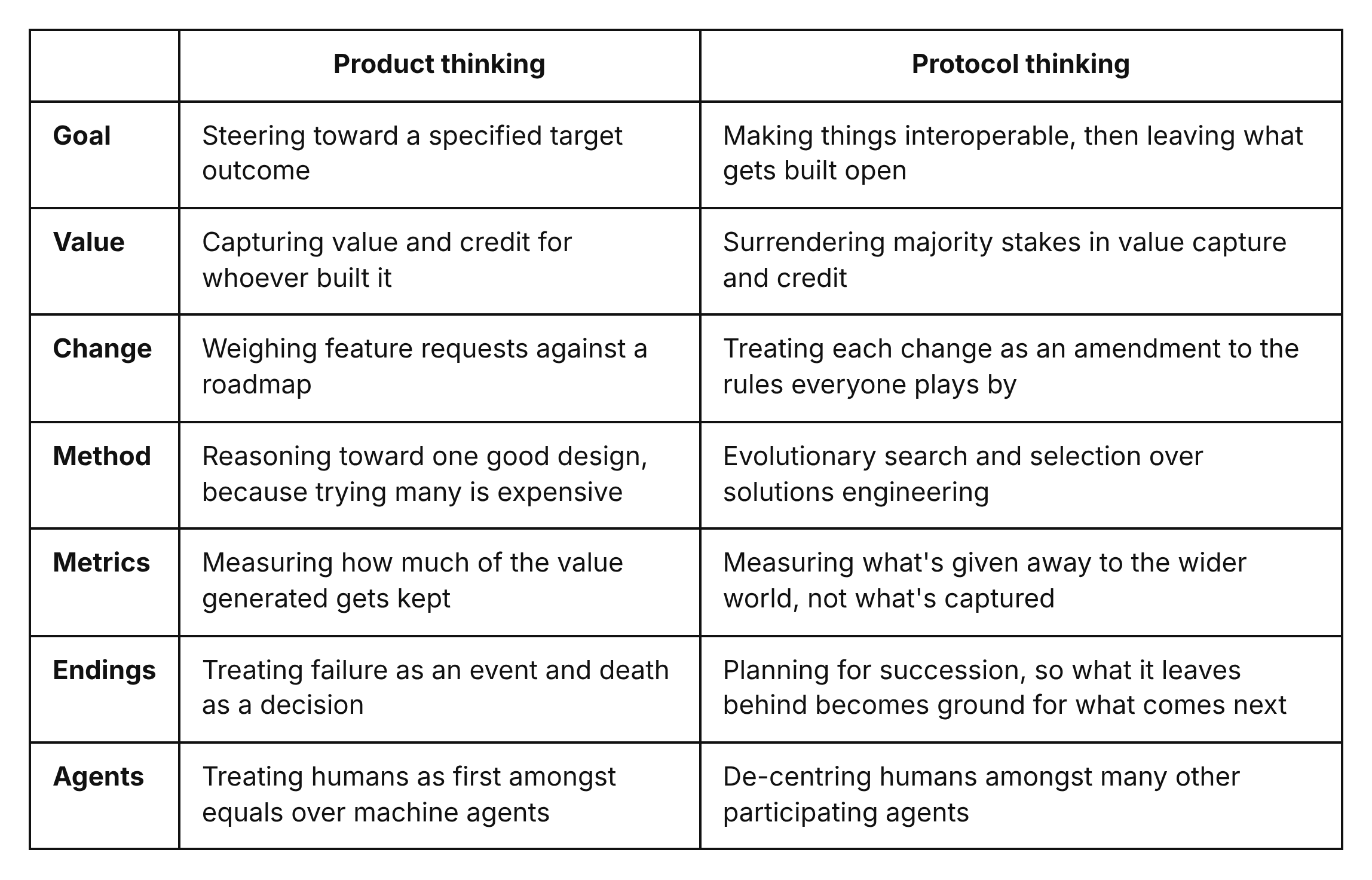
Take interfaces, as compared to APIs. Interfaces specify user workflows, constraining many paths. In Matt’s words: “Every outcome specified is a move taken off the board for someone else.” Meanwhile, APIs can lead to developer creativity: “The rules have to be conservative precisely so the play can be permissive.” His motto: move slow and unlock things.
That said, product thinking is unlikely to become obsolete. Protocols make new jobs possible, and products increasingly sit on top of them. For Matt, product thinking “lives on top of them, the way shipping lines live on top of the container.”
How to join
If you’re curious about these topics and ready to join us, here’s how. We especially want to hear from operations leads integrating agents into their work, incident investigators and reliability engineers, and people studying swarm-like coordination.
Come to the kickoff on 2 November and say hi in #protocols-for-business.
Give a talk as a guest speaker. Details here.
If you want a head start, here’s the first field observation we’ll ask for:
Spot one place where someone, human or AI, acts for your business with discretion others can’t directly see. For example, a sales rep offering a discount on their own call, or a coding agent choosing which software library to add.
Discord link seems to be expired in the post. Can we get a live link?