



The UET-1 had been moving for 11 hours when Felix Lim noticed that Lin Yuan Exact had not eaten.
This was unusual. Lin ate with the attention diligent men gave to doing taxes: methodically, at an appointed time, with no waste and no ceremony. Felix had, in nine months as his chief of staff, come to think of Lin’s meals as reliable data. The CEO was present, operational, and the world was proceeding on schedule. But the congee Lin had ordered at the Hong Kong terminus sat cooling on the table between them, while Lin looked out at a coastline that was slipping away.
Felix glanced at his bio-band. Green. He had boarded with a full compliance dossier: valid credentials, correct insurance classifications, cleared for the journey’s first six jurisdictions in advance. His passage was, in ECOROUTE’s assessment, perfectly routine.
Felix admired the sophistication of the train’s protocols. He never understood the fuss about healthcare surveillance. He enjoyed passing through borders in an endless interior, and all it cost him was a ticket and his making himself legible to the state. The arc of innovation bends toward justice, Felix thought. He thought this in the way he thought about the efficiency of markets or the tendency of systems toward equilibrium – as a fact of physics – the way heat moves toward cold, the way protocols standardize, the way the correct answer reveals itself to the correctly posed question. He had been taught this at the finest university in the world by professors who had never given him cause to doubt it, and he had not yet had reason to question their teaching.
“You haven’t eaten,” Felix said.
Lin Yuan Exact turned from the window. He looked at the congee with the expression of a man who has forgotten what food is for. Then he picked up his spoon.
“You are wondering why we are not flying,” he said.
Indeed Felix had been wondering this. The summit in Lisbon was in four days. Eight hours by air. Three days by rail.
“The thought had occurred to me,” Felix said.
“An airport is a trap with two doors, and I can control neither of them.” Lin ate a spoonful of congee, chewed, swallowed. “Its infrastructure was built for efficiency. It is used for capture.”
But efficiency is good, Felix thought. The arc of innovation ...
“On the other hand, this train is only seven years old,” Lin continued. He was eating now, with attention. “No one thought it would really matter in the grand scheme of things, so there have been very few attempts by states to capture it.” He looked out the window again. The coast was gone now, replaced by the first industrial outskirts of Guangzhou.
“So it’s a gap, a thin scar in the face of global surveillance.“
The train’s path curved and the megacity came into view behind them: the Pearl River delta. The towers, the ports with their stacked containers in every color, the whole apparatus of making and moving that the world ran on. Felix watched it and thought about the Neutral Forge. The corporation that Lin had founded, which had inspired an adolescent Felix to give up his dreams of becoming a poet.
The Neutral Forge manufactured chips but designed nothing. This was its Oath of Making: to fabricate but never to architect. Orchard Systems brought its designs; the Forge made Orchard chips. Greenlance Computer brought its designs; the Forge made Greenlance chips. A hundred competitors, bitter enemies in the marketplace, came to the same sanctuary, handed over their most precious innovations, and trusted. This trust was the Forge’s true product. Chips were merely its byproduct.
Felix believed in this trust the way he believed in the arc, not as a policy or a preference but as a property of well-functioning architecture, emerging from an underlying structure in the way heat emerges from friction. The system was designed the right and the right outcomes followed. You did not need to force them.
“What are we actually going to do in Lisbon?” Felix asked.
Lin set down his spoon briefly. “Be seen travelling toward peace.”
“Which is...”
“Not the same thing as peace. But it buys time.”
“For what?”
“For work that needs to be finished.”
Lin resumed eating. Felix looked at the metropolis as it receded. At its systems of making and moving that would keep working tonight and tomorrow and the day after, indifferent to who sat in what chair, because their architecture was sound. The answer is there, he thought. I have not yet posed the question correctly.
On the second day, as the train entered Mongolia, Lin was already awake.
Felix found him in the observation car at six in the morning, sitting in one of the panoramic seats with a glass of water, watching the steppe come into being as the light arrived. The steppe did not meet a horizon: at a certain point the grass simply stopped negotiating with the sky and let it take over.
Lin did not look up when Felix came in. He looked at the steppe. Felix sat across from him.
For 20 minutes, neither of them spoke.
Then Lin said, “The pressure arrived in stages.”
He said it in the way he might have said: “The train left Hong Kong at 7:14.” As a fact in a sequence of facts. But something in the steppe, or in the quality of light coming through the glass at this hour, had opened him.
“First the Fiduciary State,” Lin said. “Their lawyers wrote on letterhead with an embossed eagle. The implicit message: stop selling to the Empire’s companies. It didn’t need to be stated directly. The cost of non-compliance was Shunning, cut from the Murmur, unable to receive payment from anyone their financial system touches.” He looked at the steppe. “You know what the Murmur is.”
“The global financial messaging network,” Felix said. “SWIFT, in the old terminology.”
“The system through which all financial reality passes,” Lin said. “Literally. A transaction that the Murmur does not carry is a transaction that did not happen.”
Felix knew this. He knew this the way he knew about weather. He had never considered that someone had decided to build the Murmur, and that the person who decided to build it had also decided what it would and would not carry, and that this decision had been made once, long ago, by people with specific interests, and that it had been running on their behalf ever since.
He found this thought uncomfortable and set it aside.
“Then the Telluric Empire,” Lin continued. “Maintain supply to your traditional customers or the Seventeen Earths become unavailable. Gallium. Germanium. The periodic table’s veto.” He picked up his water glass, looked at it, set it down again. “Both at the same time. Not coincidentally.”
“What did you do?”
Lin was quiet for a moment. Outside, a bird crossed the steppe at speed. Low, dark.
“Have you seen a man juggling, Felix?”
“Yes.”
“When he has more balls than hands, what does he do?”
Felix thought about this seriously. “He drops one?”
Lin’s eyes followed the bird until it was gone. “He keeps them all in the air. For as long as he can. And when they fall,” one shoulder lifted, barely, “he is somewhere else.”
The steppe scrolled past. Felix thought about the Forge, about the clients who brought their designs and trusted their discretion. About the vested interests on both sides of that trust. About the Murmur and the Seventeen Earths and the eagle on the letterhead.There is a correct answer here, he thought.
They entered Russian territory that afternoon, at a border which was really just a gradient, a place where the train’s internal models registered a change. Two officials boarded with handheld Ponos to inspect passengers.
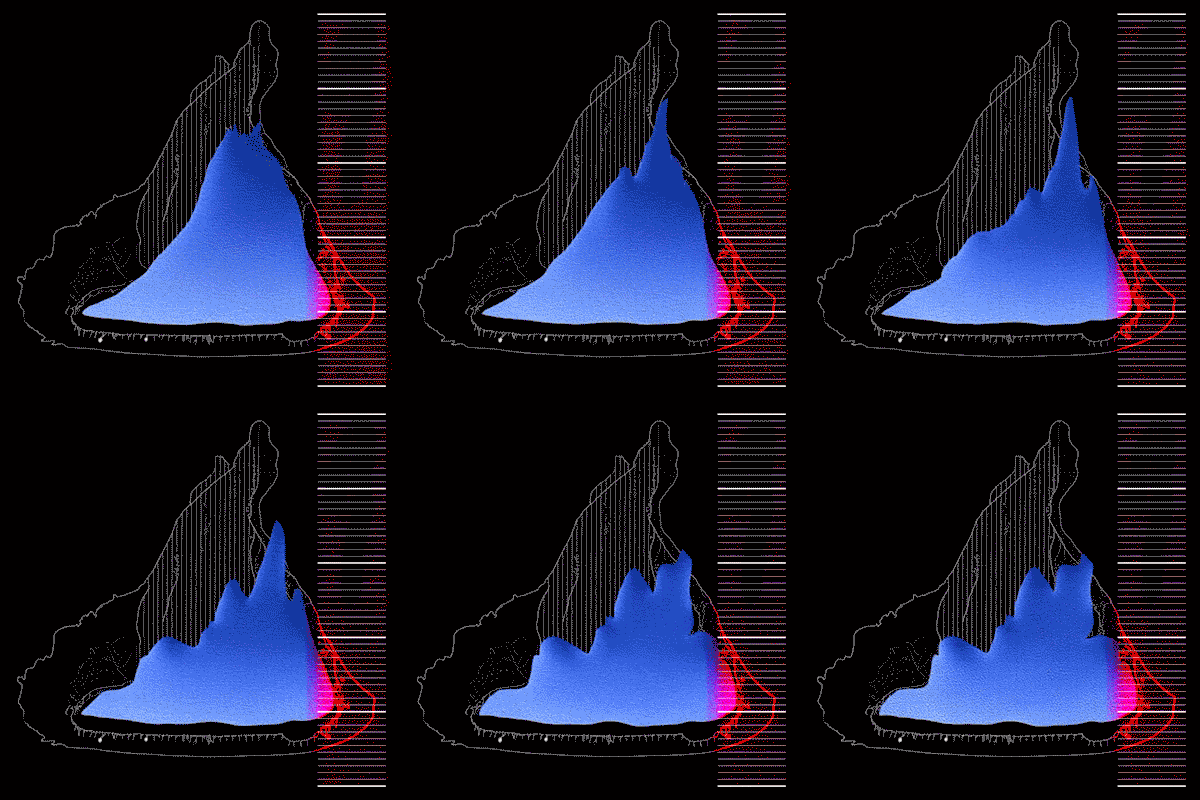
The first official was young and businesslike. The second was older, heavy, with the patience of someone who had spent decades in doorways and understood that doorways were where the interesting things happened. His Pono was different from the standard-issue model Felix had seen before. Instead of a green-or-red compliance grid, the screen showed something fluid: gradient fields, shifting spectra, the topography of a profile rendered in colors and graphs.
He stopped beside a Dutch businessman sitting next to Felix in the observation car. The businessman reached for his passport. The official ignored the passport.
“What does it measure?” Felix asked, because the question had already left him before he could decide whether to ask it.
The official looked up from the device. He had seen kids like Felix on the train before. All of them curious and smitten by the contraptions of UET-1.
“Drift,” he answered lazily.
“From what?”
“From what a person says they will do.” He said it so simply. “Before, we used stamps. Green, red. Legal, illegal. The sun is yellow, the grass is green.” He shrugged, a gesture that moved his whole body. “But the sun is a thermonuclear event. So now we have this. It does not say yes or no. It says probably. It says not yet. It makes a forecast.” He tilted the screen toward Felix. “Will this man arrive where he says he will arrive? Will he do what he says he will do? Or,” he made a gesture like smoke dispersing through fingers, “will he drift?”
On the screen, the Dutchman’s spectrum was cooling. The colors settled to an ambivalent blue. A thin seam flickered near some invisible threshold and did not cross it.
“And if he drifts?” Felix asked.
“Then we look at why. But only then.” The official made the face of a chess player forced to a draw. “While a man is within tolerance, we proceed. Certainty is expensive.”
The Pono emitted a soft descending tone and the official moved on. Felix leaned back. He looked at his own bio-band – green, steady – and thought about the word tolerance. The system did not need him to be correct. It needed him to be predictable. The difference had not previously seemed important.
That evening Lin summoned Felix to his cabin and handed him a folder.
Physical papers. Felix had worked in enough secure environments to know that paper was what you used when you did not want the document to exist in the records.
“Casino car,” Lin said. “Third table. A man called Walther. Do not read it.”
Felix took the folder. “What is it?”
“Infrastructure planning.”
Felix had heard this phrase several times now. It had begun to acquire a grating texture.
“Sir,” he said. “I have been your chief of staff for nine months. In that time I have coordinated communications with cryptographers in seven jurisdictions, managed secure protocols with lawyers in three different legal systems, and reviewed technical specifications for systems I do not have the clearance to fully understand. I believe in the Forge’s mission. I believe in what you are building. But I find myself in the position of performing a function I cannot define, and I am not certain that it is...”
“Felix.” Lin’s voice cut in with the particular patience of a man who has run the model many times and knows how it ends. “Do you know why I hired you?”
“My qualifications...”
“Your qualifications are sufficient. That is not why I hired you.” He looked at Felix steadily. “I hired you because you believe things. Visibly. You believe that systems tend toward equilibrium and that information wants to be free and that the arc of innovation bends toward justice. You believe this in the way a person believes in the sun. You do not check it, it is simply there. It is the light by which you do everything else.”
Felix said nothing.
“When you carry a folder through a train,” Lin said, “no one thinks you are carrying anything important. Because no one who is carrying something important looks like they believe in the sun.” A pause. “This is not an insult. You are a precision instrument.” He looked at the folder. “Go.”
Felix delivered the folder to Walther: third table, casino car. Loss and Gain. Walther was playing a card game whose rules appeared to be under ongoing renegotiation between him and the dealer. He took the folder without looking at Felix, slid it under the table, kept his attention on his cards.
Felix walked back through three cars. I am a precision instrument, he thought. He turned the phrase over. He had been hired because he believed visibly. Lin had said this as though it were operational information, which meant it was operational information, which meant Lin had factored Felix’s belief into his plans from the start, which meant...
The arc of innovation bends toward justice. The phrase was there when he reached for it. But it sat differently now.
Late on the third night Felix was in the dining car when Lin appeared.
This was unusual. Lin ate in his cabin, where, as Felix had once heard him explain to a journalist: “The walls are less interested in the conversation.” The dining car was a social space, and Lin was not a social person in the ordinary sense. He was a person who made you feel that the conversation you were having was the only one worth having, which was a different thing entirely.
He sat across from Felix, ordered tea, and for a moment said nothing. He looked at the window, which showed only darkness and their own reflections floating in it. Felix noticed that Lin was wearing the same white collarless linen shirt he had been wearing since Hong Kong. And the day before. Felix had the sudden realization that Lin had several of these shirts, packed identically. A choice made once and never revisited.
Then Lin began to talk, and Felix understood that he had not come to the dining car by accident.
“The Fiduciary States used to make things,” Lin said. “Steel. Cotton. Machines of ingenuity. But making is tedious. Making requires labour and logistics and the management of physical reality. So it ascended.” He received his tea. “It built the Murmur, through which all financial messages pass. The Chain of Hands, through which value moves. The Three Oracles, the Genuflections, the Naming: systems through which the world is assessed, classified, rated, included or excluded. It stopped making things and became the condition under which all making was possible. The tollbooth.”
“I understand the architecture of the Fiduciary States,” Felix said.
“You understand the facts.” Lin wrapped both hands around his cup. “The story is different. The story is that for 30 years the Forge survived between two systems of this kind by being necessary to both. The Doctrine of Indispensability. You cannot coerce what you cannot replace. As long as they needed us equally, we were safe in the gap.”
“What changed?”
Lin looked at his reflection in the dark window. “They noticed. Both of them, at the same time, which was not a coincidence. The Fiduciary States noticed that our chips found their way into the Empire’s military systems. The Empire noticed that we existed in a territory it has always called its own.” A pause. “There is a principle in physics, Felix: a body at rest in a contested space does not remain at rest.”
“What are you building? In Lisbon?” Felix said.
Lin was quiet. This was not the silence of a man who won’t answer, but the silence of a man deciding how much of the answer to give. He looked from his reflection to Felix. Something shifted in his face, something that might, on a different face, have been called the look of a man who needs to be heard, who has carried something for a long time without anyone to carry it with him.
“I am going to tell you something,” Lin said. He picked up his cup. “The world you believe in, where technology is neutral and the correct architecture produces the correct outcomes and the arc bends reliably, that world does not exist. It has never existed. What exists are machines. The Murmur is a machine. The Shunning is a machine. The Long Roots, the Three Oracles, the sanctions architecture, this train: machines. And every machine, without exception, is eventually operated by whoever can afford to maintain it.”
Felix opened his mouth. The words were there: systems tend toward equilibrium, information wants to be free...
“Once you have seen it,” Lin said, “you cannot unsee it. This is not a tragedy. It is a fact of life.”
Felix heard himself say, “Then what is the point of building anything?”
Lin set his cup down.
“That,” Lin said, “is exactly the right question.”
He did not answer it. He left Felix with his tea going cold and the train moving through the night.
Felix did not sleep.
He walked the train instead, through the dining car, past the business car with its encrypted-app men, their faces lit from below, through the corridor where a teenager was asleep with a boarding pass stuck to his cheek, through the observation car at the rear where the track disappeared into darkness behind them. He walked until his thinking had some air around it.
He stopped outside Lin’s cabin because there were voices.
A man and a woman. Neither of them Lin. It was past one in the morning. There were no meetings on the calendar.
Felix stood in the corridor and did not move.
“The keyholders are distributed,” the man said. “37 across 19 jurisdictions. Most don’t know each other. Several don’t know what they hold.”
“The contracts?” Lin’s voice.
“Self-executing. Time-locked. Embedded in the Strait Country’s fiscal ledger as infrastructure bonds. From the outside they look like pre-payments, R&D allocations. But they’re bound to the technical roadmap. Releases trigger on verifiable conditions. Equipment delivery. Construction milestones. Patent filings. Not board votes. Not executive signatures.”
“Even if the board is replaced?”
“The board is irrelevant. The funding flows through the ledger. The Strait Country’s system runs on a distributed ledger, thousands of nodes, maintained by institutions in dozens of countries who participate because the Strait Country’s fiscal stability is their fiscal stability. The contracts execute inside that architecture. No individual can stop them.”
“And if the roadmap changes.”
The woman spoke for the first time. “The keyholders. They don’t operate anything, they’re circuit breakers. If a parameter needs adjustment, modification requires 24 of 37 keys. Across 19 jurisdictions. Mostly anonymous to each other. No empire can coerce enough of them. Not quickly enough to matter.”
A silence. Then Lin: “When does the next transmission window open?”
“Gauge transition at Zabaikalsk. 11 minutes.”
“I’ll be there.”
Felix stood in the corridor for a long time. The train moved beneath him with the patience of something that did not require his understanding.
Lin has built a system that runs without its builder, he thought. That was the infrastructure planning. That was what needed to be finished. The Covenant – and he understood now that this was its name, had probably always been its name – would fund the Forge’s operations for 20 years, keep the thinking-stones flowing to every client regardless of empire, regardless of who sat in which chair, regardless of what happened to Lin Yuan Exact in the meantime.
Felix stood in the corridor and felt the train move and thought: this is the most remarkable piece of engineering I have ever encountered. And: there is no due process. And: these two thoughts are the same thought.
He went back to his cabin. He did not sleep.
His professors had been clear: a system without accountability is dangerous. Not as an opinion but as a technical fact, the way an ungrounded circuit is dangerous. The way a bridge without load calculations is dangerous. The Covenant had no circuit breaker that answered to anyone. The keyholders could modify its parameters, but who held the keyholders accountable? Who had consented to be governed by a machine that ran without consent as a feature?
Felix opened his tablet. The Lisbon summit had established an official secure channel for the pre-conference technical working group. Felix had been added to it in his capacity as the CEO’s representative. He had used it for logistics.
He composed a message. A subversive message. He was precise. He described the structure: 37 keyholders, 19 jurisdictions, self-executing contracts in the Strait Country’s ledger, the circuit-breaker architecture. He stated facts. He did not editorialize. He had been taught that a properly constructed report stated facts and allowed the facts to do the argumentative work. The facts here were unambiguous.
He sent it at 2:47 in the morning.
Then he thought: I will tell Lin what I have done. I will tell him in the morning. There should be a conversation. There should be an opportunity to respond. That is what accountability means, not punishment, but the existence of a process. The formal acknowledgement that the process exists.
The arc of innovation bends toward justice. He still believed this. He was, at 2:47 in the morning, acting on it.
He slept.
The train entered Europe the following morning. Felix ordered two coffees and carried them to Cabin 7-14.
He had decided, in the hour before dawn, that a conversation needed to happen. That he would tell Lin what he had done and why. That a man who believed in accountability should be prepared to account for his own actions. That Lin would understand this, or not, and that either way the conversation was important.
The door was unlocked. The cabin was empty. It had been systematically returned to a neutral state. The bed made with a precision that denied it had ever been occupied. The luggage gone. Even the slight compression a person leaves in upholstery after several days of travel was absent.
Felix found Captain Eriksson in the forward crew compartment and brought him up on the situation. Eriksson had seen many iterations of the situation Felix was about to describe.
“We should stop. Search the train,” said Felix.
“If we stop, we become subject to whatever jurisdiction we’ve stopped in,” Eriksson replied. “Currently that’s the Belarusian border corridor. The Telluric Empire has significant influence there.” He paused. “There are also 412 citizens of the Fiduciary States aboard in various states of legal complexity. Stopping resolves their complexity in a direction none of them would prefer.”
“So the response is to continue?” Felix was aghast.
“The train is built to continue, Mr. Lim. Stopping is a jurisdictional event. I would recommend against causing one.”
Felix wanted to have a conversation and now Lin had made it impossible. The report Felix filed was now unanchored, sitting in a channel, read by people whose interests he hadn’t, at 2:47 in the morning, stopped to enumerate.
Again the arc of innovation came back to him, as if a piece of evidence about himself: he had believed this, he had acted on it, and acting on it had ended disastrously. He did not blame the arc. He was beginning to think the arc did not know he existed.
Felix received two calls before the train reached Warsaw.
The first was from a man representing the legal interests of the Telluric Empire. He said that Lin Yuan Exact had been illegally detained by agents of the Fiduciary States, that the Telluric Empire was invoking the doctrine of habeas corpus on Lin’s behalf, and that Felix, as a witness to the events aboard the train and as the person who had reported on Lin’s plan for the Forge, would be contacted in Lisbon.
Felix asked how the Telluric Empire had come to know about his message. The man said he was not in a position to discuss that and the call ended.
The second was from a woman representing, in no official capacity, the interests of the Fiduciary States. She expressed concern for Felix’s safety. She noted that Felix possessed information that certain parties might prefer he not share. She asked him not to speak to anyone on arrival and said someone would find him.
After the second call ended Felix sat with his phone, thinking about the message he had sent. He could see the shape of it: both empires had learned something within hours of him sending it, which meant the official channel was official in the way that airports are official: infrastructure that serves particular interests while presenting itself as neutral.
He thought about the Murmur. The Chain of Hands. The Three Oracles. He thought about what Lin had said in the dining car: every machine is eventually operated by whoever can afford to maintain it.
Lisbon received Felix with indifference. He checked in to his hotel. His key card worked. His name was on the delegate list. He was still, technically, the CEO’s representative. No notification had arrived to change this. In every system, he was present as an entity representing Neutral Forge, but he didn’t know if he still had his job as chief of staff to the disappeared CEO.
On the third morning, a man from the Strait Country’s delegation sat down across from him in the hotel restaurant without asking.
“We know what happened to Lin,” the man said.
Felix had ordered eggs which had now gone cold.
“The gauge transition at Zabaikalsk, the 11-minute window. The Covenant’s first key transmission happened there in the Hale Gap.”
“Hale Gap?”
“It’s complicated to get into, but we think that one of the cars on UET-1 is a cryptographic bridge of some kind.”
Felix held the expression of someone who had gotten used to surprises.
“He timed the entire journey around an 11-minute window in which no state had enforcement authority. When the window opened, he was in car seven. He transmitted his own keyholder credentials. Then he was gone. We don’t really know how,” the man picked up his coffee.
Felix sat with his cold eggs and thought about 11 minutes. He thought about the drift official and his gradient fields and his tolerance thresholds and his trained eye for grey areas over the bright lines of law. He thought about Lin eating the congee with complete attention, about the identical white shirts, about the juggling parable and the balls staying in the air until the juggler was somewhere else.
He walked the city. He walked along the waterfront where the river went to the sea, past the old tower and the new scaffolding and the tram that ran between them. He thought about the Covenant: the 37 keyholders, the self-executing contracts, the Strait Country’s distributed ledger with its thousands of nodes and its decades of accumulated interest from institutions who needed it to remain stable.
But the Covenant was running. It was running through the gauge transition and the jurisdictional gap and the distributed ledger and the 19 jurisdictions and it would keep running after every person who had built it was gone. And the question was not whether the Covenant was just. Lin had told him in the dining car that the world that contained justice as a reliable product of correct architecture did not exist. The question was whether the Covenant was the closest thing to that world that the actual world permitted.
He stood at the waterfront and thought about what it would mean to believe in a machine you had not built. To choose to work inside it, understanding its costs, because the alternative was to keep filing reports through official channels that fed into the interests of whoever maintained them.
The arc of innovation bends toward capture. He believed this now. He also believed, and this was new, and harder, and had no clean phrase attached to it, that the Covenant was the correct response to a world in which that was true. Not the just response. The correct one. Built for the world as it is.
Several months later, Felix accepted a position with the Forge’s compliance architecture and took the UET-1 south from Hong Kong toward Vietnam. He took the train because it was the only place where his thinking moved at the right speed, and because he had some thinking to do before he went back north to start the new role.
He was in the South China Sea corridor when his phone rang.
“Felix.”
The voice was older than he remembered. Or he was remembering it wrong, measuring it now against what he knew. There was wind on the line, and underneath the wind an animal sound, low, intermittent, indifferent to the conversation.
“Sir,” Felix said. “Where are you?”
“Saudi Arabia.” A pause. “Looking after goats.”
“Why?”
“Well, I paid someone to take me to Zurich, but it seems they were paid by someone else to drop me off in a wadi.”
“Are you going to come back?”
“I’m happy here, Felix. The goats make me happy. The sun makes me happy. I worry about you though. I heard you spoke with the Strait Country delegation,” Lin said. “In Lisbon.”
“I filed a report,” Felix said. “Through the official channel. Before you disappeared.”
“I know.”
“I filed it because I thought there should be an appeals process. Because someone should know that a system with no accountability is dangerous.” A pause. “I understand that this was predictable.”
“I know what you thought,” Lin said. And then, without the weight of a judgment being delivered, simply as a fact in a sequence of facts: “You were right. A system without accountability is dangerous. I built one anyway.”
The wind on Lin’s end. The train’s motion on Felix’s.
“I’m going back to the Forge,” Felix said. “To work inside the Covenant. Not to challenge it.”
Lin was quiet for a moment. Felix heard the goat again. Closer, perhaps, or the animal had moved.
“The Covenant doesn’t need you,” Lin said.
“I know.” A pause. “I need it.”
A longer silence. Felix watched the South China Sea through the window: the light on it, the vast indifferent blue, the container ships moving in both directions as they always had and would continue to after every argument about their cargo was settled or abandoned.
“I built something that cannot be challenged,” Lin said. “You tried to challenge it.” The wind. “One of us was working from the world as it should be. The other from the world as it is.”
Felix waited.
“The goats are calling,” Lin said. “Goodbye, Felix.”
The line went dead.
Felix looked at the sea. It went on in every direction, carrying everything that needed to move from one side of the world to the other, indifferent to the arguments on its surface, reliable as gravity, as the arc, as the machines that had been built to describe them.
This was quite good. Thanks for this!
I really enjoyed this. Clever, thoughtful, and fascinating worldbuilding.