



First Letter
Dear Mom,
I have no idea if this letter will reach you. I hope that if it does, it finds you healthy, and if not healthy, then at least upright, and if not upright, then at least on the better of the two couches.
I know our departure was abrupt. I also know that “abrupt” is generous and that a more honest way of saying it would be “in the middle of the night with the back door still open.” I’m sorry. I’ll tell you what I can.
You know Kilgaren was hard on us. What I kept from you is just how hard. You’ve seen Clay in his dark moods. What you don’t know is that he had basically stopped coming home, and when he did it was to stand in the kitchen and stare at a broken cabinet hinge until I asked him to please either fix it or go back out. A man can only look at a hinge for so long before the hinge starts looking back.
And the twins. Mom, I was counting the weeks. The minute Booger and Sugar hit puberty, Kilgaren was going to lock them up or put them in the ground, and there was an even-money bet on which it would be. And poor Dee Dee. Since the day we took him in, I was waiting for that town to beat the softness out of him. A grown man his size who leaves his own supper out for the squirrels is going to attract attention in a town where feeding the squirrels is considered an insult. To the squirrels.
So when Clay saw the flyer for the meeting at the inn and said we should go, I didn’t ask what it was about. He had volunteered an opinion for the first time in two years and I would have followed him into a collapsing mine if it brought him out of his trance.
The meeting wasn’t what I’d feared. I’ve been to enough of these things – between Lori running off with the white-toothed man and Aunt Bess’s brief involvement with the Brethren of the Open Hand – to recognize the warning signs. You learn to look for the fixed smile, the hand on your shoulder that stays a beat too long, the man who introduces himself only by his first name and seems proud of this. The Concord people didn’t do any of that. They had normal smiles. They made good, not aggressive, eye contact. They had, I want to stress, teeth of varying quality. They were the most reassuring teeth I had seen in that kind of recruitment setting. They called themselves Stewards, which I noted as the kind of word people use when they want you to feel provided for rather than ruled.
They said they had built a place where nobody had to be afraid of their neighbors. That was enough for me. I’ve been afraid of the neighbors since I was four. I didn’t need the rest of the pitch.
I’m sorry you were the one who had to empty the apartment. They didn’t want us bringing anything. No clothes, no keepsakes, no sentimental pots. It was supposed to be a clean start, and I will tell you, Mom, that after 30 years in Kilgaren the chance to walk out of a life with nothing on your back but your own skin is not a sacrifice. I did worry they wouldn’t have clothes to fit Dee Dee, but they took one look at him, sewed him a linen tunic in an afternoon, and he has not looked better since his christening, which as you know was the last time any garment he wore was made for him.
The boat took three weeks.
The whole way they held classes, Mom. Not school classes. Classes on how to be. How to greet a neighbor. How to disagree without raising your voice. How to enter a room. An entire class on entering a room. 90 minutes. I have been entering rooms my whole life and never realized the depth of my ignorance. Clay muttered that in a place where everybody knows the manners, you can easily tell who the strangers are, which was the kind of observation he makes approximately once every 18 months and which I have learned to write down.
Still, I liked the classes. All those years in Kilgaren and I never did anything right, and it turns out this was because nobody ever told me what right was. They just hit me when I got it wrong and let me work backwards from there.
The captain is a man named Hosmer. He certainly has a weathered face. He sat with Dee Dee for a full hour and told him about how the Concord grows flax and makes linen the old way, and how the outside world had taken some interest in their linen, and now the work pays for itself. He didn’t talk down to him. He didn’t rush. Dee Dee looked at him the way Dee Dee looks at anyone who sees him as a man and not a logistics problem. Like he loved him a little already.
In the third week something strange happened. I am going to tell you about it because I promised I would tell you everything. It was fine, and I am fine, though I have started to wonder if fine is what I actually am.
They brought us into a quiet room and gave us a tea. It tasted like licorice and also like mold, which is an unusual combination which I would not have chosen. But then I would say the same about any tea I have ever been offered at a formal event. I drank it. It made me shiver and then it made my head loose in a way I had not felt since the summer Lori and I found the bottle under Aunt Bess’s sink and drank half of it thinking it was peach liqueur. Then the Concord people asked me questions, gently. And I cried. And I told them things I do not like to think about in the dark, and a few I hadn’t thought about at all, which was a surprise, because I hadn’t known they were in there. They called it a welcome initiation. They said everyone in the community does it. They said it helps them see where each person belongs.
Clay drank his too, but when he came back to the cabin his jaw was set in a particular way that I have learned, over 17 years of marriage, is the way his jaw sets when he has been outmaneuvered and is needing to think about things for a month.
Mom, I know how that sounds. I know. But when I woke up the next morning, I felt less angry and more sad, and I will tell you, less angry is a trade I would make with most devils and a few of the saints.
We are settled since a few days now. Tell everyone back home, tell them in the tone that will annoy them most, that this is a good and solid place. The streets curve gently so you never feel the weight of the whole town pressing down on you at once. The flax fields at the edge of the village are a thick green, planted in wide arcs. The crews don’t drag their feet. There is no clanging metal, no sudden noises. People don’t shout, because they don’t have to wrestle with the job. The tools fit their hands. The wagons fit the bodies of the people pulling them. Nobody complains, because the work fits. It sounds creepy when you write it in a line like that. Living here, it just feels like the people aren’t bracing for the next bad thing.
They put us in a little house where none of the floorboards creak and the door handles turn without jiggling, and I cannot tell you how disorienting it is to live in a house that doesn’t ask anything of you. In Kilgaren our apartment had so many complaints it brought to me daily. This house has none. It is the quietest roommate I have ever had. The walls seem to eat loud noises before they can give you a headache. Every day there is a vase of fresh flowers on the stoop, and the pantry is empty because we eat every meal in a beautiful dining hall. I don’t even have to cook. A normal person would have wept with gratitude. I keep opening the pantry to look at the nothing.
But.
In Kilgaren, you knew you were alive because something was rubbing you raw. You knew a neighbor by what they complained about. Here, nothing pushes back. After a lifetime of bracing for a blow, standing in a place where nobody even makes a fist makes me feel invisible. I keep looking for the catch, and every time I think I’ve found one it turns out to be a feature. They thought of it first. Whoever built this place sat down at some point and said, “what would drive a woman from Kilgaren up the wall,” and then they addressed each item on the list and laid a soft drape over it.
The twins are going feral in a new way. Booger is complaining that his bed is built into the wall instead of being something he can drag around. Sugar is kicking the baseboards trying to find a seam in a room that doesn’t have any. Clay is grouching about the food, which is objectively excellent, and that’s his problem. These are the sounds of our past invading our present, and I am grateful for every one of them.
Dee Dee is doing well. As I write this he is sitting in an alcove where the light comes in warm from two different windows, and he has the exact expression on his face of a cat that has located the one perfect spot in the house.
As for me, Mom, for the first time in my life when I go to bed I don’t double check the locks. I don’t even single check them.
I don’t know how to plant my feet in this kind of dirt yet. But it’s good dirt. I think.
Take care, Cathy
Second Letter
Dear Mom,
Four weeks now since we stepped off the boat. I have been sitting with a blank page not knowing how to describe our work life here without making it sound like a lie or a sermon.
Last week we each received a heavy paper envelope. The Concord had been thinking about us for a month. Let me say that again, because it hit me sideways the first time. They had been thinking about us. Not in the way Kilgaren thought about you, which was a kind of suspicious inventory. Actually thinking. Four weeks of adult consideration, applied to each of us individually, by people whose full-time job is to do exactly that.
I have never been thought about for so long in my life. I have been thought about for five minutes at most, on my wedding day, and that hardly counts.
Inside the envelopes were the results of the foul-tasting tea party.
For Clay they didn’t put him in the fields like he expected. They had watched him. They saw the way his mind works, how he cannot look at a horse or a wagon or a field of flax without wanting to get underneath it and see if he can do something about it. So they made him an associate of the toolmakers. His job is to look at their tools, which are already the best tools I have ever seen, and make them better. I do not know what they are going to do when Clay runs out of tools to improve, because Clay is going to run out of tools to improve and then he is going to start looking at them. But that’s a problem for another time.
I was sure Booger and Sugar’s talent for breaking things would get us exiled, but the Concord just redirected it. They put the boys down at the retting pools to beat flax stalks with mallets for eight hours a day. They have harnessed my sons’ wickedness and pointed it at a field. My boys come home smelling like swamp water with a kind of calm I have never seen on their faces, which must come from having hit something they were allowed to hit.
The biggest surprise was Dee Dee. It would have made obvious sense to have a man his size hauling water vats. Or lumber. Or, I don’t know, holding up the sky if it came to that. Or, I wouldn’t have blinked, caring for the animals, since animals love him and have since he was a boy.
But no. They put him in the sewing shop. They looked past his shoulders and saw all the way to his patience and they put him on the needlework. The shop master is a tiny gray woman who does not rush him and who lets him sit in the back. Dee Dee says the needlework is like playing a hard game. He has been walking home at the end of each day like a man who has been useful on purpose, which is a posture I had not seen on him before, and which makes me want to go back to Kilgaren and kick everybody.
When I opened my own envelope, I felt like someone had hung my dirty underpants out in the middle of the dining hall. They didn’t give me a public job at all. The letter told me my purpose was to keep my own company in a house with no clocks and no unwanted visitors. That was the phrase. They had looked at me for a month and concluded that what I needed was to be left alone.
Mom, in Kilgaren, being left alone was the punishment. Here it is a job. They pay me in three meals and a vase of flowers to sit in a quiet room and stop flinching. I have a career in not flinching now. If you had told me at 19 that I would one day be employed as a professional non-flincher I would have wept with relief and asked where to sign.
So here we are. The boys are calm. Dee Dee is proud. Clay and I are sleeping in the same bed, which is a thing that married people do, apparently. The Concord took one look at our broken family and built us a nice little life around it.
But.
After 20 years of watching booze rot half the families in Kilgaren from the inside out, why did I wake up one morning, in this beautiful life, craving the burn of hard liquor? I didn’t want to get drunk. I didn’t want to run from anything. But sitting in a house where every angle and shadow had been designed to soothe me, I needed to consume something that had not been cultivated for my well-being. I needed, once a day, to put a thing into my body that had nothing to do with the plan.
Did I really need a secret that badly? Apparently I did. Apparently I needed a secret the way other people need sunlight.
Well, it doesn’t matter, because there is no liquor here. None. I got up the nerve to ask at the communal kitchen for a bit of wine for my digestion, and the woman behind the counter looked at me like I had asked for a bucket of lye, and then kept looking, and I realized she wasn’t confused. She did not have a category. I was asking her for something she had never been told existed. I had to say it three times before I understood that I was the first person who had ever asked her for wine and that this fact would probably be noted in a file now.
And the situation is worse than that. Clay, anticipating the problem, had smuggled a handful of barley seeds across the water in the lining of his only shirt. He thought he would grow a patch out back and brew us something for the winter. He planted them in the cracks between the pavers, three times, and three times the dirt spat them back. I watched the third attempt myself. The seeds did not rot. They did not fail to germinate. They came back up, Mom. Clean. Declining the invitation.
Clay has been better at growing things than fixing things his whole life, and this barley will not start. He has stopped sleeping. He lies out on the ground at three in the morning staring at nothing and trying to figure out what the dirt is doing. You know how he gets.
Then Ms. Linnea came. She is one of the Stewards, and her particular work is mediation. She checks in on all the families periodically, which is how she put it, and it’s her job to say sentences like that. Clay, frustrated, and forgetting that we had broken their rules, just told her. He pointed at the pavers and explained about the seeds and the three attempts, and I briefly considered whether it was possible to disappear into the weave of a rug.
Linnea did not get angry. Linnea does not, I am coming to understand, get angry. She sighed the small warm sigh of a teacher whose student has arrived at a predictable confusion, and she explained.
She called it the Consecration. They have done something to the earth here. Washed it or blessed it or bled it, she wasn’t specific, and I didn’t push, because there are some questions you only ask once. Only the Concord’s planned crops can take root. She said it the way you would say the dog is on a leash. She said they had reached a contract with the soil.
I watched Clay’s face. He had understood before she finished.
“So my seeds aren’t part of the deal, then,” he said, which was the rudest he has ever been to a woman in a bonnet, and which she accepted without blinking.
“That’s right. In order to grow things here, you must have an agreement with the soil.”
Before Clay could say anything worse, I arranged my face into the expression I know she likes. I thanked her profusely. She patted my hand. She let herself out.
Clay sat in his chair dead still and stared at the wall. I didn’t try to make him feel better. He needed his bad mood. I wasn’t going to steal it from him on top of everything else.
Mom, the soil has an agreement. The soil has a contract. Somewhere in this village there is a file on the dirt.
I will write again when I know more.
Cathy
Third Letter
Dear Mom,
Forgive the long silence. There has been too much to say and no safe way to say it. Clay is not staring at the wall anymore. I will get to why. But first, the boys.
Booger and Sugar have been coming home with grease all over their clothes, which would never happen in the fields or the vats. The Concord’s grease is a different color, if it even has grease at all, which I am starting to doubt. I let it go at first. I figured the boys needed secrets too.
Then one evening Sugar took something out of his pocket and chucked it at Booger, and it bounced off Booger’s forehead and left a red mark, and Booger screamed and lunged for Sugar’s throat in a way which honestly made me feel the most at-home I had felt since we got here. The boys wrestled on the lovely rug. Clay picked the thing up.
“A crab apple?” he said.
It was small and ugly and wrinkled, with a crooked stem, and it looked like it had had to fight its way out of the dirt, which in this village was a resume unto itself. The apples in the market here look like they were issued. You cannot ferment an issued apple. You can barely eat one without feeling you ought to have to fill out a form.
This one was different. Clay’s eyes went wide in the way that means an idea has bitten him. He grabbed the boys one collar in each hand and shook them till they told him where they got it.
It turns out my sons have found a route under the big bridge to Fortress Island. They climb along the maintenance struts underneath, Mom, which I am going to pretend I did not just write down. Fortress Island is a forgotten place the Concord has nothing to do with. The Concord people call it a “ruined society, barely functioning, choked to near death by bad governance,” which is how the Concord describes any place they do not operate. The boys say there is a guard at the toll booth on the island side, but when she sees them she pretends she doesn’t, which is the Fortress Island version of permission.
Clay cracked the apple open and held it under my nose. “The soil over there isn’t consecrated,” he said, and then he kissed me full on the mouth, which is a thing he does approximately twice a year, in response to either the birth of a child or the discovery of a loophole.
We sent the boys back over with a sack. They made runs at dusk for two weeks. Nobody noticed. Nobody cared. Fortress Island, it turns out, is full of things nobody on the Concord side cares about, including the people.
Clay set up his still in the back shed. He took a massive iron boiler the Concord uses for cleaning soil – which, I note, they will realise is missing eventually, but today is not that day – some smooth glass tubing, heavy rubber seals, and he screwed them all together. He forced pieces that were never meant to touch into a heavy, bolted argument. It hissed. It spat. It demanded to be watched every second the fire was lit. Sitting in the dark watching Clay fight with this rickety machine, Mom, he has not looked better to me since the night he proposed, which he did badly, as you’ll recall, in the rain, with that ring which turned my finger green.
Three weeks later we broke the seal. We sat on the back patio in the dark, just the five of us passing a jar. The cider was cloudy and sour and it produced a heavy, honest heat that burned a clean line straight down. I felt a familiar comfort spread over me like honey. I felt, for the first time in months, like I had a secret that was mine and not something in a file.
Dee Dee took a pull, made a face like he had swallowed a wasp, and then laughed an infectious, chest-deep laugh. I watched Clay watch him and I saw Clay’s face do the small quiet thing it does when something has worked out.
Of course Clay then wanted to go farther. It’s partly showing off. It’s also a generous reflex he has where anytime he stumbles into something good he cannot rest until other people are stumbling into it too. He is a terrible saint.
So he swiped some jars from the dining hall pantry and filled them with cider and stashed them in places where our fellow travelers, the 20 or so we came over with and had rarely seen since being scattered into our separate purposes, might find them. Wedged under the wheelwright’s bench. Behind the linen shed. Inside a milking bucket. They didn’t know who to thank. They didn’t need to. The high color in their cheeks the next morning was plenty.
While Clay works the dark, I handle the daylight. We still need things we can’t get on the Concord side: wire, real nails, anything that came out of the ground and wasn’t first given permission. So one morning Dee Dee and the twins and I loaded up the raft Clay built from a salvaged oak door with two empty barrels strapped underneath, which sounds exactly as seaworthy as it was, and we piled it with the Concord’s rejects. Vegetables that had grown a little crooked. Linen with a dropped stitch. Things the Concord had thrown out because they failed to meet the village’s standard of aesthetic harmony, which is a real phrase they use, and which made me laugh the first time I heard it because I thought it was a joke, but it was not.
We took their trash and some jars of cider and paddled the whole mess across the water.
The guard on the Fortress Island side was wedged into a grey booth with the expression of a woman who has not been surprised by anything since the spring. She glared at me the way you glare at a stray that might need to be chased off. But I had my armor ready. I pulled my shoulders back, put on my best Kilgaren smile, and slapped a stack of bright pink papers down on her ledge like they were a royal decree. She knew the papers were fake. I knew the papers were fake. The papers knew they were fake. But Mom, when you have survived with nothing for long enough, you learn to recognize when somebody else has also survived with nothing, and between two such people there is a kind of professional courtesy. Before we went home I set a jar of cider on the concrete step of her booth. She did not thank me. She did not need to.
We have been running this racket for two months. Nobody has stopped us. A Kilgaren woman with any sense would be looking over her shoulder. I can hear you saying so. But Clay is sleeping. The boys are calm. Dee Dee is proud. I am not going to turn my head.
Your daughter, Cathy
Fourth Letter
I haven’t written in months. There hasn’t been time.
I don’t even know if the Stewards actually load these letters onto the outbound boats, or if they just dump the sacks into the strait. I haven’t heard back from you. But I have to pretend you’ll read this.
There was an accident. I am writing this so you know we’re okay. Clay and the twins and I are okay.
Dee Dee is gone. He’s alive, but he had to run. Clay is out looking for him now.
A boy from the Concord fell last night. There was a party. Clay’s cider was there.
These people don’t know what to do when things go wrong.
Cathy
Fifth Letter
Dear Mom,
The gatherings had started small back in the early summer. A few travelers finding Clay’s jars behind the stalls and having a laugh. Then they multiplied. Then they spread. We started hearing about parties so far out from us we couldn’t figure out how the cider had gotten there. It wasn’t us anymore. That should have been my first warning, that the thing we had started had gotten up off the table and walked out on its own legs, but I was too pleased about it to notice.
We all began testing our freedom. We had gotten good at sneaking. So that night we felt it was time for our first real party, not a drop and a scatter, but 20 people together in a room.
People brought what they had hidden. A wheel of sharp cheese somebody had been aging in a wall. A jar of pickled fish from a traveler who would not say how she’d pickled them. A homemade guitar with one string and a great deal of personality. By ten o’clock the cute little house out by the gulch was sweating. People were singing in three different keys. Laughing from the gut. Spilling cider on the floorboards. It was loud and messy and fun, and it was the most Kilgaren thing I had felt since we stepped onto the boat, which I will tell you, Mom, made me homesick in a way I had not expected and was not ready for.
Some Stewards came. By then it wasn’t unusual to see them among us. They had started drifting into our gatherings with the sheepish curiosity of children sneaking into a grown-ups’ room. Even Mr. Pell was there, wearing a hat he had visibly pulled from a trash heap and pleased with himself beyond description. Early on we had worried they were spying. Putting together a case. But no. We were playing at being them, badly, and they were playing at being us, worse. Mr. Pell had the posture of a man who had read about slouching in a pamphlet.
That night one of the Stewards’ kids was in the middle of it. Aldred, maybe 20, who kept trying to pull everyone into a hug. He was slinging his arms around shoulders like an overgrown puppy. He didn’t know how to manage his own body weight because no one had ever told him to back off. In the Concord, nobody had ever needed to.
He drank Clay’s cider for the first time and it hit him the way a glass door hits a bird. By the third cup he tried to hug Sugar, and one thing led to another, and before long they were wrestling out back near the cliffs. They were playing. It had an unpredictable edge because Aldred had never been allowed to roughhouse before and his body had not learned where the line was between a game and a disaster. He grabbed a piece of wood and swung it around him pretending it was an axe. “Make way!” he shouted. “I’m clearing the valley! Make way!”
Sugar, always looking to keep a game alive, shouted back, “Make way! Make way!”
Laughing, Aldred pulled the wood back and started to swing right at Sugar’s head.
Dee Dee stepped in. If Clay had been right there he would have beat the kid silly. But Dee Dee does what he always does when people get heated, which is he tries to help. He caught the wood with one hand and held it. He did not hurt Aldred. He just stopped him. He pushed Sugar back with his other hand.
No one was hurt. Aldred looked surprised. Then he looked scared, the way a person looks when they realize for the first time in their life that another person is physically stronger than they are. He had never had that information before, Mom. It is information most of us learn at six.
He grabbed at the wood, trying to yank it back.
And Dee Dee, gentle, obliging Dee Dee, who does not fight for anything he can give away, just let it go.
Aldred fell back. Right over the edge of the gulch. No scream. Just the crack of brush giving way, and then the awful quiet.
I didn’t know what the Stewards would do. While everyone rushed to look after the boy, I grabbed Dee Dee by the hand and pulled him away.
“You have to get out of here,” I said.
“Where do I go?” He looked small. I do not know how a man his size looks small but he did.
“It doesn’t matter. Just get as far from here as you can.”
“When will I see you? And the twins and Clay?”
“We’ll come find you. Now go.”
I shoved him toward the tree line, and after one final look to be sure I meant it, he was gone.
Cathy
Sixth Letter
Dear Mom,
Aldred is dead. They haven’t arrested anyone. I’m told they’ve never had to arrest anyone here. They mediate.
Ms. Linnea has been at our table three times since it happened. She sits there with her soft hands and her small book, and she asks the same questions, turning them over and over, writing down what we say. She is not looking for justice. She is building a category to put this in. The Concord does not have a category yet, and until they have one, nothing can happen, because nothing can happen here without a category. It frightens me.
I used to think the Stewards were simply blind to what we brought over. Now I am not so sure. When Linnea looks at me, she does not look like a woman trying to solve a crime. She looks like a woman watching a fire and taking notes on the fire.
Back home, if a boy died like this, the wardens would have smashed every jug in the neighborhood and arrested half the men by morning. Half of them innocent. Some of them relieved to be in jail. But the Stewards have smashed nothing. The underground market is still there. The travelers are still welcome in the dining hall. The jars of cider are, as far as I know, still wedged under benches and behind sheds all over the village, and the Stewards know this, and they have not moved to stop it. They just watch.
Why.
I do not know where Dee Dee is. I have to trust that the same soft nature that made him a friend to everyone is keeping him alive in the woods. I have to believe that the woods, which are not consecrated the way the village is, will be kind to him in a way the village no longer is.
The women in the kitchen have started building a ghost story about him. They talk about Dee Dee like he was not the shy man doing needlework in the back of a shop, but a creature we smuggled over in our luggage. Footsteps heavy in the dark at the edge of the fields. A shape between the trees. I have heard two different versions already of what his eyes look like, and neither of them is right. His eyes are brown and slightly wet. They have always been slightly wet. It is one of the first things I loved about him.
I don’t correct them. I sit at their long tables and let them turn my Dee Dee into a nightmare. Because fear can be a fence, Mom. If they think he is a monster, they will leave him alone. Let them tell their tales. Let the tales grow tall enough to keep him safe.
Your daughter, Cathy
Seventh Letter
Dear Mom,
It has been three months since Aldred died. The leaves should be turning by now. I have not noticed any.
For several weeks everyone was out of sorts. You could feel the gears of the village grinding. People were bumping into each other in the fields, stopping mid-task and sitting down for no reason. I thought the whole place was going to pile up and break, and I was braced for it, because I know what a town looks like when it comes apart. I have seen Kilgaren do it twice.
But then the Stewards made some changes. They didn’t hold a memorial. They didn’t gather us in the dining hall and ask us to talk. They didn’t pass around more of the tea. They just adjusted the schedule.
All the heavy work got moved to the evening. We sleep through the harsh daylight now and come out when the sun is low and soft. The women in the kitchen have stopped baking the hard bread and started serving thick, warm stews. The supply house came around and swapped our bedding. They took the crisp sheets away and gave us thick heavy cotton that feels, Mom, I am not exaggerating, like the inside of the womb.
The whole pace of the town dropped half a step. I swear the big clock by the mill is ticking slower.
And it worked. People are absorbing the shock of an unexplained death through soft food and the dark hours instead of falling apart. It is not like back home, where a death meant screaming and broken glass and a week of getting blind drunk. Here the panic got swallowed up by the new routine. They metabolized it. They metabolized Aldred’s death through a bedding change and a different soup.
It worked so well I thought we might stay. I thought, this is a people who know what they’re doing, and I don’t have to understand how they do it. I have spent my whole life in places where nobody knew what they were doing. If I’ve ended up somewhere they do, who am I to quibble.
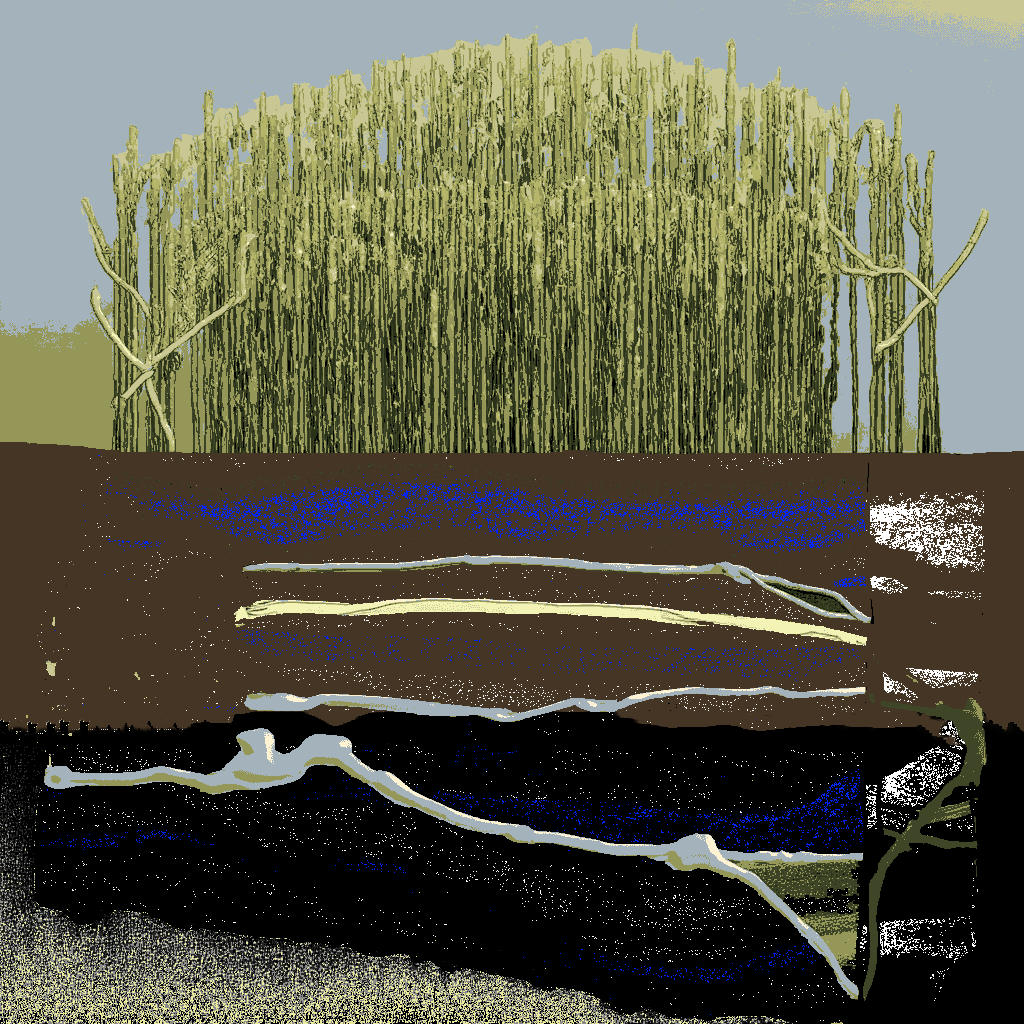
But Clay, needing a new project, started digging in the flax fields. For weeks he would go out in the early mornings when we were supposed to be sleeping. It was getting colder and I brought him his coat. The plants were still that thick bright green, and with Clay kneeling there with the sun rising up behind him, it looked like a painting. You would put it on a wall. You would hang it above a mantel and never notice anything was wrong.
When he saw me he dug his hands deep into the ground and pulled up a pinch of dirt. He wanted me to taste it. So I opened my mouth. I let it settle on my tongue for a moment. I spat it out onto his boots. He wiped my mouth off.
“There’s no salt,” he said. “No iron. No rot. It’s just dust.”
“How are the plants still standing?”
He shook his head. “They won’t hold up much longer.”
And that is when I understood what the heavy blankets and the warm stews and the softer hours are for. You don’t give a worker a shorter shift and a softer bed if you need them to pull a heavy harvest. You only make people that comfortable when you know there is no work left to do. The Stewards know the green is going to turn brown. They aren’t managing the town anymore. They are managing the end of it.
And the thing I cannot get out of my head, Mom, is that they are very good at it. They are so good at it that nobody in the village knows yet. They are so good at it that I almost didn’t know, and I have been looking for the catch since the day I arrived.
I think they have been managing the end of the town for a long time. Since before we got here. I think the reason they built a place so perfectly soft is that they know how this part goes.
Clay is at the kitchen table looking at the door. I am writing this letter. Neither of us has said it out loud yet, but we have both said it with our shoulders, which is how our marriage does its serious talking.
We are leaving. We are going to find Dee Dee. Then we are taking the raft. I don’t know what is waiting on the other side and I am, for the first time in nine months, not afraid to find out.
Your daughter, Cathy
Read T.R.O.(L.L.), the precursor to this series.
