



This post gives some context to an extensive new guide to Durable AI Adoption, developed by the Protocol Institute’s Special Interest Group for Business. In this practical guide you will learn how to adopt AI across your organization, with case studies and lessons from the PI and other organizations. Read the guide at the Durable AI Adoption microsite, and join two of its authors, rafa and Sachin on our New Nature podcast series, tomorrow, June 26, at 9am Pacific.
Shafts to Wires
For 15 years after electric power became commercially available, the typical American factory used it to do almost nothing new. A manufacturer would pull out the steam engine, set an electric motor in its place, and leave everything else untouched. Factories of the time distributed power through a long vertical iron shaft that ran up through the center of a multi-story building. The shaft was connected to the machines on each floor, and because power was delivered centrally, every machine had to run whenever the shaft turned or it would sit completely idle. Even though the power source had changed, the operation of the factory remained practically bound to the rhythms of its predecessor.
Economic historian Warren Devine, who traces this transition in a paper titled From Shafts to Wires, calls this phenomenon the “usual juxtaposition of a new technology upon the framework of an old one.”
Things changed eventually. After another quarter century, manufacturers adopted unit drives. That meant each machine in a factory was powered by its own electric motor. The new arrangement allowed each machine to be controlled independently and run asynchronously from the rest. Unit drives unshackled machines from the geometry of the central shaft, letting them be placed according to the flow of work along the production line.
The old factory layout had been arrived at incrementally, through a chain of decisions that each followed from the one before, beginning with the constraint of the central shaft. With that foundational piece removed, the layout of factory floors could begin, gradually, to optimize for electric power.
The rearchitecting of the factory around electric power was complete when the multi-story building – tall, because steam had to be delivered through a vertical shaft – gave way to the horizontal factory, which was far less expensive to build and maintain.
The lesson of Devine’s account is that the productivity gains came from the slow, accretive repurposing of machine tools, fixtures, and floor plans around the new power source – work that no one could have specified in advance, because the new layout had to be discovered. Output per man-hour in manufacturing rose at an average annual rate of 1.3 percent before 1919 and at 3.1 percent after – roughly a 2.4× jump in the rate of labor-productivity growth. Capital and labor had remained in relative proportion to one another during the shaft era, but became uncoupled after the unit drive arrived. In the years that followed, less capital was needed to make labor more productive.
Rearchitecting the Digital Environment
What electric power did to the vertical, steam-powered factory, artificial intelligence is doing to our digital work environments. AI provides a new power source for knowledge work – a unit drive of surplus tokenized intelligence available to every person in an organization. In the canonical 20th-century factory, the object being rearchitected was a building: a large, shared work environment. The object being reshaped now is the individual work environment of every person contributing to an organization. Each knowledge worker is, in effect, a small factory whose machine tools must be repurposed around the new power source.
This cannot happen by decree alone. A knowledge worker’s tooling is the residue of years of tacit decisions, each indebted to technical dependencies and arcane software, like the position of a lathe relative to a line shaft. The only way the repurposing actually happens is through the same process that relaid the factory floor: people must combine their domain expertise with the new power source – try things, build small fixtures for themselves, share the ones that work, and discard the ones that don’t.
AI adoption is the combination of deep domain expertise with the new power source, and this new arrangement has to be allowed a period of productive experiment before anyone tries to draw the new floor plan. Play has to precede planning. Desire lines must form before they can be paved.
This is what makes durable AI adoption a two-track initiative, without exception. The experimental phase cannot be skipped, because the patterns worth standardizing have not emerged yet. But chaos alone is lossy – patterns form and dissolve without ever consolidating into infrastructure the organization can rely on. The work is to read the chaos, reinforcing the traces that prove themselves and releasing the ones that don’t.
Governed and Cultivated
In an editorial introducing the research mission of the Protocol Institute, Venkatesh Rao wrote that the task of our times is to invent New Nature – “regimes of reality governed by technologically mediated laws that are nearly as inviolable, immutable, and persistent as those of nature.” While electricity introduced a new power source, the regime of reality that finished forming during the second industrial revolution was time discipline. Workers and employers alike began to treat future clock time as a natural resource to be managed and protected. Both the workers’ right to a five-day workweek and the efficiency of the assembly line were written into the reality created by clock time. We take this for granted now, but the adjustment took nearly 100 years – from the introduction of time clocks in the workplace, which in some extraordinary cases led to the lynching of line managers, to the characters in Virginia Woolf’s novels, who navigate their days by staying attuned to the town clock and Big Ben.
For companies to be successful in adopting AI, they need to consider both the rearchitecting of the work environment and the change in subjective reality of members of the organization. To achieve this, any AI adoption initiative needs two tracks: governed and cultivated. The governed track is focused on architecting new environments, while the cultivated track is focused on the psychological and ergonomic effects of the new environment.
The cultivated track is bottom-up: individual play, experimentation, the personal workflows people build and share. This track is comparable to the amateur kit stage in the deployment of a technology. Technologies such as computers and cars went through a stage where amateurs tinkered and experimented with them on their own terms. In the case of radio, amateurs were the ones keeping the entire industry alive before standardization was even considered. Kit stages are characterized by rapid experimentation and formation of a field around a particular technology. The focus is on gaining tacit knowledge and being subjectively accustomed to the effects of the technology, and less on archiving knowledge for the longer term. A cultivated stage of adoption is important for AI because it is a technology that has significant effects both at the organizational and at the individual level. In many of the previous eras of technology, such as desktop computers and the early internet, cultivation of a field was left to artists and hackers who were early adopters of the technology. But today, the effects of AI are at once wide and solipsistic, which means that the cultivation stage is something that should be diffused through the entire organization, not just the early adopters and the 10× engineers.
The role of the governed track is to create new protocols from the outcomes of the experiments in the cultivated track. The governed track should set protocols at points where AI’s outputs become consequential: how an output gets verified, escalated, and owned as it crosses from machine to human or from one team to another. A traffic light is a protocol; a blockade is not. Both are rules, but one keeps the system moving while managing the underlying tension; the other just stops it.
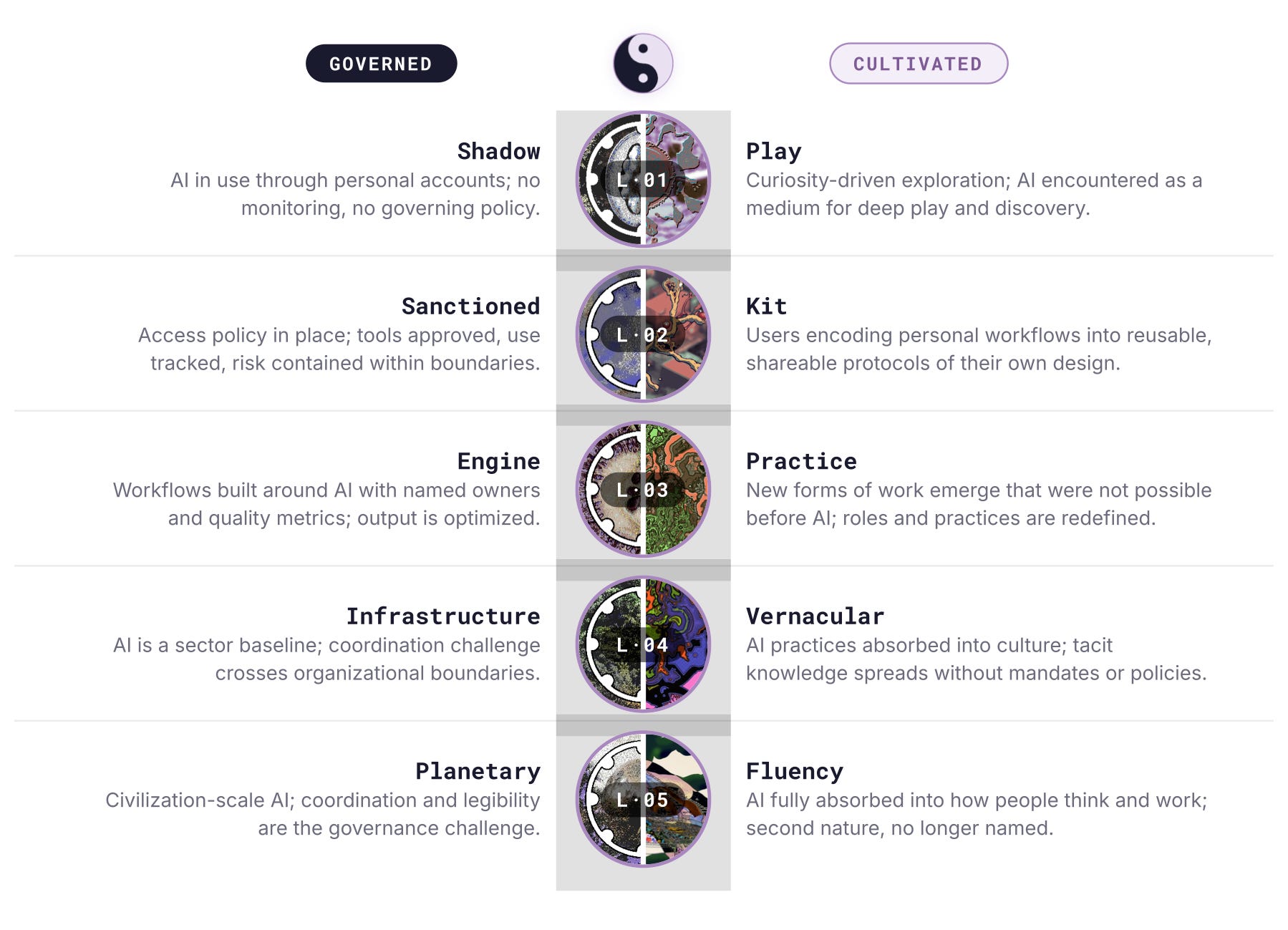
The cultivated track is trace-making – how an organization produces the patterns of coordination that a new medium makes possible, the equivalent of the desire lines worn across a park, the kits and practices that no central planner could have specified in advance. The governed track is trace-selection – how an organization reads those emerging patterns and decides which to reinforce into shared infrastructure and which to let fade.
A governed track with nothing underneath it standardizes too early. It freezes a layout before new traces have formed, the way laggard manufacturers kept the line shaft. A cultivated track with no governance generates patterns endlessly but never consolidates them, accumulating risk it cannot see. It is frontier territory with no ecosystem to sustain and learn from it. The maturity ladder is really a measure of how well an organization coordinates these two tracks as the ground keeps shifting.
Keeping the Medium Honest
Adoption of a domain technology such as AI requires us to:
Think from first principles about the traces and paths generated by the previous technological paradigm.
Generate new traces and paths based on the new technological paradigm.
Failure to do the first leads to the persistence of shaft-like thinking. Continuously doing the second without stable governance produces an organization that works without remembering or accreting its gains.
The factory took 50 years to implement the unit drive and reap the benefits of electrification. But there were journals published as early as 1896 in which the unit drive was proposed as a method to increase productivity. The race to transform the factory lasted roughly 25 years because its new form had to be discovered. Now the race is on to transform the organization with artificial intelligence. Knowing that a reorganization is needed is cheap; becoming the organization that finds and sets the standard is hard.
Enter our Jamverse Jam
Protocolized recently announced our fourth open submission contest: we’re looking for artists and writers to extend and connect the Jamverse, a network of interoperable worlds that we are incubating in our Special Interest Group for Protocol Fiction.
We have a $1,000 grand prize, with at least 10 other entries receiving $200 prizes. Deadline for entries is July 31. Read more and enter at the Jamverse microsite.
It's not clear to me what: word, pdf, excel, power point, access, my mail client, adobe, ... are "for" once my entire data world is in an offsite cloud database collection and an AI is my tool for writing editing reporting displaying etc. I no longer need any of the tools I am using. Already in just a couple years I use python via Claude or the like to do everything I used to do in excel. I go SQL Server or Access or SQLlite to Python to an image format.