



This is my first editorial as the newly anointed Director of Research of the newly formed Protocol Institute (PI) (was: Summer of Protocols), for which Protocolized serves as the flagship magazine. In his kickoff essay, Timber Stinson-Schroff, also newly anointed as the Managing Director of PI, laid out the overall organizational mission. In this essay, I want to lay out my initial ideas for the research mission.
At the moment, given that PI is just a shoestring operation working with a small launch budget from the Ethereum Foundation to get us off the ground, with mostly part-time and volunteer effort, the grand titles Timber and I have given ourselves are a case of all hat, no cattle, as they say in Texas.
As I understand from the orientation package from the Secret Guild of Institutional Directors that Timber and I received, both of us have the the same, simple job description:
Bring in money from rich but busy individuals and organizations and give it to people and groups with interesting ideas, time, and energy to do things to benefit the glorious planetary process of protocolization.
To the extent we can do that, as Director of Research, I get to make grand, philosophical pronouncements and doctrinal assertions about Life, the Universe, and Everything, in direct proportion to the amount of money we bring in.
Specifically, the Guild orientation package tells me, I’m allowed to produce one fortune cookie pronouncement per million dollars we bring in. And since this institute, in its previous guise as the Summer of Protocols program, deployed about three million dollars over three years, I get to make three fortune-cookie pronouncements.
Here’s my first one: The task of our times is to invent New Nature.
I introduced the idea of New Nature in two posts earlier in the year, and I got the idea for this fortune cookie formulation from the title of Andrea Wulf’s illuminating biography of Alexander von Humboldt, Inventing Nature, which everyone should read. The big argument of the book, pretty persuasively made, is that in the early 1800s, Humboldt almost single-handedly invented Nature as we understand it today.
In the next decade, we hope similarly to invent a New Nature at the Protocol Institute.
In my previous posts, I defined New Nature as:
New Nature is regimes of reality governed by technologically mediated laws that are nearly as inviolable, immutable, and persistent as those of nature.
I’ll elaborate on how this is going to shape PI’s research mission in a bit.
Since I am only allowed to make two more such pronouncements before the hat-to-cattle ratio becomes untenable, I am going to need some help. So I’m going to be doing my research-directing in public.
Research Directing in Public
For my piece of the PI puzzle, I want to kick off a new working-in-public series devoted to figuring out our research mission, and how it fits in with the other parts of the larger vision (the practice/application of protocols, protocol education, scene-making, this magazine).
And I do mean working in public in the fullest sense that SoP alum Nadia wrote about in her 2020 book of that name: Sharing messy, unfinished, work-in-progress artifacts as we go, in the hope that we find and connect with aligned people and institutions that can influence us, and be influenced by us, in mutually beneficial ways. Ideally, some of those people and institutions will bring money to this party. We do not want to end up part of a LinkedIn for big-hat-no-cattle institutions.
What is the Protocol Institute about, you ask? Well, here is a WIP artifact for you:
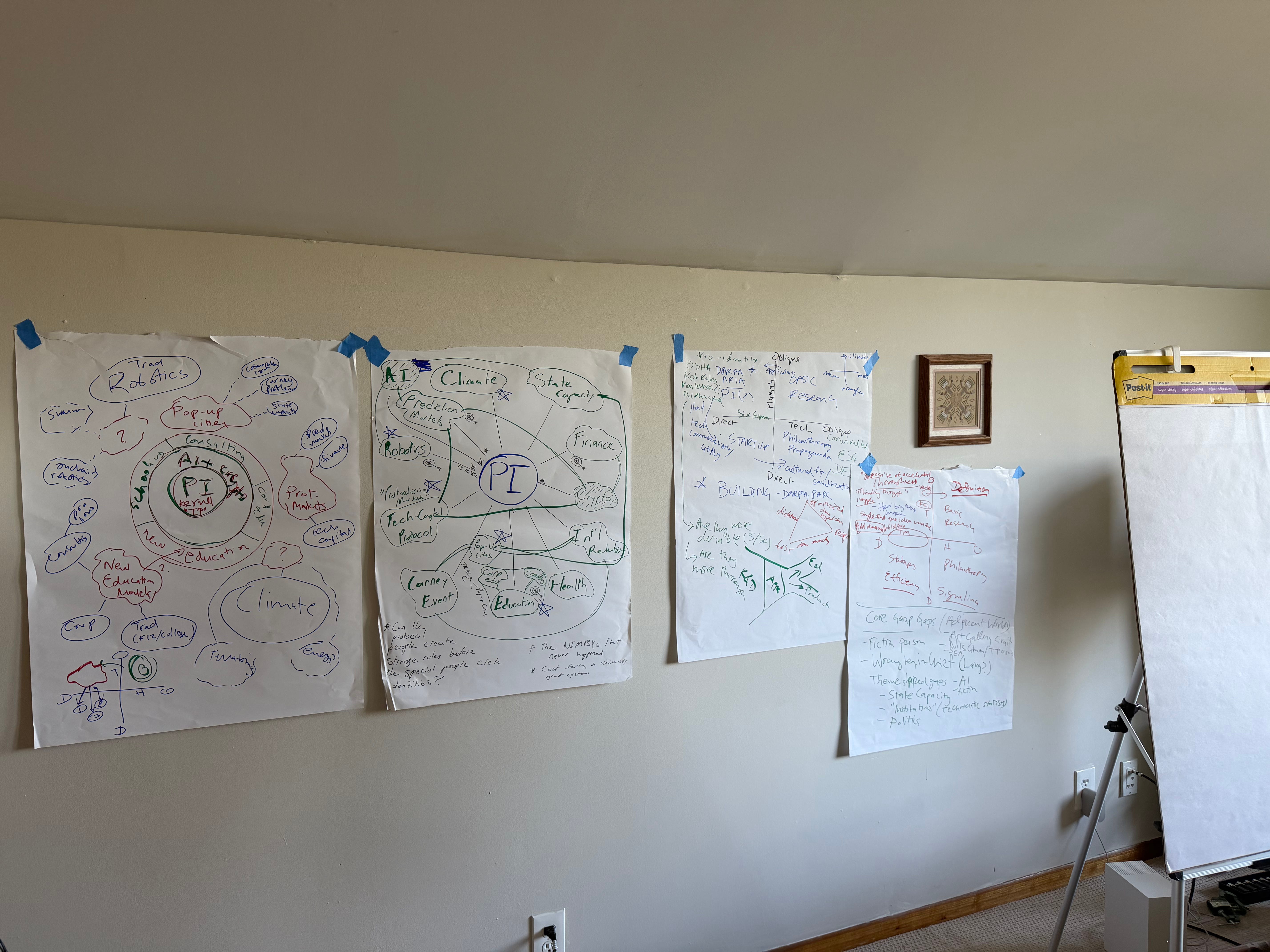
Those are some key flipchart sheets from the 3-day strategy retreat Timber, Tim Beiko (who will chair our advisory board), and I had in April, to figure out what the hell we’re going to be doing and how we’re going to pay for it. I’ve put then up on my home office wall because we still haven’t figured it out, and I need to keep staring at it until we do.
You should actually be able to read those if you zoom in, but just to spare you the pain of actually processing someone else’s WIP mess, here is a slightly cleaned up version of the key framing constructs we came up with, redrawn somewhat more neatly on my whiteboard.
In research-directing, neatness counts.
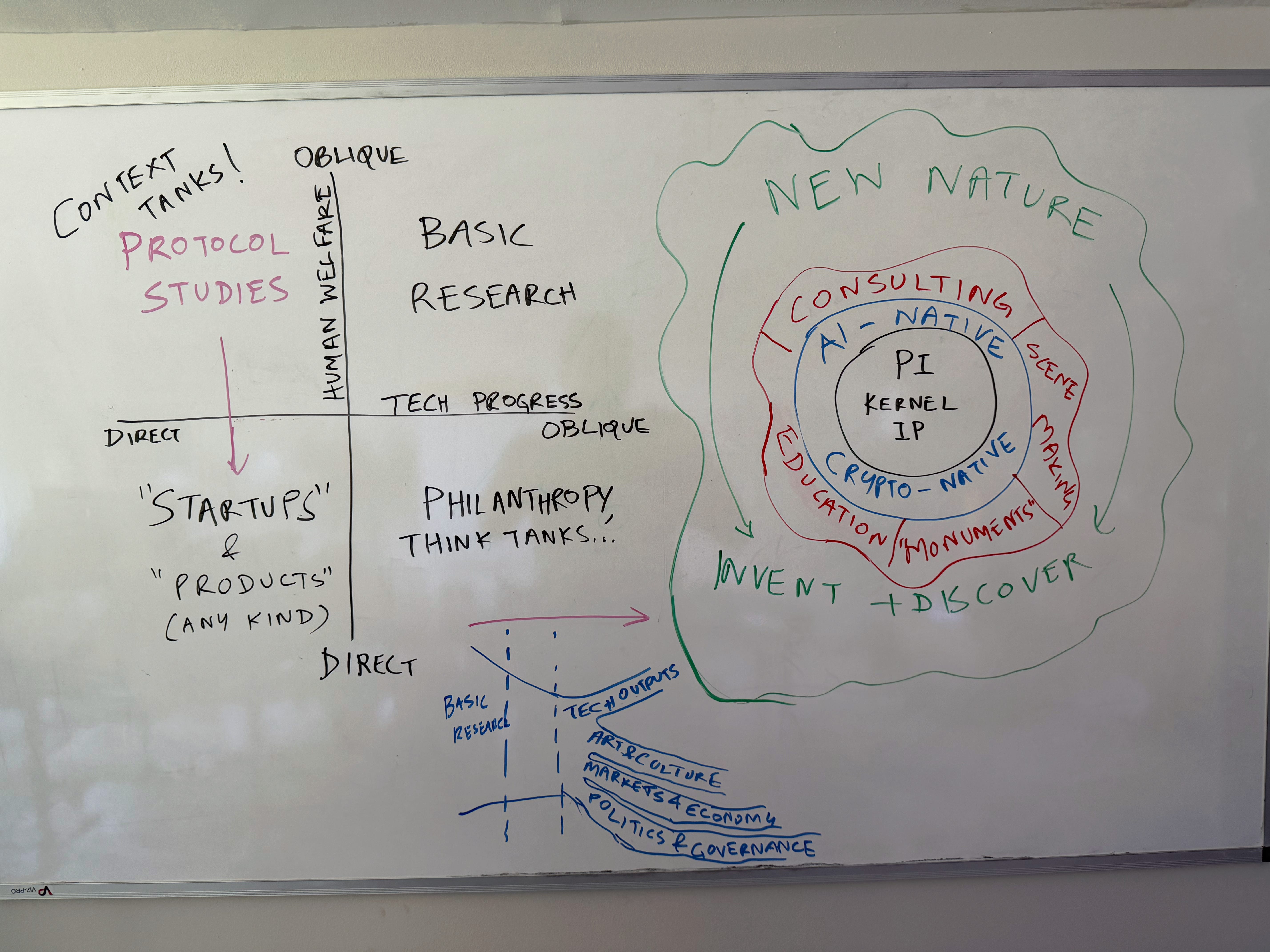
There are three pieces here: the 2×2 on the left, the pipeline drawing in the middle, and the map-thingie on the right. Let’s take them in order.
The Direct-to-Oblique 2×2
Early in the first session of the strategy retreat, we had a breakthrough moment with the 2×2, which crosses tech progress on the x-axis with human flourishing on the y-axis, with both axes going from Direct to Oblique.
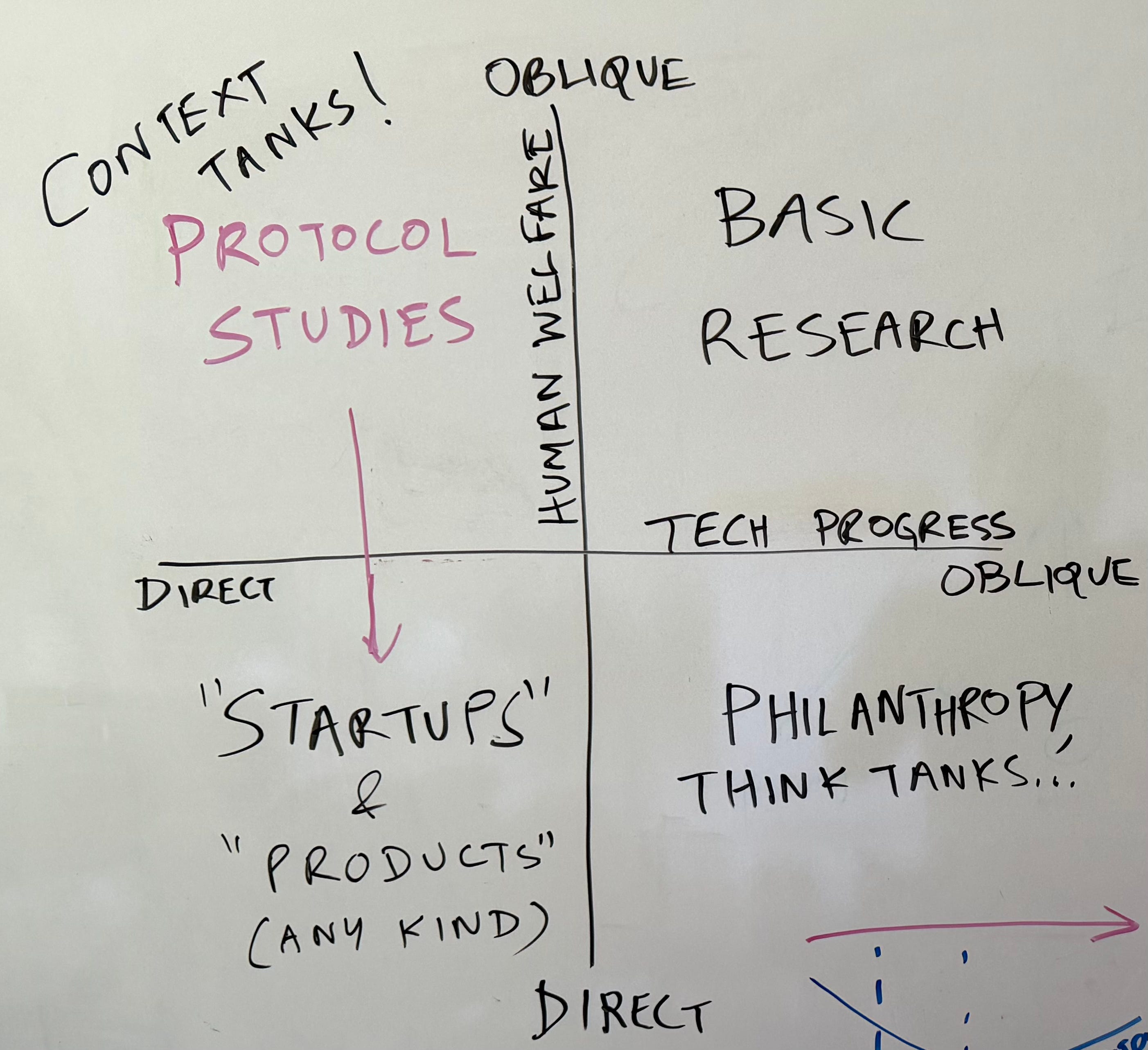
Here we mean direct as in on-the-nose and explicit, and oblique in the sense of John Kay’s wonderful little book on strategy, Obliquity (itself based on a seminal 1959 paper about effective patterns of driving change, The Science of Muddling Through by Art Lindblom).
Protocol Institute is going to plant its flag in the top-left quadrant: direct engagement with tech progress, and oblique engagement with human flourishing. For completeness, here’s how we mapped out the landscape:
Direct human, direct tech: Anything that’s shaped like “startups” or “products” making direct use of technology to try and directly benefit humanity, at least in some solipsistic sense, even if others don’t agree you’re benefitting anyone, and suspect you’re in fact hurting everyone. It doesn’t have to be a literal startup making literal products, but anything shaped like that belongs in this quadrant.
Direct human, oblique tech: Most philanthropic and ideology oriented organizations fit here, since they usually have some sort of on-the-nose notion about doing good for humanity, coupled with an oblique engagement with technological progress. Typical think tanks fit here too, since they aim to directly influence and benefit human-centered entities like particular nations, transnational entities, or business sectors.
Oblique human, oblique tech: This is the basic research quadrant, including basic scientific and mathematical research of course, but also humanities disciplines like philosophy, literature, art, and poetry, which constantly interrogate, deconstruct, and reconstruct what it means to be human in fundamental ways, often in ways that threaten naive humanists more than any tech advance.
Oblique human, direct tech: This is what I’ve recently labeled (thanks to inspiration striking a couple of days ago) the context tank quadrant. Protocol Institute is a context tank. Perhaps the first ever! We’re obviously gesturing at AI here, and yes PI aims to be a deeply AI-native institute, aspiring to reduce itself to one giant markdown file. We’ll have more to say about how context tanks differ from think tanks, studios, incubators and such in a minute.
There is an implied cycle hypothesized here: Progress Change begins in the top right, and cycles around to the bottom right. Then there’s a crisis and we begin again.
Basic Research —> Context-Tanking —> “Startups” and “Products” —> Philanthropy and Think Tanks.
Institutions in each quadrant have a role to play in turning new discoveries on the frontiers into changed planetary conditions. We can and do argue endlessly about whether particular changes are good or bad, but the fact of the process of endlessly accumulating historical change is undeniable. We at PI don’t particularly want to get into endless arguments about the nature of “progress” as such, but we do want to be part of processes of historical change currently underway.
We are wary of committing to any particular notion of flourishing/thriving vs. decline/decay, but we do broadly think change beats stasis, and that protocols are a key part of the story of change.
One subtle implication of this cycle we teased out in our conversations is that the “startup”/”product” quadrant is necessarily tribalized and identitarian, as people must commit to particular notions of human welfare, and inevitably get attached to particular notions of humanness (and thence, particular notions of “progress”), as they cross over into the direct/direct quadrant. The medium is the message is the human.
This is not necessarily a bad thing. Commitment to making particular newly enabled futures real requires commitment to making certain new ways of being human work out. At least for a while. But it does create a regime of intense cultural competition ideas must traverse before they can become embodied in the fabric of civilization.
This arc is in fact the arc of what we call protocolization. Conceptually, we can restate the arc as:
Discovering —> Contexting —> Building —> Distributing.
One sociological function of institutions in the context-tank quadrant, we think, is to provide new ideas and new ways of being human time to breathe and work themselves out in relative peace, before they must choose a particular form factor in which to enter the hunger-games arena of direct/direct irruption into techno-human affairs, competing for the future of the planet.
We want PI to serve as such a space. How do we do that? This brings me to the second diagram.
Ideas in Attention Tunnels
How do you allow ideas to breathe and take shape between discovery and building phases? What exactly is “contexting”? What happens to ideas marinating (not the same as incubating) in context tanks, and where do they go from there?
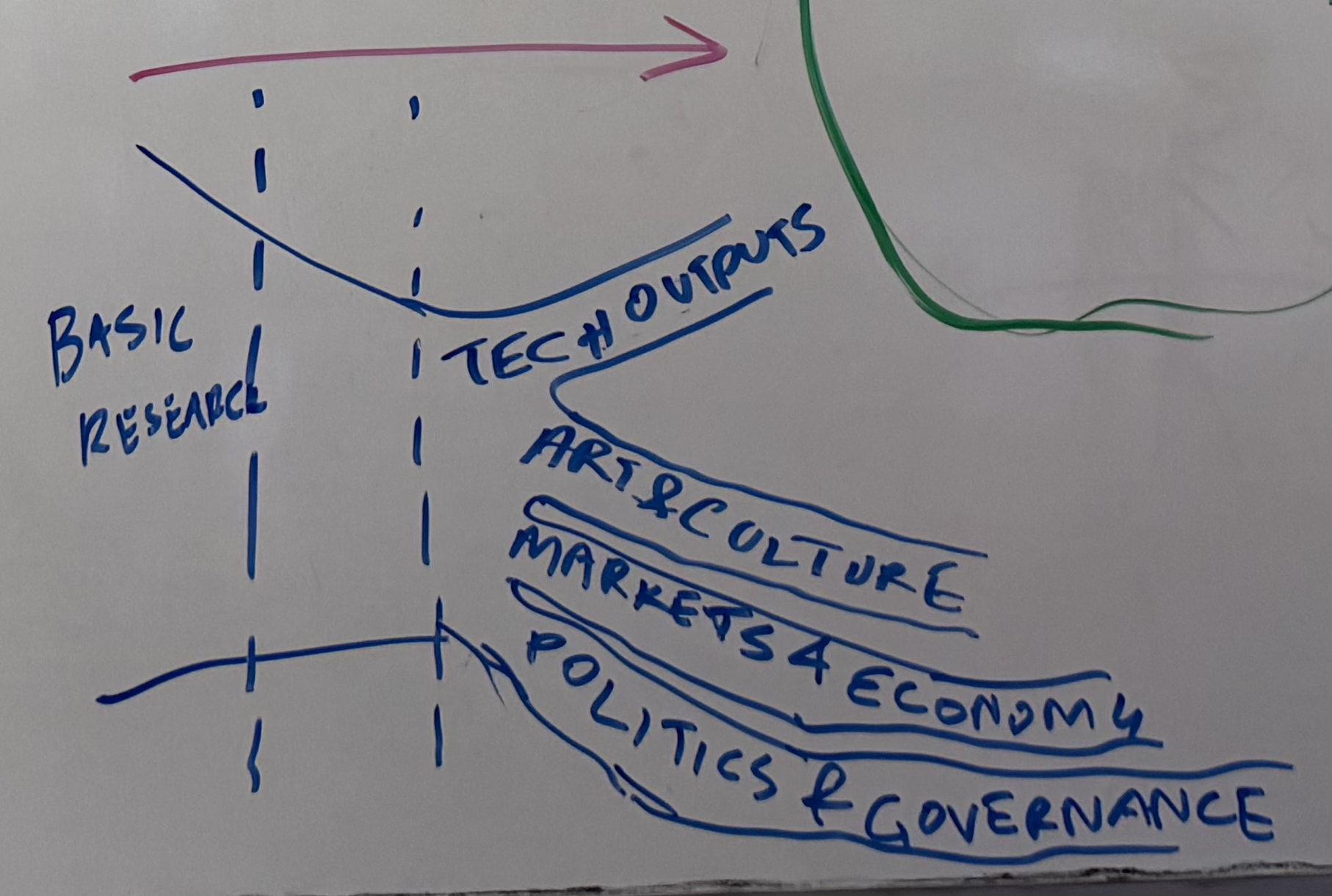
That purple arrow in the 2×2 is our attempt at an answer. That’s kind of the pipeline defining PI’s planned role. You can see the details sketched out in the blue diagram at the bottom. Here’s a zoom-in:
The logic of our pipeline is:
“Basic research” relevant to protocols and protocolization diffuses in from the top right quadrant upstream of us. By which we mean fundamental advances in cryptography, AI, epidemiology, ecology, energy, new kinds of poetry, new modes of art, new philosophies, and so on. New knowledge that doesn’t quite know how to shape reality, or relate to humans. Ideas that are stumbling around trying to enter the world.
A new idea stews in the context tank for a bit, between the two vertical dotted lines, in pre-factored forms, as an idea discovering itself and figuring out what form factor it should assume (Startup? Protocol proposal to the W3C? Great novel? Interpretive dance? Climate action protocol? New hand-washing protocol proposal to the WHO?). Contexting is about new ideas seeking their compile targets, and the new ways of being human they might enable.
Then it makes its way into the bottom left “startups”/”products” quadrant, having assumed some legible form. Again, I emphasize, anything in that rough shape qualifies. A painting is a product in the sense that it uses the technology of the painting medium directly, to produce a work that directly affect human welfare in some way (though people might not agree about the nature and valence of that effect of course). A group of people trying to get a city to change its zoning laws is a “startup.”
In our first three years, as a summer program, we relied on a particular vehicle for doing our contexting, the summer cohort. We got pretty good at cohorts, but slowly realized we needed a more persistent vehicle for creating a context.
Enter the Special Interest Group, or SIG, designed to contain new thinking for long enough for it to decide what kind of shape it wants to take as it makes its debut into the world at large.
The name is old. Many storied institutions have used the SIG form for their work, but we think we’ve come up with a particularly original contemporary spin on it. We have four SIGs going on at the moment:
Memory Research Group (led by Kei Kreutler)
SIGFPT: Special Interest Group in Formal Protocol Theory (led by Patrick Nast and myself)
SIGP4B: Special Interest Group in Protocols for Business (led by rafa)
PFSIG: Protocol Fiction Special Interest Group (led by Spencer Nitkey - Writer and Sachin)
A fifth SIG on distributed robotics is in the cunning-plans stage.
A SIG in our sense is something like a souped-up study group (roughly two-pizza sized, by that old Amazon heuristic of two-pizza teams) that has an open-ended charter to immerse itself in a theme or domain, with no particular goals, projects, or rules, and just enough resources and support to sustain itself indefinitely.
Read, think, work on your ideas in collaboration with the right set of peers, and see where the journey takes you. It is what I have started calling an attention tunnel, where scarce collective attention can do its work for a while.
Particular projects or workstreams may unfold within the context of a SIG, but the SIG itself isn’t a project or workstream. It is a manner of paying collective attention to a theme.
Nor is a SIG a heavier organizational unit like a “studio”, “lab”, or “research center.” You can’t build heavy-weight scaffolding when you’re at an all-hat-no-cattle phase of evolution. No, a SIG is simply a space to think and work between the provocations emanating from the basic research quadrant, and the pressures of operating in the startup/product quadrant. It’s the calm before the storm.
The pressure stage, of course, cannot be avoided for any serious idea that hopes to change the world, but it can be deferred while the idea grows up, and gains enough strength to handle it. This is not incubation though. Incubation is about the inner logic of a thing getting worked out, while it uses up a store of resources. Incubation is about ontgeny. Contexting is about a thing getting introduced to the world it is going to live in. Contexting is how you send an idea to school so it can get a job when it graduates.
The structure of a Protocol Institute SIG is deceptively simple – it’s just a group of people who decide they have some interests in common that have a bearing on protocols and protocolization. They start meeting (typically every other week on a Discord call), talking, studying, and working together. We pay the curators small honoraria to host these SIGs and report on their activities periodically in the form of Protocolized essays. That’s it. Nobody’s going to get rich running or participating in our SIGs. What you will get is a harness engineered to let you devote steady, cumulative attention to a thing, for long enough to do something with it. SIGs are Claude Code-like environments for groups of human brains.
Near-zero infrastructure costs. No fancy buildings, no expensive equipment. Just people, ideas, some cheap/free software tools, and a modest budget for AI and crypto tokens. Individual workstreams and projects within the SIG may have additional, heavier demands, but the container doesn’t have to be complex or heavy. All it needs to do is contain collective attention over weeks, months, and years.
Our two oldest SIGs – SIGFPT and MRG – will each be one year old in a few months. Warm contexts for the right kinds of ideas to develop.
I think this is all it takes to get started doing really big things today. You don’t need fancy buildings or big budgets. You just need a small group paying steady attention.
But this mode of working is deceptively simple because a lot more illegible kinds of knowledge and cultural capital have to be in place in the environment before stable and generative attention tunnels form and begin to do interesting, original, and useful work. Otherwise, all the thousands of communities on Discord and other platforms would be doing world-changing work.
There are certain necessary conditions for SIGs to thrive and function as attention tunnels acting on important and difficult themes. We can’t say we’ve entirely figured out sufficient conditions, let alone a “formula,” but we’ve figured out quite a few best practices. We think we know how to get a small group to pay attention to a small set of ideas for long periods of time.
Which brings me to the third diagram.
Shaping New Nature
Our three years of work in the Summer of Protocols has left us with a solid corpus of ideas and capabilities, produced collectively by almost 200 people contributing research papers, small projects, art, guest talks, workshop participation, and so on. This is the legacy PI is inheriting.
This is no mean feat by the way. Three million dollars may sound like a lot to people not used to research environments, but I’ve seen a lot more money get burned up a lot faster, with nothing to show for it.
Research directing is partly about knowing how to spend money… elegantly. I don’t know that we at PI have the skills yet to deploy (say) $10m or $30m a year well, but $1–3 million, we know how to do. And maybe we’ll build our muscles and get to those larger scales.
We think of this corpus as the core asset we’re building, and in this diagram, it serves as the anchoring center mass of our self-conception. This is a lot of material – go look for yourself on the protocolized.io site. But more than mere material, it’s a socially alive corpus, that’s steadily generating new ideas and inspiring more people to do more things everyday.
This is the kernel of PI, the innermost circle and energetic core. Three years of work is close to critical mass, and this kernel is beginning to accrete knowledge to itself at an accelerating pace. I’ve labeled it “IP” in the diagram, but that’s a loose term. I don’t mean specific forms of intellectual property like papers, patents, copyrighted artworks, courses taught, books written, and such. I mean all that and more, deeply entangled with the community that is producing it.
If I might be permitted the conceit of a somewhat self-congratulatory term, the PI kernel is a scenius structured as a commons. A young and fragile one, just three years old and a few hundred people strong, but definitely a scenius.
Kinda fun that PI reverses to IP.
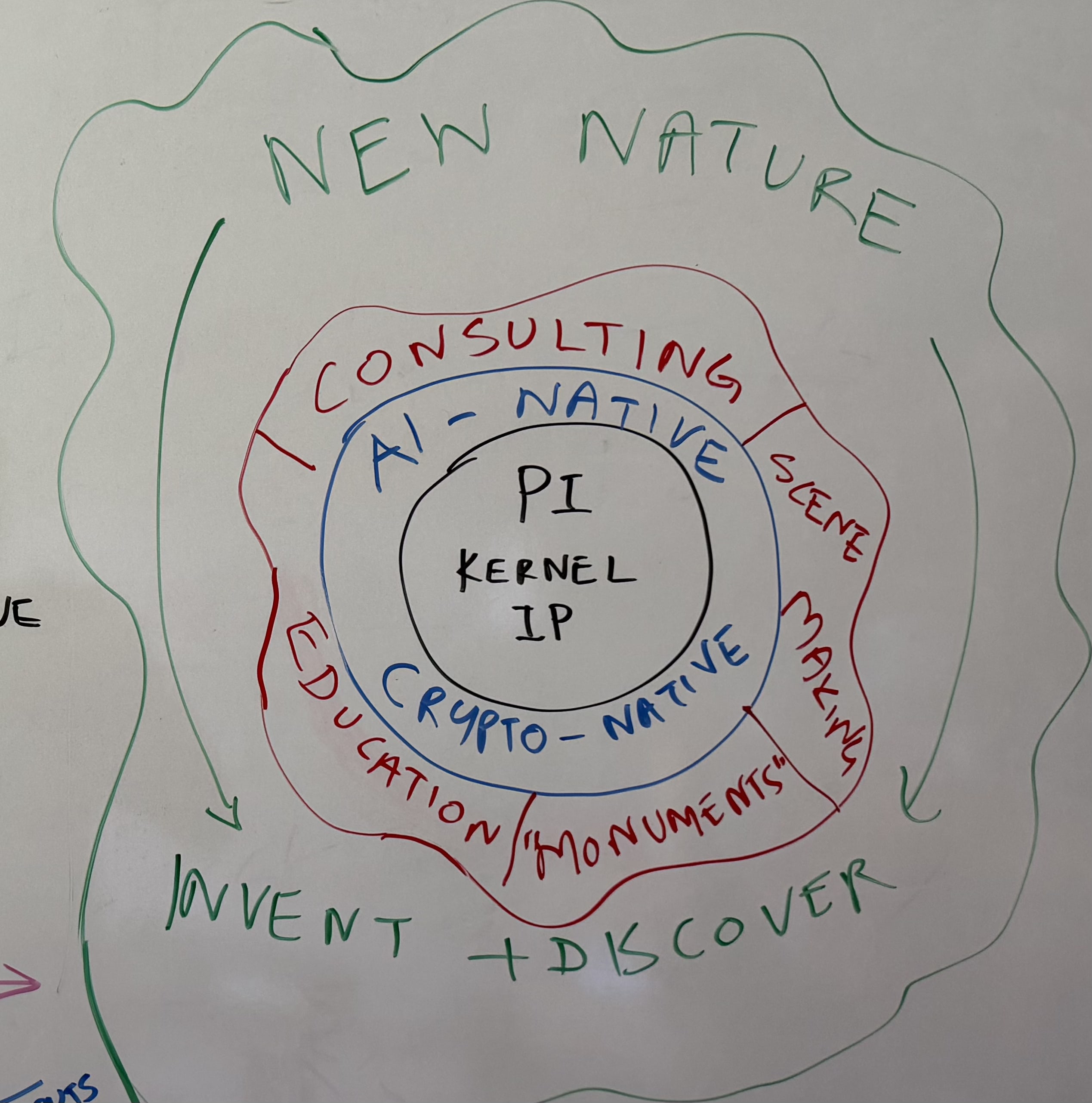
That’s one necessary condition for a context tank and its attention tunnels to work – a center-mass of scenius like this. Check.
Next, it is 2026. If you’re starting a new institution today and it is not fundamentally AI native in a deep and unsettling way, you have some explaining to do. If its patterns of working look familiar and comforting, you have a problem. Becoming AI native, however, is easier said than done.
Fortunately, that’s the problem SIGP4B is actively working on, so we are making our own dog-food to eat. We’ve got a SIG on the job here.
That’s one half of the shell around the kernel in the diagram (we like our computing metaphors around here).
We’re getting pretty good at AI-native operating modes. This magazine is one of the few that not only accepts AI-assisted writing, it actively encourages it, and pays for it the same as for hand-crafted human writing. Trad publications may be drowning in slop submissions, but we are figuring out how to thrive on generated content.
Everything we do is deeply, organically, reflexively AI-forward.
All our artwork is AI-generated – but in a boundary-pushing way using the TITLES platform we’ve written about before. Neither Timber nor I code, and the two new websites of PI, protocol-institute.org and protocolized.io, were entirely vibe-coded (and will continue to be). We have plans to digest our sprawling corpus into embeddings, and turn it into an agentic oracle. And it will be a small project that will cost a few hundred dollars in tokens rather than a ponderous enterprise IT undertaking.
But all that is just at the level of tools. We’re also starting to think in AI-native ways. You’ll see more signs of that as our activities mature.
The other half of the shell in the diagram is decidedly more controversial. We’re not just AI-native, we’re crypto-native. That, for many people, is the worse of two strikes. But as a wise man once told me, you’re always going to piss off some people if you try to do anything of consequence, and what’s important is to piss off the right people.
This is of course, partly because of our origin-story and path dependent history as an Ethereum Foundation-funded project. But it’s also a central intellectual and philosophical commitment underlying everything we do. The discovery of public-key cryptography (PKC), which is now integral to every aspect of computing (including AI), was perhaps the genesis event of what we’re calling New Nature.
It has been obvious for a few years that AI and crypto are in some sense natural duals, and it is a rather delightful technical-lexical coincidence (or is it?) that both are ecologies based on tokens of different sorts. But actually working out the nature of that duality, and the natural shape of how the two ought to relate to each other technologically and mathematically, is far from clear. And building an organization that is a native of the quicksand-like emerging convergence zone of the two is even harder.
Slowly, but steadily, we’re figuring it out though.
More and more weird new ideas are trickling through from the basic research quadrant. Zero-knowledge machine learning, verifiably private computation, encrypted inference, oracle systems, verifiable provenance data, verifiable identities – piece by piece the elements of the duality are being uncovered in the discovery quadrant. And next door, we are paying steady attention, contexting away in our SIGs, figuring out how to put the pieces together in interesting ways.
This, by the way, is the theme of our Protocol Town Hall salon series this year, which will kick off shortly. AI × Protocols. We already have half a dozen talks lined up that should challenge your imagination, and recontextualize your thinking about the future.
Downstream of us, in the product/startup quadrant, the first fruits of this years-long convergence are already emerging. Mainstream society has only recently discovered relatively simple uses of AI and crypto in isolation – chatbots and stablecoins. But complex, converged technologies are coming. Agents paying each other with crypto. Decentralized agent ecologies taking root onchain. Secrets in enclaves shaping inferences without revealing themselves.
Normal people may never hear of such things as ERC 8004, x402, MPP, MCP, and all the other ideas floating around in the acronym soup, but they will soon start seeing the consequences of this emerging AI-crypto converged backend of planetary computation.
Here at PI, the prospect of this looming convergence (and the explosive divergence it will then spark) shapes almost everything we do. We are betting that this, in fact, is the future. And we are designing PI as an organization to run on AI+crypto rails philosophically, not just at the level of tokens. Even if we have to navigate the quicksand convergence zone to do so.
There is a praxis and a poiesis to this challenge of being simultaneously AI and crypto native.
Many have noted the emerging praxis.
AI allows us to work radically more effectively, with radically minimized resources. Joules in, intelligent work out.
Crypto allows us to coordinate radically more effectively, with radically minimized friction and trust. Joules in, coordination out.
But it is the poiesis that interests us more. There is a new grammar of reality emerging here. A new kind of poetry in the very bones of the planet. That’s New Nature.
Being “native” to both ecologies, we think, will make the Protocol Institute, despite its vanilla name and conventional surface appearances, a radically alien kind of institution. Of a sort that couldn’t exist as recently as six months ago. And figuring out how to be native to these two ecologies, which are both full of all the risks of frontier ecologies, is an existential imperative for us.
That’s the second necessary condition in the diagram. AI+crypto native institution building.
Check.
And finally, there’s the third and hardest necessary condition: Plugging into the real world. Education. Scene-making. Consulting. Banal words that are forced to do a lot of practical work. But we’ve accumulated a wealth of substance behind each.
Scene-making: We’ve held a dozen workshops around the world, attended by hundreds of people, and learned how to get people “protocol-pilled” reliably. We’ve memed a new genre of fiction into existence over the last year.
Education: There are now protocol studies courses at a dozen universities around the world, as a direct result of our work, and dozens of graduates of our own hugely successful first Protocol School last year. The protocol-literate community is growing and spreading.
Consulting: Building off the experience of half-a-dozen experimental projects aimed at influencing real-world protocol domains in 2024, we’re now incubating several consulting projects, and a growing capability in our SIGP4B group. Want help for your organization to navigate New Nature? Call us.
Monuments: This one is aspirational, and partly the result of taking as a challenge the title of the research essay we published by Drew Austin in 2023, Protocols Don’t Build Pyramids. We aim to lend some visible public charisma to the invisible protocol infrastructures that run the planet.
Each of these activities, taken in isolation, feels like part of the ordinary pragmatics of running any such program or institute. But if you step back, and contemplate them in the context of the hows and whys of the activities, a more profound pattern emerges – this is how you shape New Nature, by actually constituting it from the inside out, by creating strange new institutional species that survive and thrive by strange new rules. You discover New Nature by inventing it, by being it.
Big hat, no cattle?
Perhaps. But at least it’s a strange new hat.
If you’d like to help us make all this happen, get in touch. We’re just getting started here.
Definitely an intriguing hat!
“Before you get cattle, you’ve got to have secure fencing, a reliable water source, sufficient pasture/forage, and a plan for winter hay. Managing the cows is the real job, so ensure you have infrastructure and resources in place—like a sturdy perimeter fence—before they arrive”
- AI summary of “before you get cattle, you’ve got to get ______”
… congrats on having so much of the requisite scenius in place! Exciting to be following this.
Venkat - I think you’d find Henry Farrell and Cosma Shalizi’s new article “AI as Social Technology” (https://knightcolumbia.org/content/ai-as-social-technology) interesting.
Some of the questions their article ends with seem similar to what you are trying to address: “The interesting questions involve the interaction between the ways bureaucracies abstract reality and the coarse-grainings that new AI applications will lead to. When will one system compensate for the deficiencies of the other? When will their different flavors of lossiness prove mutually reinforcing? What new problems may result from combining very different systems for managing complexity that are themselves highly complex? How will power relations change as a result? Who will benefit, and who will be hurt? These and other questions might be asked, pari passu about the relationship between AI and other social technologies such as markets and democracy too. We absolutely ought to start asking them.”