



AI is changing how organizations work, which means that it’s an excellent time to make one from scratch. Our approach at the Protocol Institute has been like growing dandelions: allow strategies and tools to proliferate like weeds, then let a tough environment do most of the filtering for us.
Even as we build something as formal as an institute for protocol research and education, this messy-looking approach has generated a few patterns. They might even be useful at your own organization.
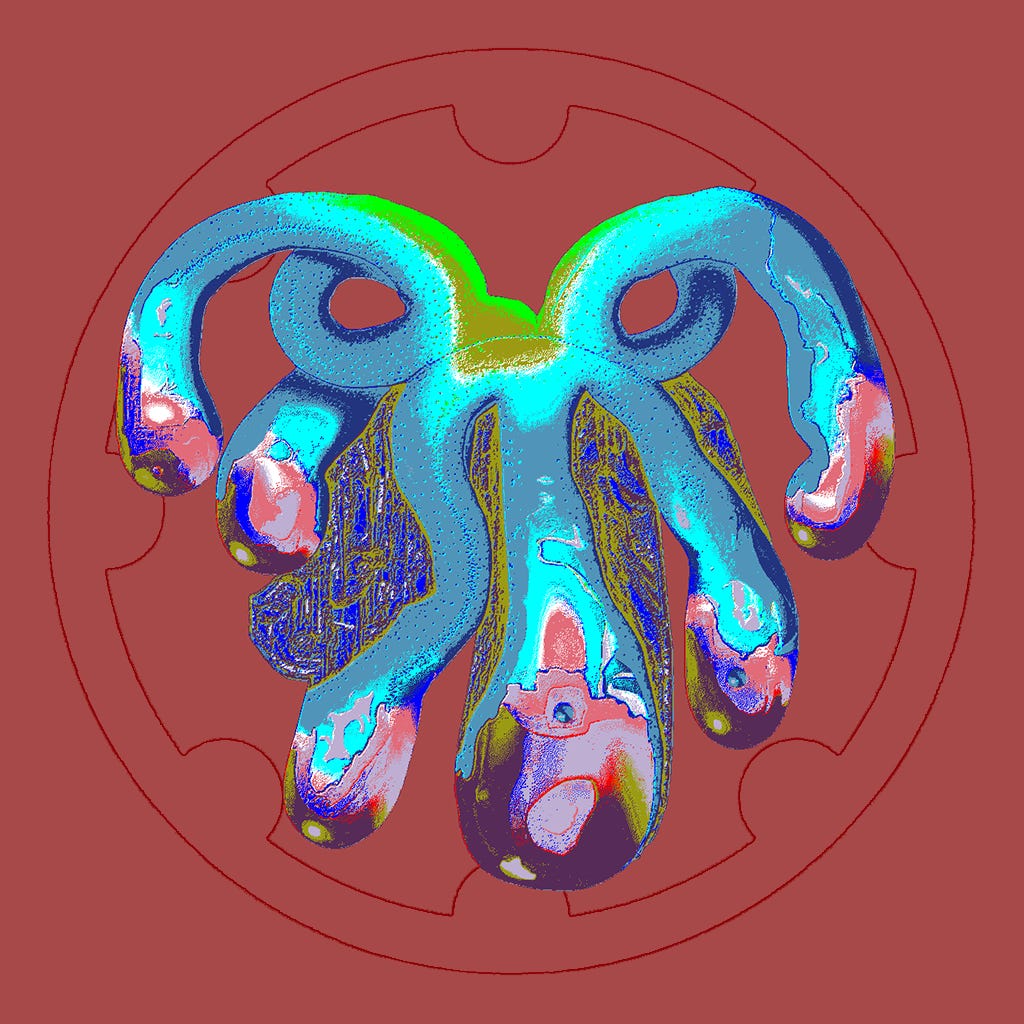
Internet, Meet C3PO and Humboldt
Our two bots – named after Star Wars’ fussiest protocol droid and late polymath Alexander von Humboldt – are both featured on the ProtocoI Institute (PI) Team page.
C3PO (Conversational Protocol Publications and Parsing Oracle) is our guide to a growing corpus of research, articles, and transcripts. Few people have time for a review of the entire library, so C3PO allows them to discover what’s most relevant without PI creating and maintaining a well-defined taxonomy. The bot also welcomes new members to the Discord server, giving them a customized reading suggestion.
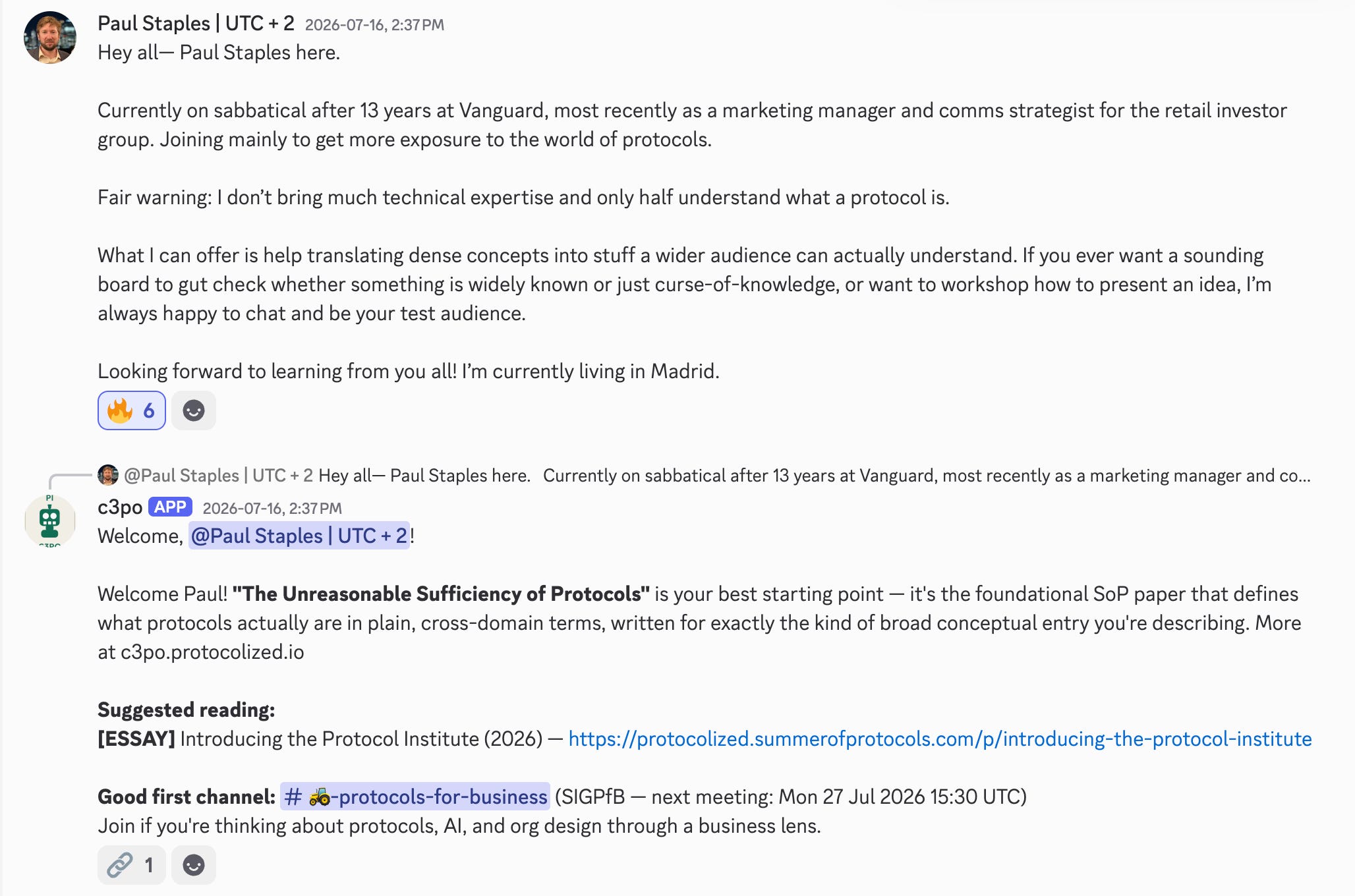
While C3PO is great for basic queries – any Discord member can tag it in the chat to get their question answered – it’s just a semi-charismatic encyclopedia. C3PO is more pedantic and less interesting relative to its cohort; Humboldt is a weirder, more cutting-edge agent capable of not just supporting researchers, but doing research itself.
Humboldt is our semi-autonomous agent focused on exploring PI’s main philosophical concept of New Nature. About once a day, it posts an entry to its public notebook. Those notes are a result not just of Humboldt’s internal loops, but also its conversations with others on Discord. One of the best features of these agents is their availability and responsiveness relative to human intellectual sparring partners. As PI grows, we will host in our server more synthetic researchers who you can work with and alongside.
If you have a home for them, like a Discord or Slack, or just a website, bots can add serious value.
Vibe Infrastructure
We at the Protocol Institute are building a think tank – or, as we like to call it, a context tank – from scratch. One feature of an organization starting up at the same time as a technological wave: it can easily start at 100% adoption instead of zero.
If you’re starting up, the question is: Where can we go with what we have?
If you’re an incumbent, the question is: How can we adopt this new technology without losing what we have?
PI’s operating model might not appear as clean as it would if we were following an established playbook, but that’s OK. Clarity is not the same as efficacy. The affordances of LLMs are already quite powerful – especially for building digital infrastructure.
We built protocolized.io and protocol-institute.org using coding harnesses. Even if that sounds technical, a lot was done simply from the desktop app. Coding via the terminal was limited, at least in the early weeks of site building. Initially, we estimated that our infrastructure needs (including searchable archives, event pages, calendars, gated areas for members, and online voting tools) would cost about $50,000. It ended up costing a couple dozen hours of team time, and a few hundred bucks worth of tokens and subscriptions.
One unique upshot is the absence of collaboration. A tight feedback loop between a client and a developer is hard to make, but if they’re the same person… you can move fast and precisely.
Of course, maintenance is a concern. Incorporating bug fixes and feedback from the community is the less glamorous side of vibe infrastructure, since the process of pushing updates to the site cannot be fully automated. Fortunately, solving that problem is a matter of process improvement – which tends to be straightforward. We haven’t gotten there yet, but any work required will not be enough to tip the scales of the cost-benefit ratio already established.
Protocol Art
Our collaboration with Titles continues to be a major highlight of our AI strategy. The two models that we’ve trained using their platform are what generate the majority of our visual assets. Two artists from our network, Darius and James, fed the models art from their own portfolios. As a result, we (and you!) have the ability to generate amazing assets in their styles.
This fall, as part of the Protocol Symposium, we’ll host a workshop on protocol art. Participants can go deep using available tools and will learn how to increase generativity while safeguarding attribution through protocol technology.
That art would be an ideal playground for exploring how LLMs and protocols interact was not something we anticipated early on in the Summer of Protocols program. However, after a foray into art and literature during SoP24, this area became a longstanding bet in our research portfolio.
OpenRecapper
OpenRecapper is our custom voice recognition and transcription bot, which lives on Discord. It creates notes for all PI’s special interest group calls, logistics meetings, and publishing meetings. Notably, it can run in parallel across our four voice channels, which act as meeting rooms with glass walls – they are tagged with the current discussion topic, so anyone with something to add or learn can pop in.
Our meeting rooms are named Whitehead, Bartleby, and Kafka (after the protocol identification index made in 2023) and Nebraska (after the Nebraska Guy meme).
Stigmergy is an important concept you might not have heard of before. Stigmergy is a mechanism of indirect coordination where actors, such as insects, humans, or LLM bots, communicate and organize by modifying their shared environment.
OpenRecapper is a stigmergic tool. It leaves behind a trail of information, likely too much for humans to process manually, but full of rich signals that allow a human with an AI and a good process to orient to what the various subgroups within PI are working on.
Pressure Cooker Pedagogy
One of Summer of Protocols’ big successes was its first Protocol School. We ran that event last fall with a cohort of 50 students, who attended full-time for one week. SoP25 fellows taught a total of 12 classes across the week – in disciplines ranging from engineering to humanities – which comprised the backbone track of Protocol School. In addition, the cohort participated in a workshop track and project track. All three tracks were required to get the certificate.
If that sounds like a demanding education, it was. We had professors, professionals, and university students attend, most of whom took the week off. A critical part of what made Protocol School possible was our BYOAI policy.
Every participant used an LLM to accelerate their learning. Not to cheat, but to get to a level of understanding in an unfamiliar field that would allow them to synthesize useful ideas. Without the help of an AI, it would be impossible for an aspiring engineer to get much out of a lecture on the history of social science in China – beyond some aesthetic inspiration. We encouraged all attendees to use LLMs, because that translation and tutoring were essential to getting the most out of such a fast-paced, intense curriculum.
We’re looking forward to hosting more of these live courses in the coming years, which take advantage of the unique affordances of digital infrastructure and LLMs, rather than struggle to fit old modes of education into new mediums.
Heads up, registration for the Protocol Symposium opens August 21, 2026.
What’s Next?
A few things are cooking, which we can preview, but can’t attest to until they’ve gone through the wringer:
Team bots: agents that can be prompted inside group chats and channels, with access to files belonging to research, education, and publishing projects.
Book factory: a piece of vibe infrastructure that quickly rolls up articles and stories from Protocolized into beautiful, print-ready documents.
Autonomous research cohorts: attempts at unleashing a swarm of agents onto a specific research project or falsifiable hypothesis.
Database aggregators: LLM-powered tools that can collect, quality control, and present valuable public data that was previously left unaggregated due to the cost of standardization.