



Today, we announce the launch of the Protocol Institute, with this magazine, Protocolized, as its flagship publication.
The mission of this institute is to advance the theory and practice of protocol design, analysis, and stewardship across domains, as well as promote protocol literacy, appreciation and cultural salience globally. In other words, our mission is to build the field and community capable of stewarding the ongoing planetary processes of protocolization – the slow, largely invisible means by which human behaviors become standardized into the coordinating infrastructure of civilization.
The Protocol Institute inherits the work of its predecessor, the Summer of Protocols (SoP) program, which ran from 2023 to 2025. The Ethereum Foundation initiated SoP with a bold thesis: deepened understanding of protocols generally would enable better governance of the core Ethereum protocol specifically. As a seasonal grants program, SoP was designed to:
Bootstrap a new field of study around protocols
Establish protocols as a first-class concept for thinking about and acting in the world
Seed a scene and improve literacy around protocols
The program not only succeeded in these objectives, it went beyond them, sparking a rich discourse spanning many domains, such as robotics, climate, government, natural resources, insurance, programmable cryptography, economics, urban planning, health, gaming, encryption, wildfire management and more. Through its successes, both planned and unplanned, SoP has created the need for a suitable vehicle to sustain long-term activities building on what has already been accomplished.
The Protocol Institute is that vehicle.
I (Timber Stinson-Schroff) will serve as the Managing Director of the Protocol Institute and Editor-in-Chief of Protocolized, supported by Venkatesh Rao as Director of Research and Tim Beiko as Chair of the Advisory Board. We are excited to work with anyone who wants to help, and encourage you to reach out by email.
The complete SoP archive has been merged with the living library of Protocolized, and is available at protocolized.io – the new home for Protocolized, which we will continue to distribute on Substack.
In this vision essay, we describe the work we are taking on, the evolving investment philosophies and strategies guiding the work, and the operating models we are employing. This is a daunting institutional and cultural challenge. We have made great progress in the last three years, but we now need all the support we can get to pursue this more ambitious, long-term mission. Throughout this essay, and on the Protocol Institute website, we share various ways you can join and support us.
Protocolization Stewardship
To steward a single protocol is already a hard challenge. To steward planetary-scale dynamics of protocolization is arguably an insane challenge. We are excited to take it on.
Protocols are a strange thing to work on. Effective ones fade into the background, as do the people who maintain and study them. When someone becomes literate in protocol wrangling, it’s as if they’ve bought a pair of glasses that reveal a new layer of the world around them. But as they immerse themselves in this world, by attending to and working on things that others typically don’t, they themselves become invisible in proportion to the impact their perceptiveness has.
Imagine you walk into a hospital. All around you are hard-to-see orchestration technologies that allow actors in the space to perform together: triage, handwashing norms, double- and triple-checking patient IDs, standard metrics for hormone measurement, recurring supply orders, wipe-down routines, badge-based access control, maintenance tags on fire extinguishers, designated waiting areas, randomized control trials, and dosing algorithms for anticancer drugs. Despite the fact that these technologies tend to operate below the awareness of individual participants, they nonetheless choreograph them and guide the increasingly unconscious performance of important, life-saving operations. The people who work on these protocols also operate below our awareness, continuing to provide stability, security, and uptime to important civilizational operations.
The recently invented Model Context Protocol (MCP) is a live example. In the span of a year, it has become the default connective tissue between AI assistants and the tools they use, coordinating a sprawling ecosystem of integrations without any central authority. If it keeps working, it too will steadily fade from the conscious attention of the developers and users who depend on it. MCP’s success will be quietly manifest in integrations that simply work, and in friction that never materializes. Hospitals and other coordination hotspots, like legislative assemblies, powerplants, stock markets and airports, exemplify the current state of protocolization around the planet. This is not a mandated process unfolding, but an emergent one. It is also not just a civilizing process, but one that creates new types of wilderness. Protocolization is old, profound, and accumulating. We have inherited a big legacy.
We are early to figuring out what protocolization is, but everyone should be eager to help create that knowledge. While still not widely recognized as such, protocols are high-value pieces of civilizational infrastructure. They allow us to coordinate at scale, often without a central authority: sanitation routines for hospitals, SWIFT for banking, diplomatic immunity for planetary politics, GAAP for accounting. These protocols are immensely practical, and once you pull away the curtain, you’ll find that they are never short on intrigue.
Working with protocols requires a disruptive imagination. The Bristlemouth Connector, an open standard for marine hardware interfaces, a case which program alum David Lang studied in his research, is an example of what it takes – and what’s at stake.
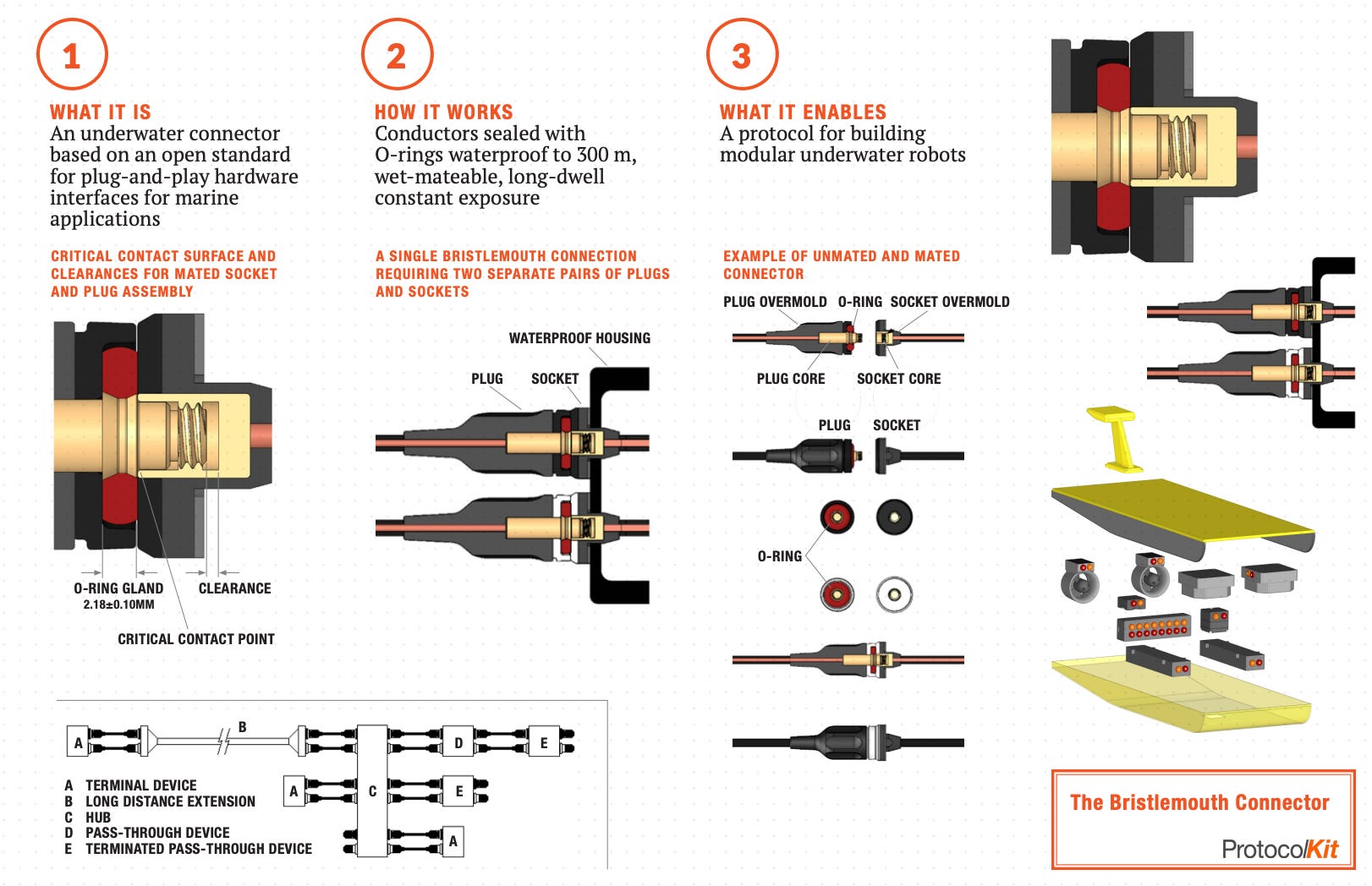
Protocols, including hardware standards like the Bristlemouth Connector, aren’t just paradoxical in their tendency to disappear. They are also generative as a result of being restrictive. Prior to the Bristlemouth project, the underwater robot and drone market comprised a ton of bespoke components which could not work together. By restricting the design space for connectors, the Bristlemouth team has enabled people to generate many new kinds of robots, drones and services built atop them, providing important services like ocean data collection and urban water monitoring. If the protocol is as successful as hoped, the industry could move beyond making marginal improvements in legacy technologies and into realising a whole new world of cheap and composable plug-and-play underwater devices.
The Bristlemouth team did not have a government or business playbook to follow. They practiced what Lang now refers to as disruptive standards-making. We’re launching the Protocol Institute, in part, to provide protocol entrepreneurs, like those that David Lang studied, with a community of likeminded peers and a knowledge commons to support their work.
The Bristlemouth project was named after the bristlemouth fish family, gonostomatidae, which we’ve adopted as a mascot for our work as well. Gonostomatidae is an unassuming but potent symbol for protocols. They are not only the most numerous fish in the oceans, they are also the most numerous vertebrates on Earth, with an estimated one quadrillion living specimens. Most people do not even know they exist. Even fewer will ever see one, since they inhabit the deep mesopelagic zone. But these tiny fish constitute the decentralized backbone of our oceanic ecosystems, just like the elements of the millions of protocols which constitute our technological environment.

Protocolization is transforming our world at this very moment, alongside more visible processes like AI adoption and climate change. As with past global transformations like industrialization, urbanization, globalization, and digitalization, it will radically alter the human condition. Stewarding protocolization thoughtfully is an urgent imperative because it is progressing invisibly whether we like it or not. In fact many of the world’s critical protocols, both old and emerging, are failing:
Carbon accounting regimes have proven to be easily manipulated
Protocol-based social media has been unable to catch up to the network effects of rent-seeking social platforms like TikTok, Facebook and X
Diplomatic protocols have not been able to stop 21st-century wars of aggression
While improving, the global banking system remains wildly inefficient and exclusive, when compared to what it could be re-engineered to become
The legitimacy of some voting protocols in states around the planet has faltered, leading to wars over state capacity
Our ambition is that the Protocol Institute will shed light on and inform protocolization around the planet.
The first question I’m asking myself in my new role is what mental models I should bring to the job. I’m finding a useful starting point in the ideas of a 19th-century political economist and a 20th-century organizational theorist.
An Ode to Unbroken Windows
In July of 1850, Frédéric Bastiat published That Which is Seen, and That Which is Not Seen. Even after living in Québec for two years I can’t read it in the original French, but a translated version is available here. Opportunity costs are well understood and priced today, but that wasn’t always the case. Bastiat explained how the broken window of a shoemaker tended to be justified because it created work for the windowmaker. While easily seen, the first-order logic is wrong. Unseen consequences dominate the arithmetic.
In fact, it is the same in the science of health, arts, and in that of morals. It often happens, that the sweeter the first fruit of a habit is, the more bitter are the consequences.
When a window is broken, the victims outnumber the beneficiary at least two to one. First, the shoemaker must purchase a new window. Second, that money flows to the accident and away from another, unseen, productive thing into which the shoemaker might potentially have directed it, like a book, medicine or shoes.
At the time of Bastiat’s writing, economics was effectively blind to the difference between these things. A repaired window was just as good as a new book. Hence why the calculus of war was (and sometimes still is) seen as unequivocally profitable. Peace, and unbroken windows, were regarded as bad for the economy. Their benefits were unseen. As the field developed, economists realized that both the seen and the unseen must be accounted for to paint a full picture.
This explains the fatally grievous condition of mankind. Ignorance surrounds its cradle: then its actions are determined by their first consequences, the only ones which, in its first stage, it can see. It is only in the long run that it learns to take account of the others. It has to learn this lesson from two very different masters – experience and foresight. Experience teaches effectually, but brutally. It makes us acquainted with all the effects of an action, by causing us to feel them; and we cannot fail to finish by knowing that fire burns, if we have burned ourselves. For this rough teacher, I should like, if possible, to substitute a more gentle one. I mean Foresight.
In the same way that a poor understanding of opportunity costs led to suboptimal economic outcomes, a poor understanding of protocolization will lead us, in the present, to short-sighted conclusions.
Protocols exhibit a similar pattern to unbroken windows. The costs of following protocol are more visible than their benefits. Institutions that govern and maintain a protocol, from traffic lights which prevent accidents to climate accords which prevent CFCs from blasting a hole in the planet’s ozone layer, struggle to prove that their worth outweighs their operating costs. A counterfactual future is always harder to see than a current expense or inconvenience.
However, over time, civilization has established many important “unbroken windows” through the process of protocolization. The eradication of smallpox. The absence of nuclear holocaust. The pandemics dodged and economic depressions avoided. The coal mines that did not catastrophically explode. The standardized drillbits that unlocked new markets. The randomized control trials that prevented dangerous drugs from entering markets. The shipping containers that formed the modular backbone of the global economy and avoided trillions in breakbulk shipping costs. The famines that never happened. The internet protocols which have enabled us to do things whose costs were once so prohibitive that they were not done at all.
Those hard-to-see things likely compose a kind of value greater than that measured by GDP. It remains arduous to measure them, even if economics has developed better tools since Bastiat’s time. This is one reason why we believe protocols are systematically undervalued.
Furthermore, many of the things that protocols generate are not owned by single shopkeepers but by loose networks of actors. Functional state capacity. Robust supply chains. Inhabitable ecosystems. Public health. Charged water reservoirs. Competitive technology markets. These sometimes delicate things exceed individuals and local groups, extend beyond political borders, even beyond our lifespans. The actors responsible for maintaining and following protocol do not fit neatly into state lines. The products of protocols are highly valuable and often invisible, each defined by the absence of a class of negative events (respectively: corruption, shortages, biodiversity loss, drought, monopolization). They are what Karl Weick would call dynamic non-events; windows with varying levels of unbrokenness, depending on the health of the protocol that generates them.
When we arrive at this unexpected conclusion: “Society loses the value of things which are uselessly destroyed;” and we must assent to a maxim which will make the hair of protectionists stand on end… To break, to spoil, to waste, is not to encourage national labour; or, more briefly, “destruction is not profit.”
Among the most valuable civilizational outcomes are things that don’t happen. Protocols are technologies for producing these non-events.
Investing in the Production of Non-Events at Scale
Aerospace engineers don’t make safe planes. They design planes capable of producing safe flights. Anyone can make a plane that never crashes – just never let it fly.
Karl Weick, an organizational theorist whose ideas were adopted in military, healthcare, aviation and energy domains, championed the term dynamic non-event. Non-events such as safety, reliability, interoperability and quality are invisible moving targets which must be continuously produced, and only become visible when they lapse.

Protocols can be understood as infrastructural technologies for producing non-events at scale, often without a central coordinating mechanism. For that reason, we like to call protocols engineered arguments. They are not universal agreements, but rather mostly predefined sets of rules that allow individual actors to make trade-offs without becoming embattled. Following Bastiat’s reasoning, since non-events are systematically undervalued, we systematically underinvest in protocol analysis, design, and improvement. A tenet of our mission is to address this underinvestment, and a few examples will illustrate the philosophy we are pursuing in order to do so.
A tell for spotting investment opportunities is the commonly noted phenomenon of small changes having big effects in complex systems. Checklists (which are simple thoroughness protocols), for example, have proved to be a powerful continuous producer of non-events in the context of domains such as hospitals and aviation. Despite being cheap and easy to implement, checklists are still underused. Dedicated operations professionals tend not to center their careers on such apparently trivial things, preferring to focus on more complex change and improvement theories and programs.
In 2024, we ran a grant program which tasked six teams of practitioners with driving small, incremental protocol improvements in their domains. Like checklist adoption, seemingly simple changes, such as adding encryption to a messaging protocol or simplifying a permit approval process, proved surprisingly hard to implement, despite their obvious potential for precipitating big changes. The 2024 grant program taught us a great deal about what it takes to drive even small consequential changes in complex systems.
Another example of our investment philosophy has to do with the critically undertheorized topic of memory. It is easy to forget non-events. That is in many ways a good thing, because it frees up cognitive (and economic) bandwidth to perform other operations. Technologies that produce non-events do not automatically create and preserve verbose traces in historical memory. Even when raw memories are produced, they tend to be easily forgotten or disregarded.
In a thoughtfully designed, safe workplace, a log of accidents not happening (such as the familiar image of a sign highlighting the number of days without an accident at a factory) does not naturally attract the attention it perhaps deserves.
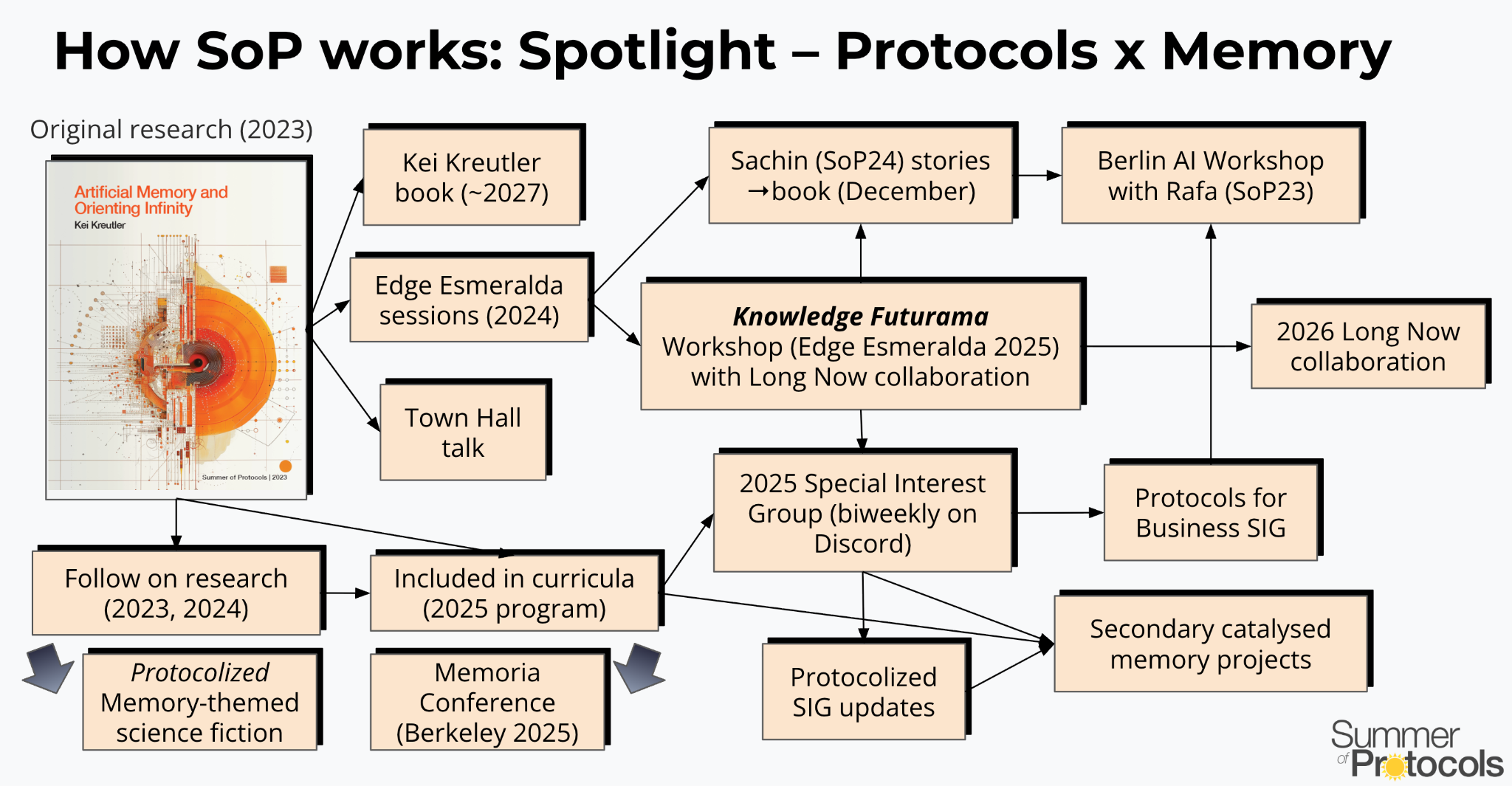
Memory, therefore, has been an important research and investment theme for us, beginning with Kei Kreutler’s seminal 2023 work on the relationship between memory and protocols.
Her essay Artificial Memory and Orienting Infinity sparked a steady stream of follow-on research and supporting activities such as workshops over the next three years. Kei now leads a Special Interest Group that meets biweekly on our Discord. The graphic below shows the evolution of this research track, which now serves as the model for our investment in other deep, undertheorized topics that require sustained creative attention and organized inquiry.
These are just two of the validated strategies we have developed over the years to invest in the world of protocols. Not everything we try works out, but we aim to gradually grow our arsenal of research, application, pedagogy, and scene-making methods by trying many such strategies and doubling down on the ones that work. From 2023 to 2025, the Summer of Protocols program helped us bootstrap into a strong initial position with solid momentum. In 2026, the Protocol Institute and Protocolized will begin transforming that into lasting institutionalized value.
This is particularly urgent with regards to another contemporary technological theme. AI systems are powerful precisely for being non-deterministic and generative, but that generativity is most useful when it operates within stable, well-designed infrastructure. Protocols are that infrastructure. Indeterminacy and stability are complements, not competitors, and understanding one requires understanding the other. Even the arguments of TCP/IP, the very foundation of the modern internet, might need to be reengineered from the ground up to accommodate both humans and AI agents.
We’ve only scratched the surface of the world of protocols. In working towards a deeper understanding, beyond pursuing our own activities, we surface and curate ideas and knowledge from existing traditions (both scholarly and practitioner), unlocking insights and wisdom on the subject of protocols.
The Beginnings of a Canon
Establishing a canon is an important part of building a new field, and an important aspect of that is deciding which ideas to inherit, and from where. In the three years we’ve been consciously working to do this, we’ve accumulated a vast library of references across our publications that we’ve curated into the beginnings of a canon. We’ve deliberately chosen to strike a middle path between relevant academic traditions and broader works that not only cut across disciplines, but look beyond scholarly traditions to writing that’s embedded in real-world practice, and popular writing aimed at non-scholarly audiences.
This selection of well-known works, which arguably belong in a protocol canon, has proved valuable in our short history, and might serve as familiar entry points. If you have read and enjoyed any of these books, stories, or essays, you might already know more about protocols than you realize:
Seeing Like a State, James C. Scott
Governing the Commons, Elinor Ostrom
Normal Accidents, Charles Perrow
The Control Revolution, James Beniger
The Box, Marc Levinson
The Nature of Technology, Brian Arthur
Finite and Infinite Games, James Carse
How Buildings Learn, Stewart Brand
The Death and Life of Great American Cities, Jane Jacobs
The Tacit Dimension, Michael Polanyi
Who Could Write Protocol Fiction for Speculative Infrastructure, Matt Webb
The Complete Stories, J. G. Ballard
Mother Earth, Motherboard, Neal Stephenson
Protocol: How Control Exists After Decentralization, Alexander Galloway
The ETTO Principle, Erik Hollnagel
From our own corpus of work, The Protocol Reader has earned a place in the canon, as have several stories from our archive of short stories.
These aren’t the only works that matter, and I’d be suspicious of any list that claimed to be complete. The canon is still being established, as is the live tradition of practice and application.
Creating a Movement
This then, is our investment thesis:
Protocols are infrastructural technologies that produce some of the most valuable outputs of society: dynamic non-events
Dynamic non-events have a natural tendency to become invisible and be forgotten
This tendency has historically led to them being undertheorized and underinvested in
Widespread improvement to this important class of technology requires creative new investment strategies and philosophies
Since 2023, an Alfred North Whitehead quote has served as our lighthouse, keeping us oriented to the essential core of this thesis: “Civilization advances by extending the number of important operations it can perform without thinking about them”
A modified version, we think, will keep us moving in the right direction in the years ahead:
Civilization advances by increasing the number of important non-events it can produce without thinking about them.
Civilization will always be partially defined by the unseen and unremembered; by the outputs of its most important non-events – safety, hygiene, peace, frictionlessness; by the technologies that produce them in steady, sustained ways; and, perhaps most importantly, by the people who analyze, design, evolve, and maintain those technologies.
The Protocol Institute and Protocolized will serve this world.
Maintaining a robust, continuously tested and refined investment philosophy and thesis is necessary for the work we have ahead of us, but it is not sufficient. While one of our main operational goals is to serve as an investment vehicle for other institutions and individuals who see the value in what we are doing (please reach out if this is you; we will share more in the coming weeks), it only makes sense when paired with our other main operational goal – creating a movement.
While our plans for the Protocol Institute and Protocolized take many cues from scholarly societies and publications, we believe the world of protocols requires a fundamentally full-stack societal approach, spanning scholarly, entrepreneurial, governance, policy-making, cultural and subcultural activities. This is a daunting scope to operate in, and we have therefore converged on a few fertile and high-leverage core operational capabilities. The most important capability is using a publication to supercharge an entire emerging movement, rather than just its nominal contents.
This vision for our publication takes inspiration from other powerful movements and scenes that were shaped by highly influential publications, such as Astounding (Golden Age science fiction), The Whole Earth Catalog (early counterculture), Wired (early digital technology) and Make magazine (the Maker movement). The editorial postures and visions of these magazines served as far more than curators of content – they erupted larger discourses and policy conversations, seeded thriving subcultural scenes and catalyzed a range of creative, entrepreneurial, hobbyist, and social activities. Aesthetics, too, played a big role in the success of these magazines. We are well positioned on both fronts and I’m excited that James Langdon will continue to be a driving force behind Protocolized as Head of MagOps and Art.
Already, through its first year of existence, Protocolized has helped spark the emerging genre of Protocol Fiction, published the output of several special interest groups pursuing important research tracks, seeded protocol watching as an engrossing new hobby, and hosted a dozen events around the world.
Going forward, we will consciously aim to use the Protocolized editorial room as the bridge from which we steer a fragile young movement through its uncertain early years. Our hope is that the movement quickly takes on a life of its own, with more individuals and institutions joining us in our stewardship efforts. In this nautical metaphor, we hope to thoughtfully design and evolve the Protocol Institute as the long-term engine for institutionalizing what needs to be institutionalized, while also helping preserve what should not be institutionalized in vibrant, wild, generative states.
A Map of the Protocol Institute
The Summer of Protocols began with a set of interdisciplinary research essays and culminated in a series of courses, taught online and at universities around the world. SoP provided the activation energy for a new field of research and practice based on real-world phenomena to emerge, just as bazaars and insurance brokers existed long before economics.
The Protocol Institute will irrigate this nascent field with the hope that it continues to develop tools and theories that will accelerate the production of important non-events. Right from the outset, we are an online-first organization and planetary in scope. Members of the protocol community already participate in this discourse from around the world, from a wide variety of countries, geographies, companies and institutions. Part of our philosophy as we chart a path during these early days is to capitalize on the energy and mediums available to us, rather than force old organizational forms like those of universities, traditional societies, or think tanks onto a digital and global network.
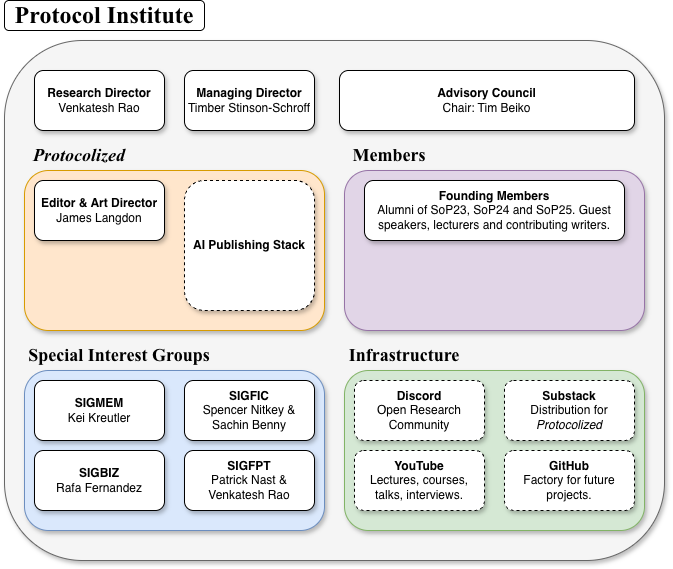
This organizational model will evolve, probably quickly, as the field and movement advance. At this time, Protocolized, the SIGs, and the annual Protocol Symposium (already two editions old) are the flagship projects of the Protocol Institute. In addition, several partnerships are in progress that we are excited to share more about soon. A big part of the Protocol Institute’s function is to create durable infrastructure for the emerging community of protocolists, including experimenting with and taking advantage of new AI tools.
Initial membership will include alumni from all three years of the original Summer of Protocols program, as well as guest speakers, lecturers and contributing writers of Protocolized. We also welcome the Class of 2025 from our inaugural Protocol School. What membership means and what direction it will take is an ongoing discussion among the founding members of the Protocol Institute. We look forward to expanding membership in a way that adds value and energizes the field.
To kick things off, we’ve put together a thorough (but not comprehensive) list of ways to work with the Protocol Institute and see the world through a new and useful lens:
Subscribe to Protocolized. Quick and easy. We’ll help point your attention to what matters in the field. This is also where we share project information – like an upcoming partnership program with the Long Now Foundation – and future opportunities, like becoming a member.
Start protocol watching. Trying to spot the protocols and dynamic non-events around you is a surefire way to build literacy.
Study the 2025 Protocol School lectures. These were taught by faculty from around the world and are completely free.
Take a weekend to digest the Protocol Reader. It’s still one of the best places to start. If you want a palate cleanser from non-fiction, read our protocol fiction anthologies: Terminological Twists, The Librarians and Ghosts in Machines.
Join the Discord server and participate in a Special Interest Group. Meet fellow theorists, practitioners and writers. Make something useful.
Write with us. Pitch an article or short story. Write something about what you saw, learned, read about or built. Fiction or non-fiction.
Apply what you learn. At the end of the day, what will come to define this new field is the real-world agency and effectiveness that it provides.
Make a tool for other people to use based on protocols in your field. Try to generalize useful principles and techniques.
The world of protocols is full of opportunities to exert an influence. You’ll have to tilt your head a bit to see these opportunities at first, but eventually it will become second nature. We want you to imagine a future where people live better through protocols. A future where, among other things, arguments are engineered to be productive, there are fewer central mechanisms at risk of becoming captured or malevolent, and where there is more peace, properly accounted for.
Here’s to the protocolists.
What does ‘protocol’ do that ‘infrastructure’ does not?
Great essay.
This is epic for the landscape of (future) models for continuing education, too. Excellent.