



Our special interest group in Protocol Fiction was convened in October last year, led by Spencer Nitkey - Writer and Sachin. Here is a brief recap of discussions in the group’s monthly calls. Interested in writing protocol fiction and experimenting with LLM-assisted writing? Join the next call in Discord on March 26 at 10am CST.
Conversations in the Protocol Fiction SIG began with a shared curiosity about what “protocol fiction” might point to beyond a genre label. Our early discussions emphasised the observational aspects of protocol fiction, as a way of noticing how rules, standards, and institutions shape experience, especially where those structures are normally taken for granted. Attention quickly shifted away from individual characters toward environments, procedures, and the conditions that make certain narrative paths possible while foreclosing others.

The first call focused on establishing this orientation. Participants were drawn to stories where agency is distributed and outcomes depend on interfaces, procedures, and constraints rather than personal will. Fiction was discussed as a medium capable of making the background logic of systems perceptible, allowing readers to sense how coordination and compliance actually occur in practice.
Readings such as Amita’s Protocol Test for Fiction and Matt Webb’s essay Who Could Write Protocol Fiction for Speculative Infrastructure? reinforced this sensibility. Both pieces helped anchor an intuition that surfaced repeatedly in the first call: protocols are best understood as durable world-making artifacts, shaped as much by history and path dependence as by design. In Amita’s writing, protocols appear as testable structures – rules that can be stressed, misused, or repurposed, and whose real properties only become visible under load.
This durable world-making artifacts framing also clarified why protocol fiction gravitates toward strange rules and systems which only partly fulfil their purpose. When a protocol is fully realized and familiar (what we call a Whitehead protocol) it tends to disappear into the background. Narrative interest emerges when rules persist despite fraying explanations, when systems continue to function even as their rationale becomes opaque. The gap between how a protocol was imagined and how it is actually lived becomes a source of texture, tension, and meaning.
What these readings contributed, then, was a shared sensibility about endurance and friction. Protocols shape the future not by commanding it outright, but by narrowing the range of plausible alternatives over time. They accumulate commitments, dependencies, and expectations. Fiction which takes this seriously does not treat systems as neutral backdrops, nor as expressions of malice, but as historical objects that exert real force. The world keeps moving forward, guided less by optimal choice than by what has already hardened into place.
The second call turned toward genre theory and the question of how readers orient themselves within narrative worlds. Genre emerged as a structuring force that signals how a text should be read and what kinds of events can occur within it. Fredric Jameson’s essay on romance proved especially generative. Romance was discussed as a narrative mode that persists across historical shifts by adapting its surface materials while continuing to perform the work of world-making. Magic, providence, psychology, and institutions appeared as successive vocabularies through which similar structural pressures are expressed.
The third meeting was centered around stories about bridges and thresholds, since we wanted to give everyone a venue to test ideas for the Protocolized Building and Burning Bridges short story contest which had just been launched. Readings such as William Gibson’s Hinterlands and H. P. Lovecraft’s The Music of Erich Zann foregrounded liminal spaces and moments of transition. These narratives emphasized adjacency, partial access, and the difficulty of navigating systems that exceed individual understanding. Characters moved through environments that felt coherent yet resistant, revealing how meaning and risk concentrate at points of passage.
A subsequent session shifted from discussion to practice. Participants worked with technical manuals, regulatory texts, and historical documents, treating them as narrative material rather than background research. This exercise highlighted how such documents already describe worlds with their own assumptions, priorities, and failure modes. Fiction, in this context, functioned as a way to probe those assumptions and observe what happens when they are placed under narrative pressure.
Our most recent meeting centered on monsters. Drawing on Jeffrey Jerome Cohen’s work, monsters were discussed as figures that appear when classification systems strain or break down. They were understood as persistent rather than anomalous, returning again and again to mark unresolved tensions. This lens proved useful for thinking about obsolete standards, legacy institutions, and rules that continue to exert force long after their original rationale has faded.
Across these sessions, our readings have ranged widely, but the discussions have kept returning to the same concerns: durability, intelligibility, and the experience of living within inherited structures. The group’s attention has gradually settled on questions of how worlds hold together, how they remain navigable, and how they continue to shape behavior even when their reasons are no longer fully accessible.
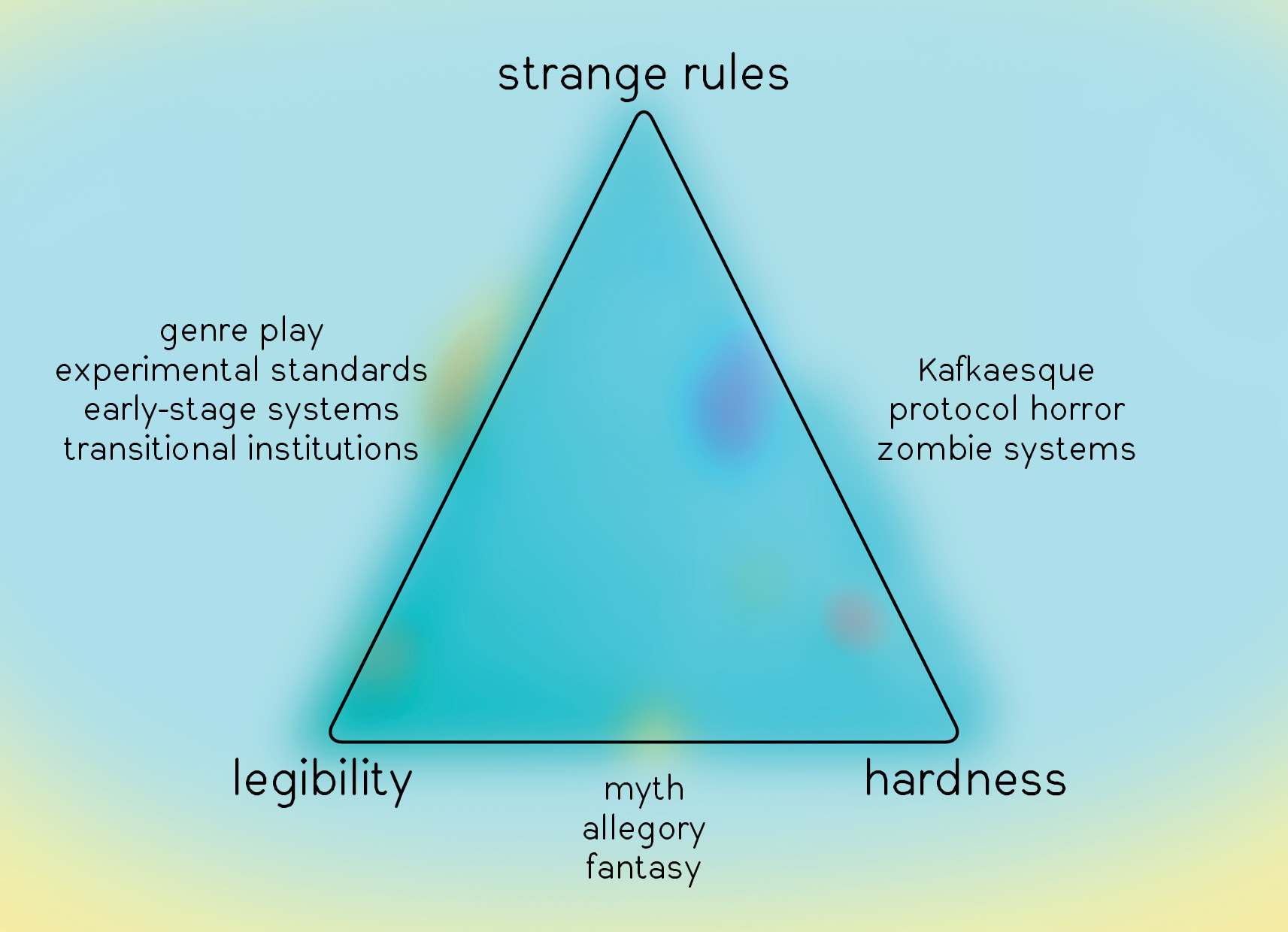
Synthesizing the Properties of Protocol Worlds
Ted Chiang’s observation that science fiction tends to revolve around strange rules rather than special people has been a steady reference point for the group. It offers a simple reorientation: narrative interest migrates away from exceptional protagonists and toward the systems that quietly govern what anyone can do. In these stories, characters rarely solve problems through heroism/force of will. They encounter rules, interfaces, and constraints that shape outcomes regardless of intention. Drama comes from contact with those structures, not mastery over them.
As our discussions unfolded, another recurring instinct became apparent. Many of the most generative story ideas emerged from moments of illegibility – scenarios in which a protocol clearly exists and clearly matters, but cannot be fully seen or explained. This illegibility often produces Kafkaesque effects, but it also does something broader. It conveys the sense that ordinary reality rests on an immense, layered substrate of procedures, standards, and agreements that most participants only ever glimpse in fragments. The world continues to function, even when its logic cannot be fully reconstructed from within. Spencer’s Zoothesia series is a good example of this, as it gives readers the chance to see the consequences of a particular reality from the perspective of multiple protagonists.
Our discussions of genre theory have helped the group to reflect on how readers orient themselves within these environments. Genre is a contract defines how readers constantly calibrate their expectations: what kinds of actions make sense, what kinds of outcomes feel plausible, how much explanation to demand from a text. Genre provides a scaffolding for legibility. It allows readers to move through strange systems without needing a full account of how they work. This legibility can be thin or thick, provisional or deeply entrenched, but it shapes how the world is read long before individual rules are encountered.
The final conceptual ingredient came from Josh Stark’s discussion of hardness as a property of institutions and technology like blockchains. Hardness, in his formulation, describes the likelihood that something will remain true in the future. Applied to protocol worlds, hardness captures the resistance a system offers when one tries to change it, exit it, or imagine it otherwise. Some rules are soft, easy to revise or abandon. Others are embedded so deeply in infrastructure, coordination, and expectation that they effectively dictate the shape of the future.
Taken together, these threads are suggesting ways of describing protocol worlds in terms of their dominant properties. Strange rules name the local, often opaque constraints people actually encounter. Legibility moderates how readable the world is – how well its signals, genres, and atmospheres allow participants to orient themselves. Hardness describes how resistant that world is to deformation, and how costly deviation becomes once paths are set.
The triangle that emerges from this synthesis is meant as a map of tendencies. Some worlds are rich in strange rules and legibility but remain relatively soft, producing spaces of play, experimentation, and transition. Others combine strange rules with high hardness and low legibility, giving rise to protocol horror, zombie systems, and the distinctive unease of Kafka protocols. Still others emphasize legibility and hardness with fewer strange rules, producing mythic or allegorical worlds whose logic is clear and whose constraints feel inevitable.
If you want to learn more about protocol fiction, get feedback on your story ideas and drafts, and talk shop with a small group of passionate fellow writers, check out the Protocol Fiction Special Interest Group on our Discord.